Sound Fun: The Future Unveiled by Japan's 'Mirai Speaker' Technology for the Hearing Impaired | Sound Fun
Sound Fun
An Interview with Representative Kazunori Sato
The Future Unveiled by Japan's Technology for the Hearing Impaired, 'Mirai Speaker' (Part 1)
People with hearing impairments can hear sound just like those with normal hearing. Sound Fun, a Japanese venture company, has developed the 'Mirai Speaker' to make this possible. We had the opportunity to interview Kazunori Sato, the company's representative.
Photographs by TAKADA MidzuhoInterview & Text by IWANAGA Morito (OPENERS)
From a Secret Base in Asakusabashi, Tokyo, to the World
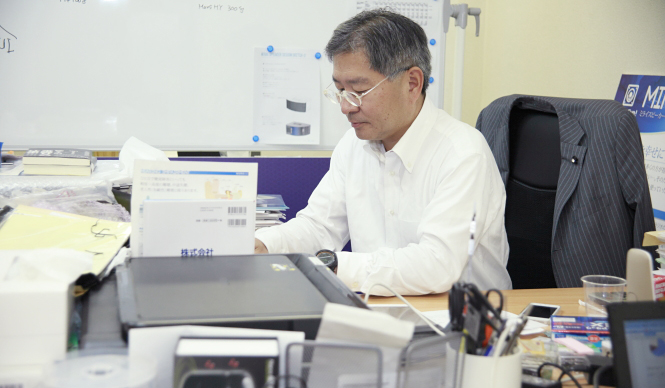
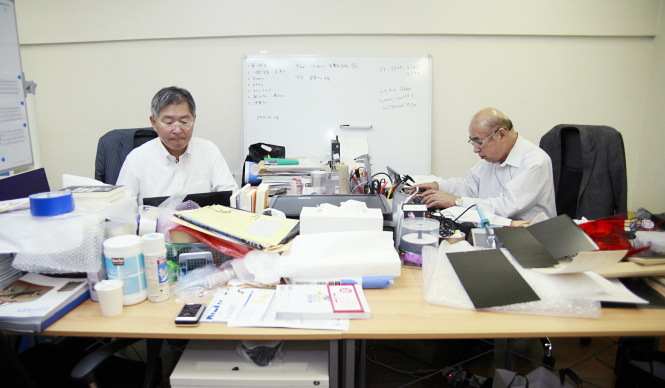
Sound Fun is an acoustic equipment venture company established in 2013. At the time of this interview, it had only two employees. The office, located in an old building in Asakusabashi, felt like a secret base. From this very spot, new Japanese technology is poised to be shared with the world. This product is the 'Mirai Speaker,' an innovative acoustic device that allows individuals with hearing loss to perceive audio at the same volume as those with normal hearing. We spoke with Kazunori Sato, the representative of Sound Fun.
—Why did you choose this location for your office?
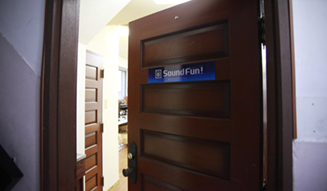
Simply because the rent is cheap (laughs). It's also close to Akihabara. Even so, being close to the station means customers are willing to make the trip.
—What does Sound Fun do?
One is the online sale of consumer acoustic equipment based on the concept of 'Comfort Audio.'
The other is this 'Mirai Speaker.' Our goal is to mass-produce this and help many people with hearing loss. These are our two main businesses.
—What prompted you to start this company?
In 2013, I participated in a retreat hosted by a business school in Akihabara. I met someone there who told me about this technology, and I found it fascinating. I established the company in October of that year. The prototype of the 'Mirai Speaker' was completed about a month later.
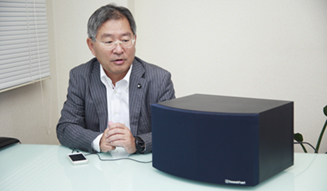
First, I had my father try it. He has moderate age-related hearing loss, and he said he could hear clearly without hearing aids. However, I wasn't confident in the product yet, so I continued to gather data. This revealed that individuals with acquired hearing loss due to accidents or illness could also hear clearly.
What was decisive was the feedback from a music industry professional. About 15 years ago, he damaged his eardrum in his right ear and can now hear almost nothing except high frequencies.
He mentioned that while he could only hear about 20% of the sound from a regular speaker, he could hear 50% from the Mirai Speaker. He also said that the sound from regular speakers was distorted, whereas the sound from the Mirai Speaker was clear. That's when I became truly convinced.
Sound Fun
An Interview with Representative Kazunori Sato
The Future Unveiled by Japan's Technology for the Hearing Impaired, 'Mirai Speaker' (Part 2)
How the Mirai Speaker Works
—What is the principle behind it?
Unlike conventional speakers that vibrate air using longitudinal waves called 'compressional waves,' we utilize transverse waves called 'shear waves.'
This is similar to the principle of a gramophone. With a gramophone, a needle is placed on an SP record, a soundbox acts as a weight on top, and a pipe is connected behind it, leading to a horn from which sound emerges. It doesn't use electricity, does it? In essence, it's a return to analog.
—With a gramophone, can people with hearing loss hear normally?
I was curious about that too, so I went to speak with a professor in the rehabilitation department at a university. He is a collector of gramophones and owns various types, which he uses for rehabilitation. He confirmed that people with hearing impairments can indeed perceive sound from them.
Hearing this, we conducted a monitor test at a nursing home and gathered more data. As a result, we received feedback from nearly 100% of participants that they could hear.
—Is it already in practical use?
Not yet. We applied for the patent on March 28th of last year and officially received it recently. Next, we plan to file an international patent (PCT) application and also an industrial design application.
As an acoustic speaker, there are still areas for improvement, so we are initially planning to focus on a voice speaker specialized for vocal communication. For example, this could be used for announcements on train platforms or at crosswalks. It's applicable in places where people gather. In homes with elderly individuals, TV volume often tends to be too high, but with the Mirai Speaker, the volume can be set to an appropriate level, similar to that for people with normal hearing. It could also be used in hospitals, care facilities, public institutions, and for disaster warning systems.
—Perhaps announcements should be standardized to use the Mirai Speaker.
That's a possibility. A key feature of the product is that the sound does not attenuate easily. Conventional speakers, which use vibrations called compressional waves, experience attenuation that follows a parabolic curve, proportional to the square or cube of the distance.
The Mirai Speaker's attenuation is linear with distance, allowing the sound to travel further.
—When do you expect a consumer product to be available on the market?
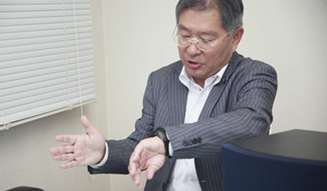
We will primarily start with B2B. To move into B2C, we need to ensure a certain level of quality, design, and a more accessible price point. Furthermore, if we were to sell out completely, there's a risk that the technology could be reverse-engineered and developed in ways contrary to our intentions. Assuming we can overcome that challenge, B2C will likely be realized around next year. Alternatively, we might be able to deliver it to individuals through a B2B2C rental system in the near future. It's also possible to place orders directly at our office.
—Have you already received inquiries like that?
Yes. However, at this stage, we would be producing them one by one for each order, so we cannot offer them at a reasonable price. But since it's a product with a purpose, we aren't selling speakers or sound per se. We believe it's a worthwhile exchange for the value of 'being able to hear.'
—Are there any benefits for people with normal hearing?
Consider TV speakers, for example. Modern flat-screen TVs, with their large screens and slim bodies, often compromise on speaker quality, don't they? They have speakers positioned to the side or bottom, but the sound quality isn't great. Reproducing a truly three-dimensional soundstage is particularly difficult.
When you connect and listen through the Mirai Speaker, the sounds become distinct. In sports commentary, for instance, human voices stand out. This leads to improved communication through audio media. Even people with normal hearing can clearly perceive this difference.
Sound Fun
An Interview with Representative Kazunori Sato
The Future Unveiled by Japan's Technology for the Hearing Impaired, 'Mirai Speaker' (Part 3)
The Only One, Not a Commodity
—What inspired you to start your other business, 'Comfort Audio'?
Our motto is to bring happiness to people worldwide through sound. One aspect of this is our desire to make music more accessible and enrich people's lives, which is where it all began.
—Did you play music yourself, Mr. Sato?
I started playing piano at the age of four and picked up the drums in my first year of high school. I worked at a live house for five years during university. After graduating, I joined a computer industry company and lived without music for a while, but I rejoined a band about ten years ago.
—Is your passion for music the primary driver behind Sound Fun's business?
Yes. While it's not just an extension of my hobby, I want to focus on human emotions and sensibilities. In Japan, audiology is lagging behind, and even otolaryngology is not considered cutting-edge globally. Although I am neither a doctor nor a researcher, I want to delve deeper into this field with these tools.
—So, this Comfort Audio is sold online, correct?
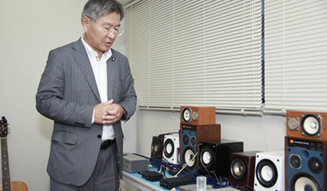
Yes. Our main product is the 'POCO 3,' but we also offer models 1 and 2, which have been well-received. We are also considering selling vacuum tube amplifiers in the future, aiming for a hybrid design with transistors that supports high-resolution audio.
Incidentally, the product name is an abbreviation for 'Portable Component.'
When I left my previous job, I vowed not to deal with commodities. That's because you end up competing on price or corporate brand strength, selling the same things as everyone else.
Sound Fun is about innovation. In Japan, there are still no products like this that are Bluetooth compatible. If we were to price similar products based on standard considerations, they would cost around 60,000 yen, but selling them for around 30,000 yen makes them highly cost-effective. We have pricing control, which makes this possible. In this way, we aim to introduce timely products in niche markets that are currently underserved in Japan.
—So, affordability is also a key point?
Yes. The model currently under development can also function as a headphone amplifier and includes a high-resolution audio-compatible USB-DAC. While these individual components would normally be quite expensive, we are offering them at an accessible price. I understand price elasticity and the concept of a 'sweet spot,' so I believe these are attractive products.
—Indeed, component systems might seem daunting for those who aren't hardcore audiophiles.
With major manufacturers, products often include features that users don't need, driving up the price. While our Comfort Audio may not be considered high-end, it offers a quality that audiophiles will appreciate. Inputs include AUX line and Bluetooth. The output is around 25 watts. It uses a triode vacuum tube, so one tube handles both left and right channels.
Smartphones and tablets have become the starting point for modern audio. For example, you can connect your mobile device to this amplifier and stream music from internet radio. You can enjoy high-quality sound in various settings, such as at work, at home, or during small gatherings. Its compact size makes it a perfect fit. Within a week of receiving it, you'll notice how your daily life becomes enriched with music. We call this new value proposition 'Comfort Audio' and that's how we market it.
While digital technology is widespread, we want to imbue our products with the essence of craftsmanship. I wasn't a 'radio kid' and I'm not adept at tinkering with circuit boards, but my colleague Miyahara previously worked in product planning for an audio manufacturer, making him a 'traditional engineer.' At Sound Fun, Miyahara is in charge of acoustics and communications. Incidentally, he is the talented engineer who developed the world's first FM transmitter.
We want to turn ideas into products. We aim to create unique items, not commodities. Both the 'Mirai Speaker' and 'Comfort Audio' are purely 'Made in Japan,' and we want to appeal to the world with them.
Sound Fun
Tel. 03-5825-4749
Reception Hours | 9:30 AM - 6:00 PM (Excluding Saturdays, Sundays, and Public Holidays)
http://soundfun.jp/