Kouichi Yanagimoto | Part 15: Asking Shunsuke Umiyama (MicroWorks) about "Communication Tools" (Part 1)
15th Installment: Asking Toshiaki Umiyama (MicroWorks) About "Communication Tools" (Part 1)
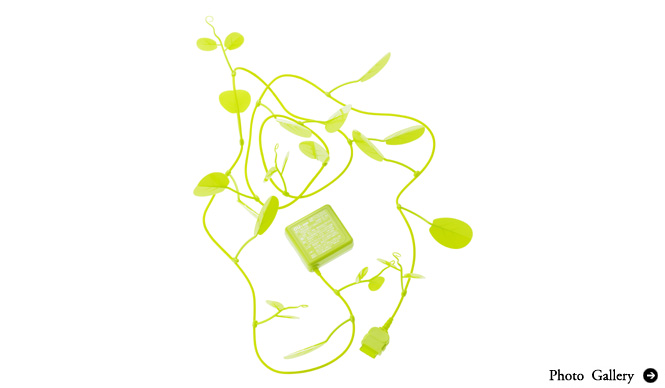
Our second conversation with a designer born around the 80s is with Toshiaki Umiyama (MicroWorks). Even if you don't know Mr. Umiyama himself, many might recognize the leaf-shaped charger released by iida. What is the secret behind creating products that always have a touch of humor? We hope to explore that.
Text by Koichi Yanagimoto
A Rare Designer Who Embodies Both Manufacturer and Dealer Roles
YanagimotoI first met Mr. Umiyama last July, during the announcement of "iida" another works. Since then, we've encountered each other in various places. Mr. Umiyama is a rare designer who embodies both manufacturer and dealer roles, creating products and selling them himself. I haven't heard of many designers working in the same way... How did you begin this style in the first place?
UmiyamaIt was a very simple motivation. I design, place orders with a factory, manage inventory, and do sales to shops. I thought this was the most direct way to realize my ideas. There wasn't a deep intention behind it; originally, I thought of working with a manufacturer, but since I had only recently graduated from school, I didn't have those connections.
YanagimotoIsn't holding your own inventory a risk?
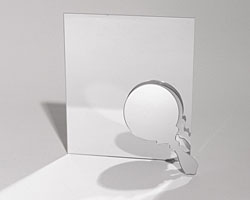
Jump Out Mirror 2004
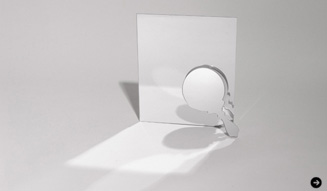
UmiyamaThanks to the cooperation of the manufacturers who produced them, I was able to do it without taking on much risk. The very first thing I made was the "Jump Out Mirror" (2004). My wholesale clients were select apparel shops. I would first take orders, and then confirm production based on those orders. By balancing the payment schedules between the factory and the wholesale clients, not only did I avoid causing trouble for either party, but it also didn't place a significant burden on me.
YanagimotoSo, you confirm a certain number of units for delivery before placing an order, which is somewhat similar to the order-taking process in the apparel industry. You hold exhibitions and then take orders based on the number of orders received.
UmiyamaThat's right. Since I operate on a personal scale, and considering space limitations, holding inventory is generally difficult.
The Closer You Are to Customers, the More Real the Feedback
YanagimotoAs a producer, I also create products with other manufacturers, and I've also been involved in wholesale and publishing myself. The act of creating and selling your own products requires you to genuinely consider how they resonate with consumers, as long as you're the one paying for the inventory. That's why you become truly invested in what you're doing, thinking, "I'll be in trouble if this doesn't sell." How is it for you?
UmiyamaIn my case, I realized later that I didn't consciously focus on that; I just did what I wanted to do. At the time, the "Jump Out Mirror" sold for around 14,000 yen, and we sold over 100 units in a year. Considering the price, I felt it was a result of people empathizing with it, and it gave me the confidence to continue. Since then, because I was also selling them myself, the reactions to whether they sold or not were direct. I could immediately understand the details, the colors, and the reasons for their success or failure. Through that, I've made minor changes. Because I'm close to the customers, the feedback is very real. Whether they "buy" or "don't buy" is a primary criterion. While it's important to exhibit prototypes and get feedback from visitors, I believe it's different from the evaluation of "buying." It's tough, but that also makes it rewarding.
YanagimotoI feel the same way. Many people say, "It's good, it's good," but the act of "buying" is a significant hurdle, and overcoming it means the evaluation is very high. Where are you primarily wholesaling to now?
UmiyamaMainly interior shops and museum shops. I used to actively pursue sales myself. Now, due to time constraints, it's difficult to be proactive, but I generally try to accommodate anyone who contacts me.
Mr. Umiyama Intuitively Stands on the User's Side
YanagimotoYou're not a pure product designer, are you, Mr. Umiyama? You're not the type to meticulously refine details, but rather a designer who connects with users and buyers. That's why I believe you have a strong sense of creating "communication tools." What do you think?
UmiyamaWhen I consider the form based on a concept, I do pay attention to the details, of course. And the fundamental principle is whether I myself would want it. In creating something, I consider the meaning of its existence. If I don't want it, then at the point of creation, there will be no one who wants it.
YanagimotoI see. I don't get the impression that you're pushing yourself to the limit as a designer. Product designers tend to have that inclination.
UmiyamaWhile functionality is prioritized in design, I do check if it's enjoyable to hold and use. I also think it's good to have more options for design choices and for buyers. However, that doesn't mean we should have an excess of products.
YanagimotoWhile thinking subjectively, you're probably unconsciously absorbing the customers' reactions and comments. Other designers also have the same desire to create what you want to create. However, whether it will be accepted by the world or not is uncertain. In your case, you intuitively stand on the user's side, so you're closer to the general user than a design enthusiast.
UmiyamaI originally loved objects. I imagine most people involved in design feel the same.
Designers of Mr. Umiyama's Generation Have Strong Connections and Are Close
YanagimotoPerhaps many designers forget that initial feeling. They start with passion, but as they begin creating, they become guarded and lose that sense of wonder. When I wasn't a designer, I was deeply moved. By the way, you gained attention with your "AC Adapter MIDORI" released by "iida." Your work on mass-produced items made other designers start paying more attention to you. In that sense, you've inspired those around you. Designers of your generation have strong connections and are close. This is something rarely seen in other generations. Have you consciously considered this?
UmiyamaOriginally, I thought that if I went to places where people gathered, some kind of development would happen. With that faint hope (laughs), I actively sought connections, and that circle has grown into what it is now. It's not unpleasant, it's comfortable, we're simply close. My furniture teacher at vocational school also had designers who were close and had a community, so I thought that was normal. I haven't really thought about it much.
YanagimotoThe community around you, Mr. Umiyama, includes both stars and lesser-known individuals. As a generation that actively builds broad connections, I find it very interesting. Yet, when I ask each person individually, they also harbor a sense of rivalry. Normally, when people are close, it can become too casual, like a school play. But you seem to be aware of each other, interacting well, while also maintaining a mental balance of wanting to "progress further." In my generation, we formed communities only with those who shared the same mindset.

Toshiaki Umiyama / MicroWorks
Born in Tokyo in 1981. Since his university days, he has planned and produced original designs. Upon graduation, he established "MicroWorks" in 2003.
He handles a wide range of designs, primarily products, transcending materials and genres. While exhibiting his work in various projects, he also launched "MicroWorks Label" to develop and sell his own creations.
http://www.microworks.jp
Toshiaki Umiyama Participation & Event Information
Participated in "DESIGNTIDE TOKYO 2009" / "TIDE MARKET"
Main Venue: Tokyo Midtown Hall
Dates: Friday, October 30, 2009 - Tuesday, November 3, 2009 (National Holiday)
http://www.designtide.jp/09/jp/
Announced new brand involvement as a designer at "BIRTHDAY" / CLASKA 8th Floor "Mix room"
Date & Time: Friday, October 30, 2009 - Tuesday, November 3, 2009
11:00 AM - 7:00 PM (October 31st until 11:00 PM)
http://www.massitem.com