Part 9: The Olympics Through the Lens of Design - Part 1
The 9th Installment: The Olympics Through the Lens of Design, Part 1
To commemorate the Beijing Olympics, a monumental event that felt like a sprint through this summer, this installment of "How to See About Design" is a special edition: "The Olympics Through the Lens of Design." We explore the evolution of this quadrennial festival and its design history. In this first part, we will focus on the "Tokyo Olympics," a period when both the Olympics and design entered a transformative phase.
Interviewer & Composition: Takeshi Takahashi, Masaki TakeiPhoto by Jamandfix
For this "Olympics Through the Lens of Design" feature, we plan to focus primarily on Tokyo, Mexico City, and Munich. In fact, it was along the trajectory of these three Games that modern "design" as we know it was established. Four years before the Tokyo Games, a pivotal conference coincided with a turning point in design, profoundly influencing the design world thereafter. Let's begin by delving into that story.
A Design Turning Point, Looking Four Years Ahead
In 1960, the "World Design Conference" was held in Tokyo. Architects, product designers, and graphic designers from around the globe gathered – Charles Eames, Jean Prouvé, Herbert Bayer, Saul Bass, and Paul Rand all came to Japan. It seems to have been a dream team of such caliber that perhaps no greater one has assembled since.
At the conference, they discussed how they wanted to shape design in an increasingly international society. A pressing issue that emerged was the need to create designs that would achieve international recognition. At the time, road signs and airport signage varied by country and were not standardized. As international travel and exchange grew, the decision was made to establish a system of signs and "recognition" that transcended language. It was then decided that the upcoming international event, the "Tokyo Olympics" four years later, would be an opportunity to achieve this design standardization. In essence, the Tokyo Olympics were a crucial event for the design world as well.
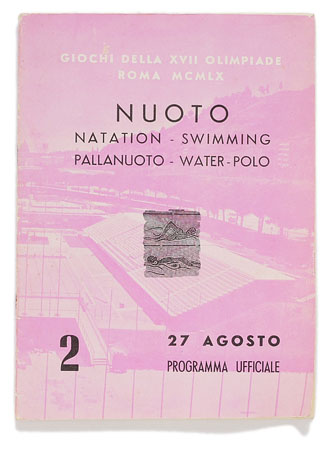
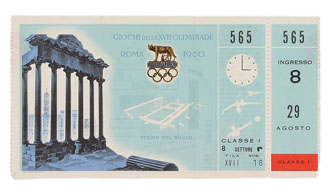
The joint swimming and water polo program (left) and an admission ticket (top) for the 1960 Rome Olympics.
The program features an illustration of the competition in the center, with motifs inspired by ancient Roman stone monuments.
The Olympic rings on the ticket are also adorned with decorative elements like animals at the top, indicating they are not yet purely abstract marks.
Furthermore, "Modern Design" had been gaining momentum since the post-war period. The idea was to create something universally understandable, transcending the knowledge and disparities of wealth from an era bound by history, culture, and religion. Looking at the graphics from the Rome Olympics, one cycle before Tokyo, Modern Design had not yet been adopted; they were highly decorative, evoking Rome's unique religious and historical background. It was the Tokyo Olympics that truly saw international sports events align with Modern Design.
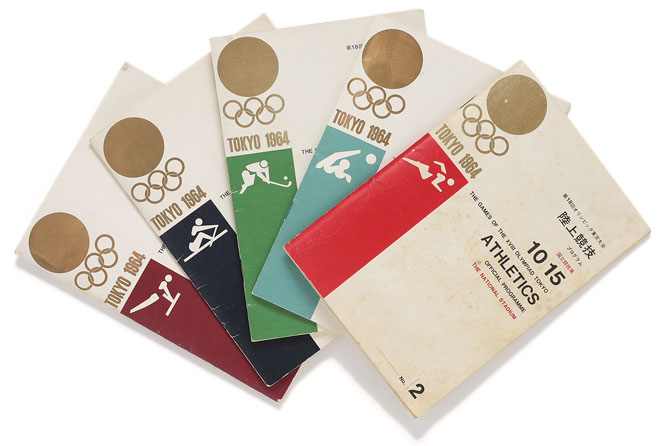
Event programs for the 1964 Tokyo Olympics. Design by Tadasu Kawano. Gothic typeface was used for the body text, and Neue Haas Grotesk (later Helvetica) for the Latin characters.
Design Began in Tokyo, 1964—
For the Tokyo Olympics, Masaru Katsumi, serving as the design editor, took on a producer-like role and led the charge. The precise refinement of the Olympic rings also originated with the Tokyo Games. For the Tokyo Olympics graphics, leading Japanese designers such as Hiroshi Ohno, Yusaku Kamekura, Kohei Sugiura, and Kiyoshi Awazu competed, designing for a social mission. It is said that most of them worked without compensation.
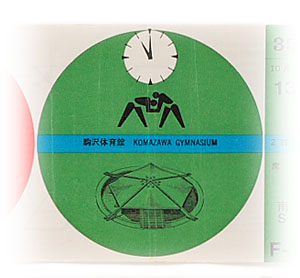
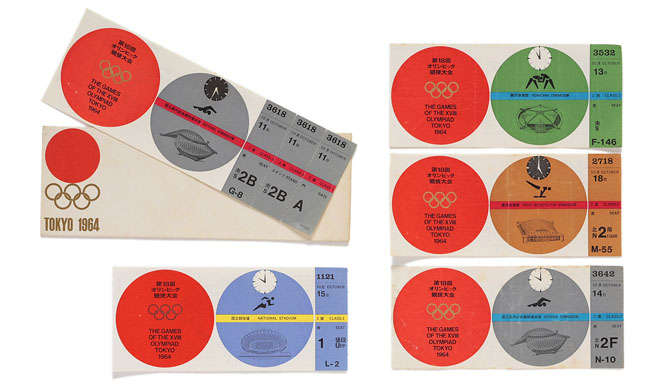
Admission tickets for events at the Tokyo Olympics. Design by Hiroshi Ohno.
While the content is not significantly different from the preceding Rome Olympics, pictograms were adopted, resulting in a more cohesive design overall.
Looking at the icons (pictograms) for the Tokyo Olympics events, they convey the essence of each sport with remarkable clarity using minimal information. Yoshirō Yamashita was responsible for these pictograms. The greatest strength of Japanese design in this area stemmed from its cultural background in family crests (kamon). Just as a simple mark representing a plant could denote a family lineage. In contrast, foreign family crests often featured excessive ornamentation, making them difficult to discern at first glance. The Tokyo Olympics pictograms can be considered the genesis of international design.
The poster for the Tokyo Olympics by Yusaku Kamekura is famously known. It's said that the image wasn't captured at the start of a race, but rather around the 40-meter mark when all the runners were running side-by-side. In those days, without photo manipulation technology, it must have involved immense effort, requiring hundreds of shots.
Incidentally, offset printing was not yet widespread in Japan at the time, and the printing was reportedly done in Switzerland, which was at the forefront of the technology. For Japan, this also marked a transitional period in printed materials.