May 15, 2015
Koichi Yanagimoto | Part 14: An Interview with Norihiko Terayama on Dutch Design (Part 3)
Part 14: Interview with Norihiko Terayama on Dutch Design (Part 2)
In the third installment of our series exploring the ideas of Norihiko Terayama, head of studio note, we delve into his time at Design Academy Eindhoven, his signature works like "f,l,o,w,e,r,s" and "r,o,o,t," and his upcoming exhibition this autumn.
Text by Koichi Yanagimoto
Considering the Japanese Approach
YanagimotoWas the principal of Design Academy Eindhoven during your studies Li Edelkoort (Note 1)?
TerayamaYes, that's right.
YanagimotoDid the principal have a strong influence within the academy in Eindhoven? I ask because when I've previously asked prominent Dutch designers about who influenced them, many mentioned the name of their principal.
TerayamaThe principal would appear for critiques and final project presentations. I'm sure there was an influence. Speaking of the principal, I received the Principal's Award for my graduation project, "Pick your light" (Note 2). I even got a necklace made of carrots as a memento (laughs).
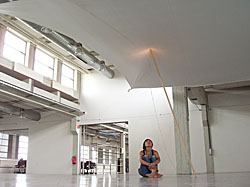
Norihiko Terayama, "Pick your light"
Design Academy Eindhoven Graduation Project, 2006
(Note 1)Li Edelkoort
A trend forecaster who provides analysis and consulting services across a wide range of fields. In 2009, she curated the exhibition "Archeology of the Future" at the Dutch Institute in Paris.
(Note 2)Pick your light
A lamp presented by Norihiko Terayama as his graduation project at Design Academy Eindhoven. It works by pressing a stick against a soft ceiling covered in white fabric, which then illuminates at that spot. A video of the work can be viewed in the project showcase on Terayama's website (http://www.studio-note.com).
YanagimotoWhile the pursuit of interest is universal in both East and West, when I saw "Pick your light," I felt the approach was somehow Japanese, especially in how the ceiling was presented.
TerayamaI was told that quite often. The work itself isn't particularly Japanese in style, though. One of my instructors, Gijs Bakker, even advised me to remove the white fabric. In the end, I felt that having the white fabric was better than exposing the raw mechanics.
YanagimotoPerhaps "invisibility" is a Japanese characteristic. Even a thin piece of cloth can obscure things, and Japan has a culture of shoji screens, so perhaps it's similar to that. Shoji screens act as a barrier, yet they also allow light from beyond to pass through. Speaking of Japanese characteristics, do you feel you are a "Japanese designer"?
TerayamaIn my case, I often abandon projects when I feel something is impossible to make. However, the designers I encountered overseas were willing to try anything. Their boldness and drive were different from mine.
YanagimotoThe Netherlands is a country where industry is not highly developed. Japan is a country of manufacturing. In that sense, students born and raised in Japan can judge what is producible and what is not, and many of them understand production lines.
This kind of perspective doesn't exist in the Netherlands, so perhaps there's an appeal in creating things from scratch. Because Japanese people can immediately tell what's possible and what's not, this environment might be limiting the potential for creating things.
For example, a Dutch person might conceive of a "one-meter-long mobile phone," but for a Japanese person, considering battery size and specifications, ten out of ten people would likely end up with a phone of almost the same size.
TerayamaThat might be true.
The Reason for Using Plant Motifs
YanagimotoAre you the type to meticulously craft prototypes from the outset?
TerayamaIt depends on the object and the concept.
YanagimotoIs there a particular reason for using plant motifs, as seen in your works "f,l,o,w,e,r,s" and "r,o,o,t"?
TerayamaPlants wither quickly, so if you dry them, they can last. Also, I've wanted to use these motifs for a long time.
YanagimotoJust as Piet Hein Eek continuously uses salvaged materials, is the combination of plants and acrylic resin something you intend to pursue throughout your life?
TerayamaThinking about it that way... not necessarily. Regarding materials, I feel I haven't found or encountered them yet.
YanagimotoIndeed, being bound by a style can be difficult, especially in Japan where there's a possibility of products being consumed. It must be challenging.
"r,o,o,t" combines natural and artificial elements in a mismatched way, and it also functions as a ruler, with the tip of the root marked in one-centimeter increments. When I first saw it, I thought it was madness (laughs). I hope you continue to show us this kind of world.
TerayamaThe balance between the adhesive and the acrylic resin is tricky, so "r,o,o,t" took a considerable amount of time to create just one piece.
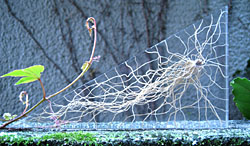
Norihiko Terayama, "r,o,o,t", 2008
YanagimotoHow about a chair with this combination next? (laughs)
TerayamaA chair... I can already imagine the immense amount of time it would take (laughs).
YanagimotoAre you planning to exhibit at any design events this autumn?
TerayamaI will be exhibiting at "novelax," a joint exhibition that started last year. Nine creators will present their unreleased new works.
During the event, we will also open a shop called "novelax store" where you can purchase products from the participating creators.
YanagimotoThank you for your time today.
Norihiko Terayama
Designer. Graduated from Chuo Institute of Technology in 1998 and the Product Design Department of KIDI (Kanazawa International Design Institute) in 2001.
He enrolled in Design Academy Eindhoven in the Netherlands the following year, interned at Studio Richard Hutten and MVRDV during his studies, and graduated in 2006.
He established studio note in the same year.
"novelax PREVIEW 2009 + novelax store"
Venue: TOKYO FAMILY RESTAURANT "playroom"
1-3-1 Higashi, Shibuya-ku, Tokyo, Kaminito 20 (2F)
Dates: Saturday, October 31 - Tuesday, November 3, 2009 (4 days)
Hours: 11:00 - 21:00 (until 17:00 on the final day)
Organizer: novelax
Exhibitors: fift, FormlessDesign, PRODUCTIVE MIND, Schatje Design studionote, Wataru Kumano, Notofusai, Keisuke Hori, Nami Mizuguchi
http://novelax.jp/
Purchase unique design products here
