May 15, 2015
Koichi Yanagimoto | Part 12: An Interview with Norihiko Terayama on Dutch Design (Part 1)
Part 12: Interviewing Norihiko Terayama on Dutch Design (Part 1)
Lately, I've been working with designers born around the 1980s quite often. However, when we actually meet, our conversations tend to focus on work, so I feel I don't fully grasp their true personalities. I want to engage in dialogue with the designers who will lead the next generation and draw out their individuality.
Text by Hiroshi Yanagimoto
Alright, let's go to the Netherlands!
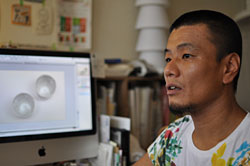
Our first guest is Norihiko Terayama, who leads studio note.
Among the young designers I work with, his starting point for ideas is a little different, which I find interesting. Where do these ideas come from? I'd like to ask him.
YanagimotoI hadn't had a chance to talk with you personally yet, Terayama-san, so I have many things I'd like to ask. Could you tell us why you decided to study product design, and why you chose the Netherlands as your study abroad destination?
TerayamaI was originally studying architecture in Tokyo, but in architecture, projects often ended with just a model. That felt disheartening, and I had internal conflicts about it.
I thought that with product design, I could create things with my own hands, so I went to a vocational school. One day, I had the opportunity to see droog design's "do series," and I was deeply impressed.
There was a world completely different from what I was learning in school. At first, I didn't understand it, but as I looked at it for a while, it gradually made sense. And I thought, 'I want to create things like this too.' So, I did some research and learned about Design Academy Eindhoven. I thought, 'Alright, let's go to the Netherlands!'
Eindhoven: Making You Think About 'What to Create'
YanagimotoWhat do you think are the fundamental differences between studying in Japan and the Netherlands?
TerayamaI'd say it's the emphasis on concept and the dedication to pursuing a single approach. Just as Piet Hein Eek continues to use scrap materials, I believe the education encourages you to stick with one thing. It's more artist-oriented. Perhaps that's the fundamental difference.
YanagimotoJapanese design education has a bit of a vocational training feel to it, teaching 'how' to make things. But overseas, they make you think about 'what you can do.'
I once asked a graduate of Eindhoven, and they said the most difficult part was the introspection and then the process of creating something from within themselves.
TerayamaI read philosophy books for the first time too. It was a case of 'read first, then create.'
YanagimotoIn Japan, we start thinking about 'how to design this,' but overseas, especially at Eindhoven, you're made to think about 'what to create.'
TerayamaThat's right. In the department I was in at Eindhoven, the professor would say, 'First, go on a trip.' Just from Eindhoven to Amsterdam. And do it using a different method than everyone else. Then, the curriculum required you to 'record it,' without being told what to create.
I chose the bus as my mode of transport and took a photo every minute to create a movie. Then, based on that experience, I was told to 'create something.'
YanagimotoIt must be challenging to give form to vague experiences. Especially since Dutch design often starts with research.
You travel yourself → research the surrounding environment → translate it into an object.
This process is likely absent in Japanese design education. That's whyMarije Vogelzangfood designers like her emerge, I believe.
Also, you were lodging withRichard Hutten, one of the prominent figures in Dutch design. Could you share some anecdotes from that time?
TerayamaIt wasn't exactly lodging; I was living in the office. I brought in a bed I found among the inventory and set it up. It was by the sea, and the wind would blow in. It was spacious and dark, and at first, I was too scared to sleep (laughs).
The reason I went for an internship at Richard's place was that he came to Eindhoven as a teacher. There was a six-month internship program as part of the school's curriculum, so I asked Richard, and he readily agreed. He was a representative figure of Dutch design, so I wanted to learn from him.
(To be continued)
Next week, we will introduce episodes from Terayama's time at a Dutch design office.
Norihiko Terayama
Designer. Graduated from Chuo Institute of Technology in 1998 and KIDI (Kanazawa International Design Institute) Product Department in 2001.
Entered Design Academy Eindhoven in the Netherlands the following year, interned at Studio Richard Hutten and MVRDV during his studies, and graduated in 2006.
Established studio note in the same year.
Purchase unique design products here
