March 9, 2015
Matthew Waldman Vol. 02: Bicycle Story
Vol.02 Bicycle Story
My apologies for starting with my own personal story.
While I don't believe I was difficult from birth, the environment I grew up in led me to find many things challenging. Perhaps it's thanks to the therapy and yoga I started in my thirties, or perhaps it's simply the accumulation of age and experience, but I've become much more settled. However, the biggest turning point came from a single comment from a friend.
“Misery is easy, happiness is hard work.” Simply put, if you wake up in a bad mood and do nothing, that unpleasant feeling will linger. If you don't take action, that bad mood might even worsen. If you want to make yourself happy, you have to think positively, and that requires action. From the day I heard that, my life began to transform into a happy one.
For me, making myself happy is incredibly simple and straightforward. It's riding my bicycle.
When I'm on a business trip to Tokyo, I ride a MUJI bicycle. In New York, I ride a Cannondale mountain bike. It's no exaggeration to say that without riding my bike, I become stressed, gloomy, and short-tempered. So, I ride in rain or snow. Riding a bicycle makes any city look beautiful. It's good for my health, it's clean, and honestly, what's not to love?
Bicycle culture varies from city to city. When one thinks of bicycle cities, Beijing and Amsterdam immediately come to mind. I also think Tokyo is a bicycle-friendly city. Unfortunately, New York is not quite there yet. Unfriendly taxi drivers are the worst, but even the police are strict with us cyclists. The lack of safe places to park is also a problem. In 2007, 23 cyclists died in traffic accidents in New York City. From 2000 to 2007, the number of cyclists increased by 77%.
Let me share a little about bicycle culture in New York.
Thanks to Mayor Bloomberg, a slightly better wind has begun to blow for riders. It's still dangerous, but dedicated bike lanes are increasing on the roads, and parks within Manhattan are nearing completion year by year. Most importantly, I believe the magnificent skyline and views of New York City can be best appreciated while cycling.
As you cycle through the city, you'll see pure white bicycles fixed to lampposts or on the side of the road. These are called “GHOST BIKES,” and they serve as memorial sculptures and reminders of cyclists who died in traffic accidents at that very spot. As you get closer, you can see a card with the deceased's photo, name, birth date, date of death, and details of the accident.
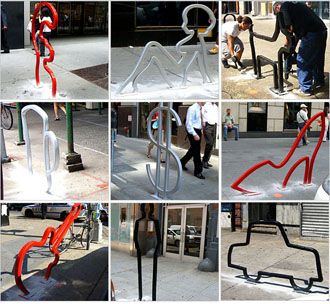
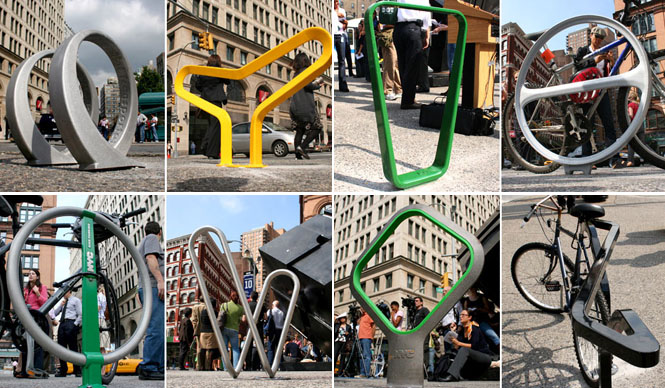
The issue of bicycle parking has also been a recent topic. If office buildings lack parking facilities, commuters won't increase. In the future, safe bicycle parking spaces will need to be provided in all New York public buildings. This requires action not just from politicians, but from the entire city. Recently, two competitions were held: David Byrne's work and the Cooper Hewitt CityRacks Design Competition. While I personally like the very cool designs, I doubt they can actually be installed everywhere. Right now, there's a severe lack of parking space, to the point where it's almost laughable.
New York City's bicycle culture is complex. There are commuters, trendsetters, messengers, fitness enthusiasts, and whimsical guerillas... The messenger style has become fashion, and I hardly need to explain that anymore, do I? The trendsetters wear Y-3 clothing and ride expensive, stylish bicycles. What you rarely see in Manhattan are families, grandparents shopping, and children... Perhaps if the city were a little more bicycle-friendly, we'd see more of them?
Reference: GHOST BIKES
http://nymag.com/news/features/47819/
