
March 10, 2015
The Committee's new Lladro narrative
Lladro possesses the creative spirit and power to challenge "new forms".
Committee Interview
Lladro chose Committee as a partner from among a myriad of young designers.
That this "mariage" was the right choice is evident from how the artisans in the workshop have fallen in love with their creations.
Compiled by Masaki TakeiPhoto by JamandfixWith the cooperation of CIBONE AOYAMA

A Story Woven in the "New Language" of Figurines
— What is the fundamental difference between your own work and the collaboration with Lladro?
As Committee, we depict "the world we want to see" and "the world we dream of," creating works that our viewers can share. In our collaboration with Lladro, the priority is to build a triangular relationship between ourselves, Lladro, and the customer.
— Do you see your customers? Is there a specific type of person you want to reach?
At our core, we want people from different cultures to understand our work. Perhaps those people are our customers.
— Are "figurines" (ceramic dolls) popular not only in Spain but also in the UK, where you both are from?
Yes. I believe they were a popular item with a long history. They were particularly inexpensive in the 1800s and were used, for example, to convey current news. However, in the UK over the past 50 years, the rise of hippies and punk accelerated the rejection of tradition.
Although figurines once fell into disuse, I believe they are now becoming a new language for expressing something.

— Are there aspects of your work that you feel are "typically British"?
It's difficult for us to judge, but there must be some (laughs). What do you think? We'd like to ask you.
— I'm not sure if it's typically British, but I find your work to be "narrative."
Yes. What you just said stems from the fact that we studied art, not design. Art is established through concepts and stories. That's what we are expressing.
— This collection is the result of meticulous work. Could you tell us about any challenges you faced or any episodes from the sample production?
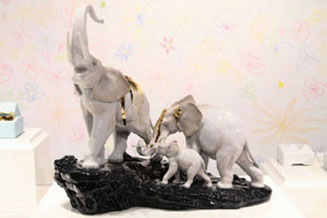
I believe this collection was made possible by the trust we built with the craftspeople at Lladro. The high skill of each individual craftsperson allowed us to fulfill our aspirations one by one. At British ceramic manufacturers, "new things" often just mean changing colors.
However, Lladro, as a unified team, possesses the creative spirit and power to constantly challenge "new forms."
— Were there any "constraints" when creating these pieces with Lladro?
Within Lladro, there is a "Creative Committee" to which designs are ultimately proposed for decision-making and production progress. We exercised our creativity to the fullest and created designs that we are truly satisfied with.
— What are your thoughts on Japanese design?
I believe it expresses the pure essence of materials themselves, something unadulterated and pure. Japanese design is about application. In other countries, "what is fixed is used only in its fixed way." In Japan, elements are brought from various sources, refined into practical objects, and given new life. That is what I believe Japanese design to be.
— But doesn't that sometimes receive negative evaluations?
That is not a negative opinion. Design is fascinating and enriches culture. To earnestly understand and learn from what exists in other countries, to find new discoveries from it, and to make it usable—that is truth and nothing but sincerity.
What is unique to Japan compared to other countries, I believe, is the way things are handled. For example, shrines and temples with over a thousand years of history, like Ise Jingu, are dismantled and rebuilt. This attachment to objects and the act of cherishing them may be difficult for Europeans to understand.
— Then, what are your thoughts on recycling?
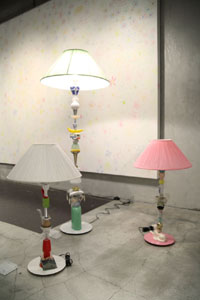
Our Kebab Lamp (Committee's signature work: photo on the right) uses various objects found at flea markets and antique markets. People often say it's environmentally friendly, but we didn't use them with the intention of solving waste disposal issues. Each object has a message, and we are simply finding value in that message.
Whether expensive or inexpensive, the lives and experiences of those who used them are projected into their forms. We simply use that message as part of our art. Recycling solutions are for scientists to figure out; we believe there might be a different way for us to contribute to recycling.
— Currently, there seems to be a major global trend, exemplified by Art Basel in Switzerland, where the boundaries between design and art are blurring. Designers are now creating "art pieces" with added value. What are your thoughts on this?
I think it's a very interesting trend. We call the "gallery system" the practice of adding immense value to art, making it exist in a realm separate from our world. While we reject this system, it also allows us to create unique works by generating investment through reliance on the "gallery system."
However, the current design industry can be described as being in a state of explosive growth. While creating things that are beyond salvage, new ideas and processes are also being conceived. In such circumstances, design needs to move in the right direction, but skepticism and misinterpretations about design are prevalent in reality.
I believe the existence of the "market" is the cause of this. But perhaps when the market begins to convey truth, buyers and customers will finally grasp the essence of things. We aim to create works that possess realistic "artistic value."
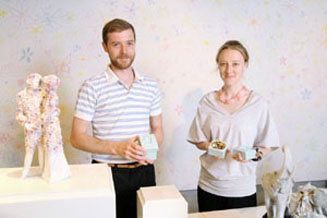

Committee
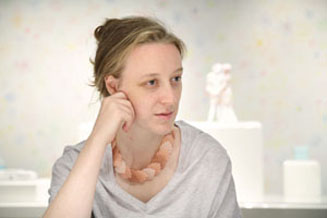
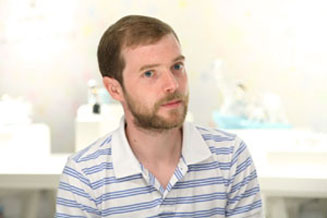
Committee. A design unit by Harry Richardson and Claire Page.
Both born in the UK in 1975, they graduated from Liverpool School of Art & Design in 1998 and moved to London. In 2001, they established the design unit Committee upon their marriage, handling interior design for furniture, lighting, and textiles. They gained widespread recognition in 2005 with their floor lamp, the Kebab Lamp.
LLADRÓ
Tel. 03-3293-0802
http://www.lladro.co.jp/
