March 12, 2015
The 9th: Family Happiness Embodied in Children's Glassware
The 9th
Children's Glassware Embodies Family Happiness
Text by Ariadna KanazawaPhoto by JamandfixStyling by Yasuhiro Takeishi (City Lights)
Design in a Prosperous Era and the Baby Boom
The 1950s in America marked a path of high growth, often called a golden age. With a 22% increase in national purchasing power between '46 and '64, and birth rates hitting an all-time high in the same year, glassware companies also began developing products for the baby boomer generation. Beyond the products themselves, perhaps the most significant difference from general household goods of the past was the package design, which was strongly geared towards being picked up and handled.
In post-war America, the expansion of suburbs, a phenomenon dubbed the "doughnut effect," gradually led to large shopping malls becoming the center of commerce. Amidst such retail environments, the children's sets, designed to stand out on display, effectively appealed to the younger generation of new parents, showcasing the novelty of Fire King.
Since having my own child, I've come to truly recognize the obvious: that it's parents, not children, who choose items for children. This means that children's products, which must be made for enjoyable use by children and also gain approval from parents to sell, are perhaps one of the most challenging categories for creativity.
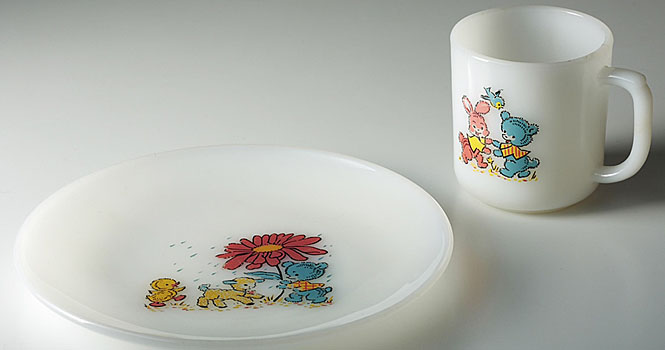
With such ingenuity, Fire King released "Kiddie Mealtime" from its "Children's Series" in the 1950s, featuring charming original illustrations of animals. Initially sold as a set of three items: a mug, a plate, and a soup plate. The mug, made from a mold created exclusively for this set, was about one size smaller than the regular stacking mugs, fitting perfectly in a child's hand. This is a rare set, and it's become difficult to find pieces in very good condition today.
Happiness Depicted on Glassware
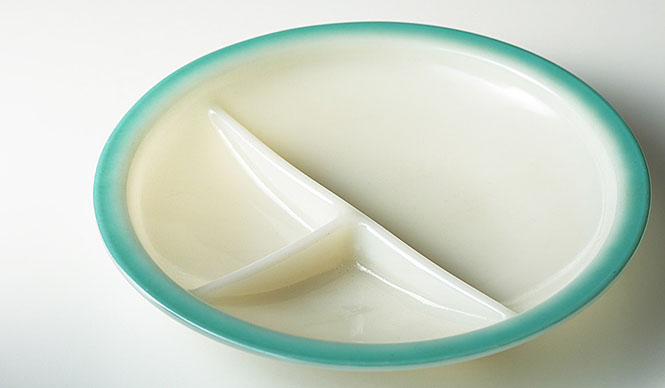
The three-compartment plate, also released during the same period as part of the "Children's Series," was an adaptation of the adult version for children, featuring a plump design at the bottom to make it easy to scoop food with a spoon. It was rimmed with a pale blue around the ivory, with a unique brushstroke-like color application. Furthermore, this plate came with a rubber holder to be placed on top. This was designed to prevent children from flipping the plate when placed on the table. It's astonishing to see universal design principles like this incorporated even in that era.
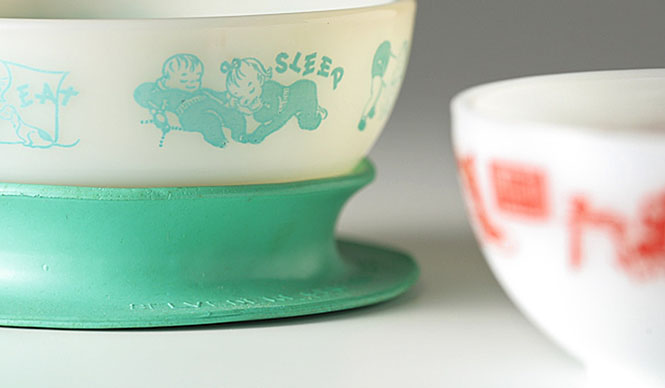
Additionally, there appear to have been five different designs for children's cereal bowls released at the time: "Circus," "Baby," "Eat, Sleep, Play," and "Player." These were also sold as sets in boxes, each including a rubber holder and a spoon. "Eat, Sleep, Play" features adorable illustrations of babies still in diapers hugging each other while napping, exercising, and eating, printed in green on ivory. "Player," printed in red on Anchor White, depicts a child's daily life: playing with friends at the beach after breakfast, feeding a cat, and praying before bed.
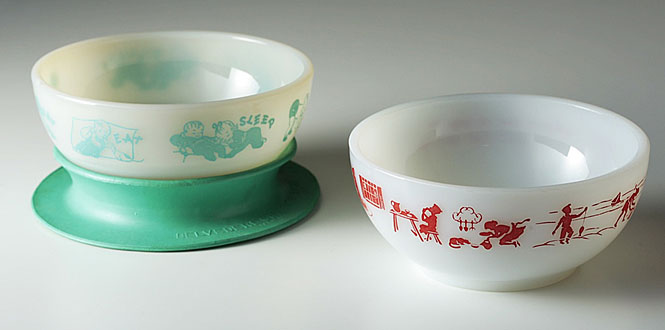
The subtly depicted illustrations project the stories unique to family life. Meal times every day. The many stories woven through the trial and error of raising children. As we age, there are times when we risk losing sight of what's truly important. Perhaps happiness lies in being able to spend time nurturing our hearts, eating, sleeping, and laughing with loved ones, without missing a moment.
In the next installment, we will introduce crystal glass products such as sapphire blue.
