April 3, 2015
Series: Yoko Ueno Lewis | Living Notes - Part 14: "Living with Wood"
The Way We Live with “STYLE”
Living Notes: Part 14
“Living with Wood: Raw Wood, Slow Life, and Less Design” (1)
It has been 15 years since I began designing with Shimanto cypress, grown in the Shimanto River basin of Kochi Prefecture. I now receive inquiries via email from as far as America, Australia, Sweden, and Italy.
Recent Feature: “LOOKSLILEGOODDESIGN”
Text & Photographs by Yoko Ueno Lewis (Nov. 2013)

My appreciation and sensitivity towards wood have deepened.
The temporary room I am currently staying in Tokyo is a project with Yayoi Minowa, an environmental journalist (http://gogreen.petit.cc/), and Tetsuhiko Kuroiwa, an environmental architect.
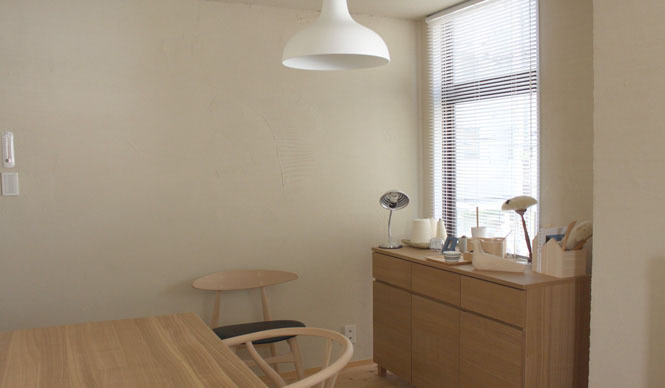
The interior features flooring of 100% natural Kyushu cypress and walls of diatomaceous earth from Hokkaido.
Since humans are part of nature, having natural, raw materials for walls, floors, and ceilings reduces stress, prevents the air from feeling dry, and creates a calming atmosphere.
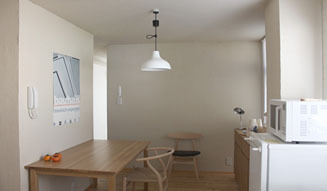
My home in Berkeley has white painted walls and maple floors, but these diatomaceous earth walls have a humidity-regulating function, like breathing. They absorb excess moisture and light, creating a simple, understated space that feels closer to nature.
The solid cypress planks used for the entire floor are so comfortable underfoot, they could be called for bare feet only. Their natural humidity-regulating function keeps them cool in summer and warm in winter, while also absorbing impact. Above all, their fragrance brings an aromatherapy effect to the entire room.
Americans might call this a "tea room." Since moving into this environment, I feel my appreciation and sensitivity towards wood have deepened.
The more light circulates, the more vibrant colors become.
Raw wood, raw light—I am drawn to light-colored woods like cypress, beech, and maple, with their unvarnished, natural appearance. Even though they are light in color, they possess rich expressions and a simple elegance. Light circulates brightly, and from an interior design perspective, the natural variations in light and shadow, and the saturation of colors, become more distinct. When incorporating many colors into a room, I believe a space created with light-colored wood allows the colors themselves to stand out more. In the long winters of Northern Europe, white wood furniture and vivid textiles likely become symbolic concepts in interior design precisely because of this light circulation. I believe it's because the more light circulates, the more vibrant colors become.
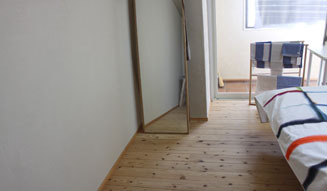
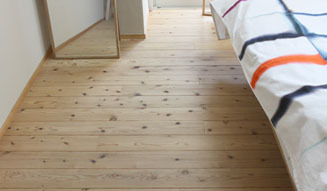
In this room, I photographed wooden tools and chairs. "Raw wood & raw light"—the interplay of shadows created by this alone, which also depends on the time of day, seems to become even more dramatic when viewed through a camera lens that captures even the finest particles.
Spaces where walls, ceilings, and floors are all made of natural wood are gaining attention as a global interior trend. Spaces abstracted by a single material seem to enhance the presence of both the wood itself and the objects placed within them. The view from a framed window, the sky, the path of sunlight streaming in—everything resonates like an unexpected piece of music.
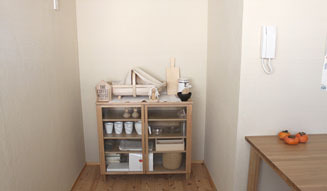
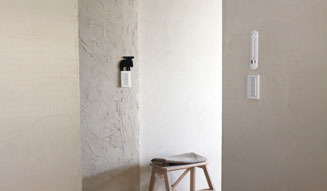
Below is information about the room.
The design was by Tetsuhiko Kuroiwa (Director of Architecta).
http://homepage2.nifty.com/architecta/index.html
http://architecta.blog64.fc2.com/
The cypress used for the flooring is solid wood from Miyazaki, Kyushu. The diatomaceous earth for the walls and ceiling is MP Powder. Plastering walls using a plasterer's tools can be a fun project for children with a little practice.
http://www.passiveatelier.com/pasv/muku.html
The Meso-Pore diatomaceous earth, the raw material for Diatomaceous Earth MP Powder, is highly effective at regulating humidity and is mined in Hokkaido.
http://www.minnano-tane.net/
Electromagnetic wave shielding for the room
http://www.passiveatelier.com/pasv/denjiha.html
These are specifications for an All-Earth home, produced by Regena Co., Ltd.
http://www.all-earth.net/basic/materials.html
Following a similar concept, with production by environmental journalist Yayoi Minowa and design supervision by architect Tetsuhiko Kuroiwa,Organic Cafe "Furomae Cafe & Gallery"(http://furomae.jimdo.com/) has also opened (directly opposite is a Showa-era public bathhouse).
For those seeking a more comfortable space amidst the diverse stresses of modern life—environmental, health, mental, and social—this is a total package I highly recommend.
The Way We Live with “STYLE”
Living Notes: Part 14
“Living with Wood: Raw Wood, Slow Life, and Less Design” (2)
Design and craftsmanship aimed at everyday, unadorned use
Description of the subjects.
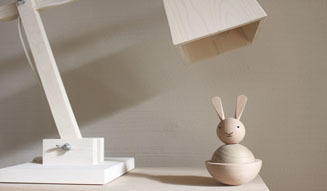
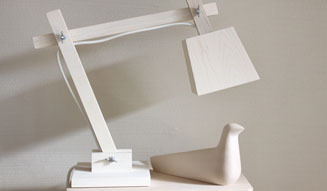
After three years of persistent requests, I purchased this wooden lamp from storynorth (UK). The design, with its visible wood grain and joints secured by screws and nuts, embodies a low-tech aesthetic that paradoxically creates refined elegance. It is a work by Mattias Ståhlbom, a member of the Swedish design duo TAF.
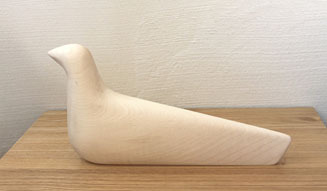
Carved from a block of maple into the form of a waterfowl, this piece is by the brothers Ronan and Erwan Bouroullec, whose sensibility is almost superhuman. It is handled by the Swiss company "vitra."
Beyond its organic and minimalist form, when held in the palm, it conveys a gentle, quiet warmth—the unique dry texture of solid wood. It is a serene object.
The rabbit ornament is an embodiment of cuteness, crafted from beech and oak. The body parts can be inverted for play. It comes with a leather cord for hanging. This work by the Danish design firm OYOY, with a concept fusing Scandinavian and Japanese sensibilities, possesses a deep, enduring charm that speaks through the beautiful texture and natural color of the wood.
The appeal of Nordic toys and objects lies in their sense of relaxed imperfection, a distance maintained from excessive refinement. Especially with wood, I feel that design and craftsmanship aimed at everyday, unadorned use allow the material's essence to speak more profoundly.
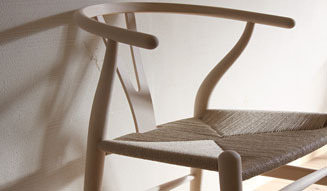
A good chair creates a good space and allows for a good time.
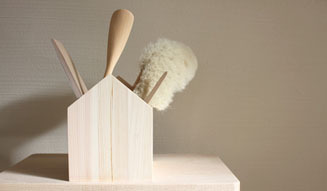
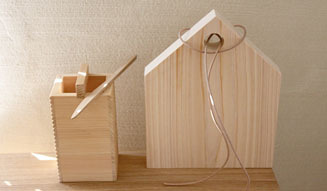
The house-shaped toolboxes (large and small), cutting boards (two types) with carefully crafted edges, a house-shaped cutting board, a toothbrush holder (or chopstick rest), and a paper knife, along with a tray carved with six circles (all made of cypress)—these are my recent creations.
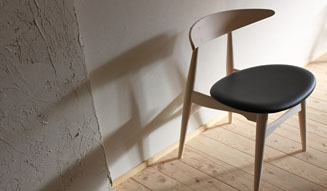
The two chairs are the iconic Wishbone Chair (Y Chair, 1944) and the dining chair (CH33P, 1957) by Hans Wegner. Both have a soap finish. This delicate finish, achieved by meticulously treating the wood surface with soap, retains the oil while creating no film from a coating, thus preserving the natural feel and texture of the wood (from Carl Hansen & Son). Surprisingly, the dining chair feels more comfortable to sit in. The dynamic, refined curve of the backrest and the humorous composition reminiscent of Joan Miró—their exquisite balance conveys the timeless ethos of a genius designer.
A good chair creates a good space and makes one feel like spending a good time.
Design & Planning
Yoko Ueno Lewis
Web & Blog | www.yokoueno.com
http://lookslikegooddesign.com/wooden-products-by-yoko-ueno-lewis/
Online Shopping | http://kaunis.jp/handle_uenoyokolewis.php
