January 9, 2015
Series: Hiroshi Yanagimoto | Part 31: Discussing Design Management with Manabu Tago
Needs and markets exist if you excavate them with new concepts.
Series: Koichi Yanagimoto | Part 31: Discussing Design Management with Manabu Tago (Part 2-1)
Previous installmentFollowing the first installment, we welcome Manabu Tago, who has been involved in rebranding for established manufacturers. Tago himself clearly states, "What I pursue is design management, and I believe there are no boundaries between genres." This time, we had an insightful conversation with him, covering everything from the major hit of amadana to projects undertaken after starting his own company, including his specific approaches. Finally, there are hints on how to compete with overseas brands.
Text by YANAGIMOTO Koichi
A scenario different from previous approaches to electrical products
YanagimotoThen, Real Fleet gave birth to the "amadana" brand, didn't they?
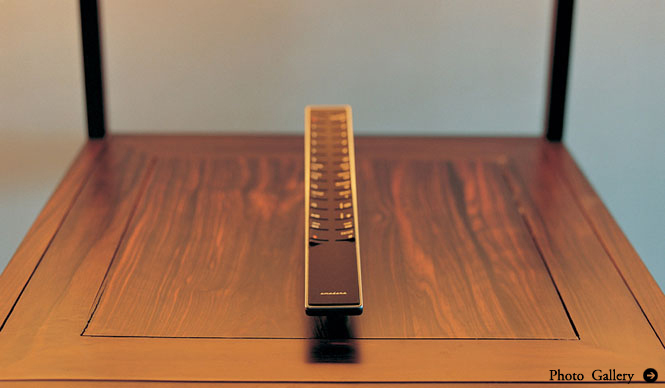
TagoThe direction of the amadana brand was "unique home appliances woven from Japanese lifestyle, aesthetics, and technology." This was the direction set at its founding. Mr. Kumamoto (Hiroshi Kumamoto, current Representative Director of Real Fleet Inc.) was focused on remote controls at the time. It was a period when televisions were transitioning from CRT to flat screens and beginning to resemble parts of the wall, making the presence of products in living spaces more subtle. However, the remote control, which operated the TV, was the only tangible object that could be held and experienced, and it was thought that it could convey the joy and pleasure of owning a TV. We thought, why not have a product that finds new value in something previously considered a mere accessory to the TV, and allows users to appreciate the value of time spent with a TV? That was the "CR-102 Multi Remote Control."
I wanted to re-examine Japan's manufacturing capabilities and visited manufacturers with a long history that had produced remote controls worldwide. The "CR-102 Multi Remote Control" was the first remote control in Japan to adopt die-cast zinc. According to cost calculations, it was approximately 6,000 yen (at the time). Amidst the typical remote control costs of "30 yen or 70 yen," this amount surprised everyone. The representative from the manufacturing company asked, "Are you serious?" (laughs). However, this product, announced simultaneously with amadana's brand debut, seemed to resonate with the idea of a different scenario than previous approaches to electrical products, and it got off to a strong start.
YanagimotoMany people probably associate amadana with mobile phones, but...
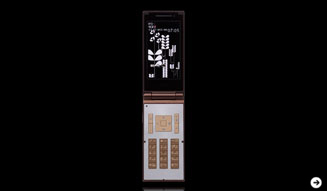
"N705i" docomo
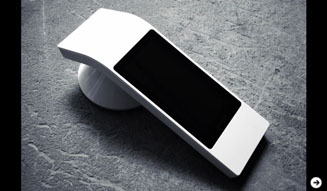
"REMO 901" Nasnos
TagoAt that time, Real Fleet was in a development rush. I was involved in detailed design and design management. Around that time, an executive from Docomo, who was an amadana fan, made an offer. "We can't see the launch, but let's do something together." The "90" series was at its peak then. They wanted a mobile phone that could be used worldwide, and Docomo also wanted to appeal globally, so they decided to launch a new brand, approaching globally active creative directors and searching for vendors. When I first joined, I repeatedly proposed luxurious mobile phone concepts, such as a product with a real diamond embedded in the camera flash LED.
Amidst rapid product development and lineup streamlining, amadana eventually oversaw the "70" series. And after three years from the project's inception, the "docomo N705i" was completed. This is an unusual development period for a mobile phone. We asked Towa Tei to handle the ringtones and operation sounds, and paid close attention to ensuring the hinge didn't make a sound when opening or closing. We aimed for a product that felt cohesive yet had that distinct amadana flair. The wood texture on the brown casing... we actually tried to use real wood. We wanted to give each piece a unique character because we valued a feel that wasn't mass-produced. However, due to the manufacturer's internal regulations, only a fake material was permitted. But I didn't give up easily (laughs). We specially made a long sheet of fake wood, cut out each piece individually, and devised a way to ensure no two patterns were the same. The "docomo N705i" was released to great acclaim, becoming the number one selling model in 2008. Even now, four years later, I still see people using it on the streets. At times like that, I feel the amadana policy of "creating products to be cherished for a lifetime" has taken root.
YanagimotoThat must be the ultimate reward for a developer.
TagoDue to the buzz surrounding these projects, Real Fleet began receiving various offers, but we couldn't accept them all, and the number of rejections started to increase. In such an environment, I began to feel a desire not just for our own profit, but to help competitors, enhance competitiveness, and revitalize the market through mutual improvement. So, while continuing my work at Real Fleet, I also started actively participating in collaborations with other companies.
YanagimotoSo, success became the catalyst for expanding your activities?
Series: Koichi Yanagimoto | Part 31: Discussing Design Management with Manabu Tago (Part 2-2)
Multi-remote controls, laundry products... design as a trump card
TagoAs one example, I worked with Nasnos, a dimmer manufacturer, to create a remote control. The Nasnos brand and products were already released at the time, and I participated as the creative director and product designer. The offer wasn't just for device design; it was to interpret the company's vision in my own way, define what "design" should be, and reflect that philosophy in the products. That's how "REMO 901" was created. It's a learning multi-remote control that can operate lighting, curtains, and blinds, as well as TVs, air conditioners, and audio equipment. We adopted a "bent" shape to meet technical requirements while considering operability. It was announced at the "Interior Lifestyle Exhibition" in 2009 and won the Design Management Award. It was a very happy memory, as it felt like my aspirations since I was a student were being recognized. As my activities expanded, it naturally led to me starting my own company.
Next, I participated in the laundry project for "Kyowa Nasta." They wanted to develop laundry products. When I saw the items, they were so... ordinary. But the moment I saw the "clothespin" and the "rod," I thought, wait a minute... There are many things in the world, but not many people design laundry rods, I thought, and my interest was immediately piqued. First, I pictured the scene of doing laundry and considered the value of the actions we perform daily in words. Laundry is done on a sunny day. In Japanese, "hare" not only means weather but also "unusual occasion." So, I wanted to make the routine of laundry an unusual occasion. In that context, I proposed the brand concept "A life with hare" and began discussing the brand's value proposition. That became "nasta."
Nasta comes from "Nasta" in Kyowa Nasta, but it also includes the Swedish word for "tomorrow." It embodies the idea of resetting one's mood through laundry, connecting to tomorrow, and evoking hope. Kyowa Nasta is a long-established manufacturer of housing hardware, with 80 years of history. With the declining housing starts year by year, subcontractors are gradually losing their strength, a problem that has come to light, and Kyowa Nasta was also grappling with this. However, they possessed the pride of an established company that had persevered through these challenges and a firm vision.
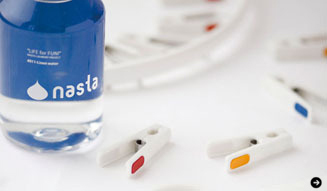
"nasta Laundry series & Clips" nasta
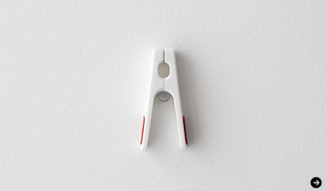
"nasta Laundry series & Clips" nasta
Series: Koichi Yanagimoto | Part 31: Discussing Design Management with Manabu Tago (Part 2-3)
The basics of marketing: creating something for someone
YanagimotoAround this time, did you start shifting your focus from industrial design to everyday life?
TagoIn terms of specific product design, yes. However, as I mentioned at the beginning, what I pursue is design management, and I believe there are no boundaries between genres. Regardless of the field, people's lives are always at the background. That remains unchanged.
The offer from Narumi China (a ceramics manufacturer) was precisely that: design management. They had primarily sold through department stores and wanted to develop the market for the baby boomer generation, and by extension, increase brand recognition for NARUMI. At the time, a project was already underway internally, and they were busy preparing for the opening of a flagship store. The approach for a sales floor within a department store, where many brands are displayed side-by-side, is naturally different from that of a flagship store, which is the face of the NARUMI brand. Therefore, management was necessary. I decided to assist in a follow-up capacity.
Subsequently, as creative director, I focused on overseeing the company's overall creativity, spending time identifying what was lacking and what was needed. Through that process, I realized that while NARUMI had high potential, they were not effectively communicating with consumers. By carefully understanding the needs of the target consumer group, there was ample potential for them to be incorporated into specifications. I believe it was an opportunity to re-examine the basics of marketing: creating something for someone. From this, "OSORO" was born. It took three years to develop, and through Narumi's efforts and the skill of its artisans, it achieved a level of precision unusual for ceramics. The market is definitely there. I believe it is the result of insight to perceive challenges hidden in everyday life, the ability to logically construct hypotheses, and the execution to pursue them relentlessly. I believe this is the case.
Aiming for virtue, not just tomorrow's meal
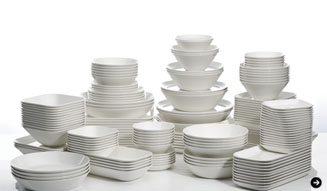
"OSORO" Narumi China
YanagimotoThat's right. When you talk to individuals or consumers, they always have problems, but when you become an employee of a manufacturer, things you thought were problems become normal. That happens often, doesn't it?
TagoI believe that "OSORO" was a successful release precisely because there were management decisions made at the business level. The perspective of design management – "What should this company be?" and "How can people find happiness by engaging with this company?" – forms the foundation of a brand. I believe that without grasping this, the output of shapes and colors cannot be achieved.
TagoI believe that "OSORO" was a successful release precisely because there were management decisions made at the business level. The perspective of design management – "What should this company be?" and "How can people find happiness by engaging with this company?" – forms the foundation of a brand. I believe that without grasping this, the output of shapes and colors cannot be achieved.
TagoThat's certainly true. Companies always have opportunities for production. It depends on whether they can accurately convey their values and messages. When recipients aspire to something, it leads to trust. That is precisely what a brand is. Lately, I often think about "What is a virtuous company?" Virtue, I believe, is about positively impacting society by creating something (sometimes driving innovation) and bringing benefits to all involved. The "something" created refers not only to physical objects but also to experiences and all phenomena that affect spiritual richness. It means we should consider long-term best solutions, not short-term profit pursuit. Being aware of that larger momentum is creativity and the foundation of design. Aiming for virtue, not just tomorrow's meal. Isn't that how we can compete with overseas brands?
Koichi Yanagimoto x Manabu Tago Dialogue: "What is Design Management?" (Part 1) →
Manabu Tago
Representative Director of MTDO, Art Director/Designer. Graduated from Tokyo Zokei University, II Class, Design Management. Engaged in the design and development of numerous home appliances and information devices at Toshiba Design Center. After leaving the company, he worked as the Head of Design Management at Real Fleet. Subsequently, in 2008, he established MTDO to explore new frontiers, where he remains today.
Currently, he is involved in total production, from concept making to product output across a wide range of industrial fields, covering design, direction, and management.
Recipient of numerous awards including the GOOD DESIGN AWARD, red dot design award, JDCA Design Management Award, ILS AWARD Design Business Award, and many others. Since 2010, he has served as a judge for the "Good Design Award" at the Japan Institute of Design Promotion (JDP).
http://mtdo-ch.com