April 17, 2015
Series: Hiroshi Yanagimoto | Part 29: Rethinking the Role of the Designer with Yota Tsunoda
Series: Koichi Yanagimoto | Part 29: Rethinking the Role of the Designer with Yota Kakuda
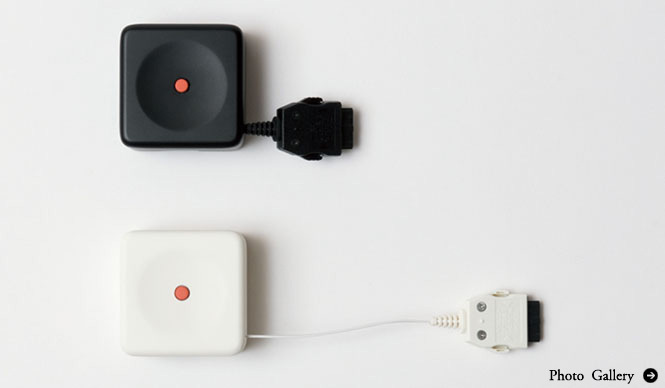
This time, we feature Yota Kakuda, who went independent last autumn. While a prolific product designer, his work possesses an almost anonymous quality.
In an era where 'design' is often a difficult sell, and attention is focused on folk crafts and utilitarian objects, I wanted to understand the very essence of design. It was then that Yota Kakuda came to mind as a conversation partner. I believe we were able to discuss the role of the designer once more.
Text by YANAGIMOTO Koichi
Why Did You Go to Ross Lovegrove?
YanagimotoCould you start by telling us about your journey to becoming a designer?
KakudaAfter graduating from university in Tokyo, I moved to London and worked part-time at 'AZUMI' (a design office active in London until 2004). There, I learned how to work, and afterwards, I worked under Ross Lovegrove (known internationally as a designer who has received numerous awards). By then, I had already been accepted into the RCA (Royal College of Art), but I postponed my enrollment by a year to go work with Ross.
YanagimotoIt seems surprising that you went to work with Ross Lovegrove. Jasper Morrison comes to mind as a closer stylistic match, so why Ross?
KakudaHe simply lived nearby (laughs). I didn't know much about Ross either. However, his design is quite opposite to mine, but I thought that as Ross is a proper designer, there would be many opportunities to learn. So, I had an interview. In Ross's office, I mainly learned about 3D.
YanagimotoWhy did you go to the UK in the first place?
KakudaThe design scene in the UK was incredibly vibrant from the mid-1990s to the early 2000s. Star designers gathered in London, and they also became involved in design and art education. The RCA, where Ron Arad was teaching at the time, was symbolic of this. My initial reason for going to London was to study there. Once I went to the UK, which I admired, and actually studied... in my first year, I realized that I didn't need to create overly flashy or conceptual designs. I discovered that my approach to design was 'ordinary.' In my second year, this became even clearer, and I realized that my strengths lay in details, meticulousness, and creating forms that people could cherish. From then on, my second year became a truly fulfilling period of study.
While I was at the RCA, there was a special tutor named Kenneth Grange (one of the founders of the design studio 'Pentagram'; a product designer), and I always took his tutorials. I think many people aiming for 'proper' design wanted to learn from him at that time. Meeting him also prompted me to start thinking about the nature of design.
Upon graduating from the RCA, I joined 'Pentagram' through Kenneth Grange's introduction. There, I was assigned to the interior design department. Since I had majored in interior design in Japan, I understood the workflow, but I really wanted to do product design, so I quit after about two months. After that, I sent my portfolio to various design firms, and eventually, I received an offer from 'MUJI' (Ryohin Keikaku Co., Ltd.), and I returned to Tokyo. Although not an employee, I contracted with MUJI as an in-house designer and worked there for three and a half years before going independent last summer, which brings me to where I am today.
I Want to Do What I Can't Do as an In-house Designer
YanagimotoDid you have any specific aspirations for going independent? And why at this particular time?
KakudaI felt that around three years was a good milestone for work. During that time, while working with MUJI, I was also taking on other projects, so I thought I could manage. I also received advice from senior designers, which gave me the push I needed.
YanagimotoDuring your time at MUJI, you exhibited at Design Tide Tokyo and the Milan Salone. What was your intention behind that?
KakudaThe motivation was to do things I couldn't do as an in-house designer. I believe that design is a form of communication with the world, so I wanted to present the ideas I had been accumulating, pursue what I wanted to do individually, and communicate with many people through that. With in-house work, projects don't start without a request like 'Please design this.' So, I participated in Design Tide Tokyo in 2010 and the Milan Salone in 2012.
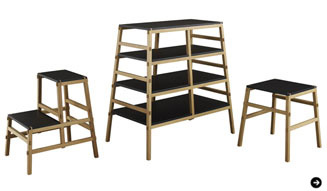
YanagimotoWas the 'Mortaise' furniture series released by 'Ligne Roset' (a French furniture company founded in 1973) a result of your exhibition at the Salone?
KakudaYes, it was. At the Salone, manufacturers' product development teams carefully observe designs, and I was approached there. I realized that opportunities are all around us.
YanagimotoThe timing was also good. Your design aesthetic is somewhat European, yet not quite. If it existed, it would likely be a current trend.
KakudaThank you. After the Great East Japan Earthquake, I seriously questioned whether design was truly necessary. Ultimately, I concluded that it was. Although the economy is currently poor, I am a designer whose work is not dictated by economic conditions, so I intend to focus on what I should be doing.
As a Designer, 'I Want to Inject a Bit of My Own Style'
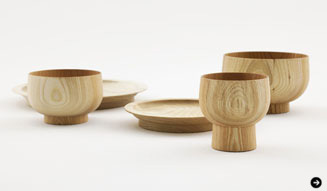
YanagimotoI'd like to ask about the 'Ie-Love-Zoku FAMILY TREE TABLEWARE' that you recently announced. For the general public, design can be abstract, often presenting a clear 'I'm designing this' vibe. With this product, it's not immediately obvious 'where the design is.' Yet, you're not fixated on that; it's clear that you prioritize the comfortable feeling of use above all else.
KakudaI have a fondness for old things and frequently visit flea markets and antique fairs to find sources of inspiration. I believe I excel at redesigning based on inspiration from old objects. The 'Ie-Love-Zoku FAMILY TREE TABLEWARE' is produced by Sakai Sangyo Co., Ltd. in Kiso, a company also known for making bowls that were originally created by Yoshio Akioka (an industrial designer). Since there are excellent existing bowl designs in their archives, I retained the part under the base where fingers fit comfortably and added my own touch with the rounded shape. The process of determining how much character to infuse and finding that balance was fascinating. Thinking back, even when I was at 'AZUMI,' I often discussed 'how much character to add?' with Azumi-san and fellow designers.
YanagimotoThat perspective aligns with MUJI products, which, true to their name, aim to minimize character. If you understand how to remove character, you also understand how to add it.
KakudaI agree. Beyond usability, the primary goal was to minimize the traces of design. At MUJI, I primarily worked on kitchenware, and the last item I was involved with was a mug. While I had a desire as a designer to 'inject a bit of my own style' into an ordinary mug, it ultimately ended up being the most basic shape.
YanagimotoSpeaking of your hobbies, besides frequenting antique markets, you also DJ at events and enjoy bar-hopping in search of good drinks... How do you approach these activities as a designer?
KakudaFundamentally, I'm greedy about enjoying myself. Whether it's finding inexpensive or delicious places, or bars with a great atmosphere. Music is similar, but what connects it to design is 'hospitality' at its core. Searching for places to go or things that interest me, finding old items at antique markets, playing music for people, and bringing them joy – it's all like design. I don't consciously strive for it, but as a result, people say I'm 'a designer who knows bars well' (laughs). I think it's perfectly fine to have a designer who is 'knowledgeable about bars, loves antique markets, and plays music on vinyl' rather than the typical designer.
I Want to Design 'Tools That Are Used'
YanagimotoDesign is an integral part of life, so one doesn't live by design alone. Perhaps the role of a designer is to find the place of design within everyday life.
KakudaWhile design is my livelihood, it's not the sole focus; everything is connected to life. When I visit a certain restaurant in Kagurazaka, I notice many things about how they serve drinks, like the temperature at which they serve sake, and all of that relates to design.
YanagimotoThe bowls in the 'Ie-Love-Zoku FAMILY TREE TABLEWARE' aren't meant to be enjoyed for their form alone, but rather as objects used in the act of eating, to savor soup. When you go out for drinks, the glasses and sake cups are also designed.
KakudaMy approach has been consistent since my second year at the RCA. Rather than being flashy and self-assertive, I want to design 'tools that are used.' Designers don't necessarily need to have their names on things. Whether it's furniture or appliances, I want to focus intently on the act of 'using.'
YanagimotoThat's where the commonality with antiques and folk crafts lies, isn't it?
KakudaI think so. The antiques I like aren't valued for their rarity, like 'made many years ago' or 'by so-and-so,' but for their appeal as 'tools.' Cutlery, glasses, soba cups... I prefer mass-produced items – actual products – over one-of-a-kind pieces.
YanagimotoSo, you extract design essence from these sources.
KakudaYes. I often draw inspiration from the quality and details of objects. The 'Mortaise' series released by 'Ligne Roset' also has a precedent; I saw details in furniture used in a certain region of Asia and redesigned from there. I'm not a designer with particularly groundbreaking ideas, so I think it's partly a matter of keen observation.
YanagimotoNew discoveries are also greatly influenced by technological advancements. Sometimes, new technology dictates the direction. Most things have been created in the past, so instead of copying past objects, we utilize them. This also requires one's own vocabulary. DJing is similar, isn't it? Playing only obscure tracks won't get the audience going. It's about sensing the current mood and presenting something that resonates with people.
KakudaInterpreting past songs in my own way and highlighting the best parts. In terms of input and output, DJing and design are indeed similar. Cooking is also like that. Creativity stems from the ingredients.
YanagimotoIf you were to create cooking utensils, it would likely be difficult without a passion for cooking and a hobby of eating and drinking.
KakudaExactly. If you're making cutlery or glassware, a designer who knows good restaurants and bars would be better suited (laughs).
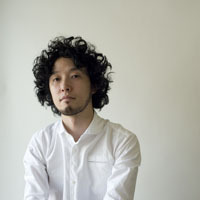
Yota Kakuda
Born in Sendai in 1979. Moved to the UK in 2003, gaining experience at the offices of Shin & Tomoko Azumi and Ross Lovegrove. In 2007, he completed his studies at the Royal College of Art (RCA) in Design Products, supported by the Overseas Study Program for Artists of the Agency for Cultural Affairs. After returning to Japan in 2008, he worked as a product designer for MUJI before establishing YOTA KAKUDA DESIGN in 2011.
http://www.yotakakuda.com/
Born in Sendai in 1979. Moved to the UK in 2003, gaining experience at the offices of Shin & Tomoko Azumi and Ross Lovegrove. In 2007, he completed his studies at the Royal College of Art (RCA) in Design Products, supported by the Overseas Study Program for Artists of the Agency for Cultural Affairs. After returning to Japan in 2008, he worked as a product designer for MUJI before establishing YOTA KAKUDA DESIGN in 2011.
http://www.yotakakuda.com/