March 13, 2015
Series: Yoko Ueno Lewis | Living Notes - Part 6 "Feel Felt Felt"
The Way We Live with “STYLE”
Living Notes: Part 6 - “Feel, Felt, Felt” (1)
We wish to express our deepest condolences and sympathy to all those who lost their lives and were affected by the Great East Japan Earthquake on March 11th. The family of a friend of mine was caught in the disaster in Otsuchi Town, Iwate Prefecture, and miraculously, they were all safe. However, they continue to make unimaginable efforts for survival each day amidst the devastating aftermath. First, I would like to use this space to explore what I can do, and to find concrete ways to help in cooperation with my friends in Japan.
Photos and text by Yoko Ueno Lewis (Mar. 2011)

Combining Two Excellent Materials
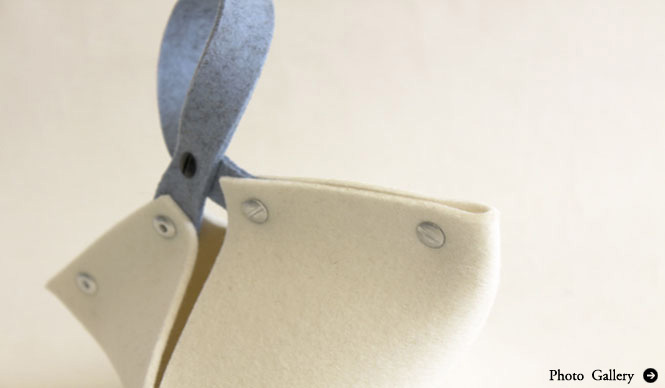
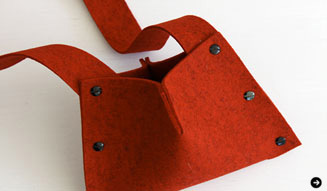
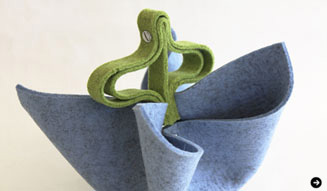
This time, I'd like to introduce designs for felt organizers. All of them are three-dimensional works created by taking approximately A4-sized, 3mm thick wool felt, making a few slits and holes for screws, then bending, layering, or inverting the pieces and fastening them with screws.
Wool felt made in Germany, which I fell in love with at first sight in Frankfurt about eight years ago, has finally become relatively easy to obtain through a distributor in Boston (though popular colors often sell out). This has dramatically sparked my creative drive. I find it to be the most effective way to achieve the characteristic curves of felt, created by bending and inverting 3mm or 2mm thick wool felt. Using polyester felt results in a more linear appearance, a bit sharp and paper-like, giving the same design a completely different look.
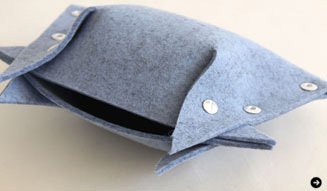
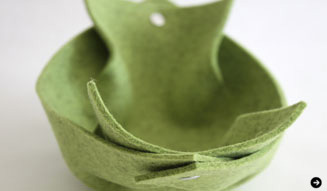
The aluminum screws are officially called Screw Posts, but they are colloquially known as Chicago screws for reasons I don't understand. I first saw them about nine years ago when my husband, an architect, used them to fasten large architectural drawings, about the size of tatami mats. I was personally captivated by their "cheap chic" aesthetic and have been thinking of ways to incorporate these Chicago screws into designs for雑貨 (zakka, miscellaneous goods) and stationery.
It is through combining these two excellent materials that this design was realized. Some designs seem to allow for anything to be placed within them, while others leave one pondering what to put inside. However, the basic idea is to allow users to freely enjoy the interesting forms in their own way.
The Way We Live with “STYLE”
Living Notes: Part 6 - “Feel, Felt, Felt” (2)
Pursuing Inevitability, Not Ornamentation
While I have previously designed with ceramics, wood, and paper, the most appealing aspect of felt is that it requires no blueprints. However, this doesn't mean that everything is completely free or solely based on chance; I establish certain constraints or my own rules for my work.
First, I use rectangular pieces of felt of the same size (both rectangular and square) to avoid waste from offcuts or cutouts. I do not pursue ornamentation. I pursue the inevitability of form (it sounds like studying for art school entrance exams, doesn't it?). I create based on these personal rules.
The meaning of pursuing inevitability rather than ornamentation is, in other words, that it is possible to easily create multiple identical items, rather than a world where the same thing cannot be made twice. This may be the significant difference between design and art (formerly called fine art).
It is not widely known that Japan is one of the world's leading producers of felt. This refers to the beautiful, thick, milky-white felt used to cover piano keys. Unlike felt rooted in the climate and lifestyle of countries like Germany, Scandinavia, or Switzerland, Japanese piano felt is conceived as industrial felt. Consequently, it never appears in the public eye. The felt remains hidden, contributing to the superior sound of the piano.
I once visited a manufacturer's factory, and this thick, milky-white felt is truly, remarkably beautiful! With the know-how of industrial felt production, I believe Japan could achieve a quality and color comparable to German or Swiss felt, but why hasn't this field developed further? Is it due to our lifestyle? Perhaps it's difficult without a culture where felt is a familiar material, passed down through traditional designs and products over a long period, as it is in Europe?
Hand-knitted wool sweaters tend to felt after being washed multiple times. I remember being shocked one day when a sweater suddenly shrank dramatically. In my childhood, I recall everyone wearing felted pure wool sweaters, even though they were stretched to their limit. Feel, felt, felt…
For someone like me, who is not good with sewing machines or needlework and tends to be a bit lazy, felt is truly the king of materials because I don't have to worry about cut edges, selvages, or the direction of the fibers. When the screws are removed, it returns to a single sheet of felt, and it's incredibly light. It's truly an ideal material for me!
The felt items introduced on OPENERS this time are original designs, most of which are being shown for the first time. If you are interested, please contact us. We will send you more information.
(Design Copyright Registration Number: VAu 1-047-435)
