May 14, 2015
Series | Yoko Ueno Lewis | Living Notes - Part 5: "Before Design"
The Way We Live with “STYLE”
Living Notes: Part 5 – “Before Design”
If there is one person I would most want to meet and interview in Japan, it would be the architect Tadao Ando. Of course, the reverse is impossible, so this remains a distant dream. Yet, visiting Ando’s works is easily done. I, along with my late husband Jim Lewis, an architect himself, have explored his buildings, as well as those left behind by Le Corbusier and Mies van der Rohe, whom Ando visited in his youth.
Photos and text by Yoko Ueno Lewis (Feb. 2011)

Works Coordinating Nature with Concrete
Among his many works, perhaps Le Corbusier’s Villa Savoye and Ando’s Church of the Light left the deepest impression. (The Church of the Light is movingly described in Go Hiramatsu’s book, “Church of the Light: Tadao Ando’s Site.”)
Why Tadao Ando? When I was a student at Kyoto University of Art and Design, passively engaging with design, I was profoundly struck by Ando’s approach to materials—an approach that could be called “before design”—and his triumph in harnessing concrete, a material of immense strength. This marked the beginning of my own dialogue with materials, a journey that continues to this day.
This is work that can be described as “before design,” or, in my case, it’s possible that the design was already complete before the design process even began. Such is the importance and decisiveness of materials.
I understand Ando’s architecture as a work of coordinating nature using concrete. What is being coordinated? Light, trees, water, sky, earth – his architecture is a coordination with these elements. Conversely, it is concrete that grants a decisive freedom of beauty to natural elements like light and trees, or rather, natural conditions.
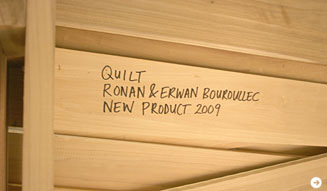
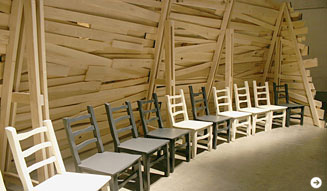
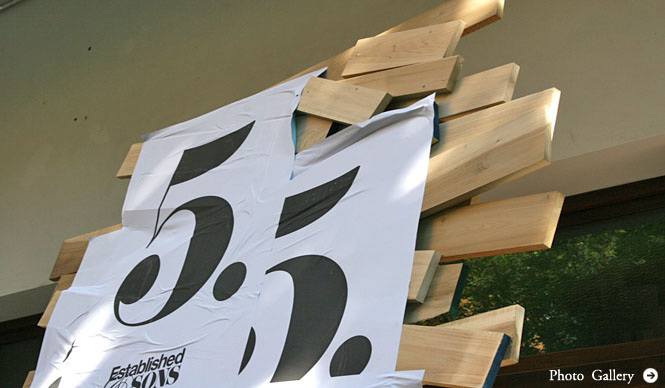
The photographs in this article were taken at the Milan Salone. I was drawn to the designers’ approach to wood as a material, an approach that could be called “before design.” In creating with wood, I believe there are two perspectives: creating through design, and creating through material. While the results may be the same, I personally find it easier to control stylistic freedom with the latter.
Last month, I had the opportunity to visit a thinning site in the forests of Aki City, Kochi Prefecture. Though it was near a settled area, the difficulty of extracting felled timber from the mountains makes utilizing thinned wood challenging. There are also human resource issues, such as the training of scarce lumberjack artisans. Amidst these complex, intertwined challenges and problems, the felled and neatly stacked cedar logs revealed their fresh growth rings. Rings that speak volumes in their silence.
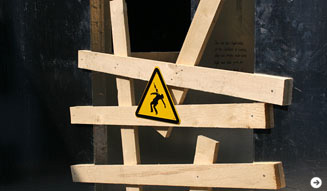
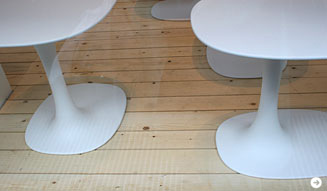
As a cutting-edge concept in European architecture, the idea of “board-on-board” construction, which radiates a shocking beauty akin to exposed concrete, is fresh. The sheer scale of this endeavor—using vast quantities of solid boards, arranged uniformly or seemingly at random, to form floors, ceilings, walls, exteriors, and partitions—is a testament to the power of the material. Like concrete, it grants a decisive freedom of beauty to natural elements (natural conditions).
I believe Japan, a nation rich in forests, could benefit from a greater use of wood, incorporating the effects of natural phenomena like drying and rain, and anticipating the passage of time. Similar to Ando’s reforestation projects, I feel a need for cross-genre initiatives that connect to the responsibilities of humankind, which can be termed slow culture.
