March 13, 2015
Series: Yoko Ueno Lewis | Living Notes - Part 3: Do You Know About "Made in Occupied Japan"?
The Way We Live with “STYLE”
暮らしノート Series | Vol. 3: Do You Know “Made in Occupied Japan”?
With Halloween and the midterm elections behind us, America is rapidly accelerating into the holiday season. Every year around this time, I'm reminded of Mr. Snowman, born in Japan.
Photos and text by Yoko Ueno Lewis (Nov. 2010)

The Meaning of "Made in Occupied Japan"
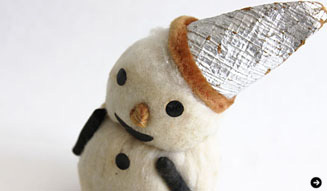
As you can see from the photo, Mr. Snowman is made of cotton. Though faded, his red chenille nose, dark eyes, silver hat, and his two-tiered, rather than three-tiered, form are somehow endearing. (Snowmen born in America are three-tiered.) If you gently turn him over, you'll find the words "MADE IN OCCUPIED JAPAN." This signifies products made for America and exported in large quantities during the period of the American occupation of Japan, from 1945 to 1952.
At that time, countless Mr. Snowmen and their companions crossed over to America, already overwhelmingly prosperous, and became one of many ornaments on the tree placed at the center of a large house, gazing at the happy family celebrating Christmas while thinking of their distant homeland, Japan.
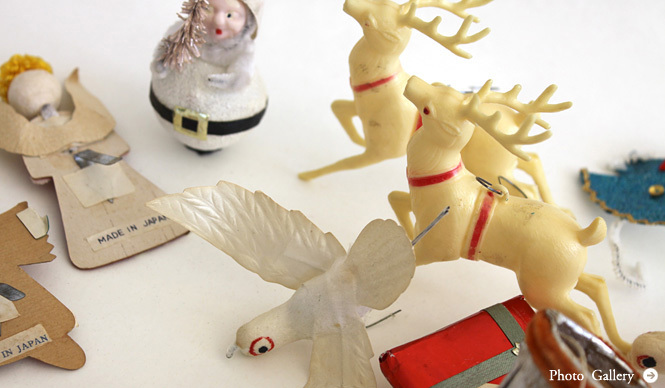
Cheap, junky ornaments. The word "JAPAN" is visible on each one. In the small towns of Japan shortly after the war, under the glow of bare light bulbs, what were the people imagining as they packed boxes of these ornaments, adorned in sparkling reds, greens, and golds, of the Christmas in the victorious nation, so distant from their own lives?
Many of you may recognize the chenille Santas. Weren't these chenille Santas common in Japanese homes in the 1950s, posing playfully behind the Christmas tree? However, these Santas in the photo are also companions who made their way to America.
West German Kugel
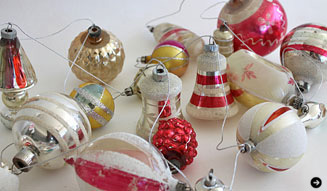
At the end of the 19th century, Christmas trees were made of white goose feathers. White bird feathers were perfect for representing snow-covered trees. The glass balls hung on them were called KUGEL, and the first to release them was Woolworth's, which still supports everyday life for many. The sparkling, colorful kugels quickly captivated people. Kugels sold like hotcakes.—The ones in the photo are from after the war until around the 1960s. When I was collecting them, they were practically given away for a dollar each at antique shows. The faded reds and blues, the chipped hand-painted brushstrokes, still bring warm dreams, far exceeding their one-dollar value. These are Made in West Germany.—The post-war West German kugels were very well-made even then and seem to have been very popular.
Even the Christmas ornaments that reflected small dreams had unexpected histories. Within the history of people's lives lie the silent stories of objects.
During a chance visit to a local stationery shop in Prague in late autumn with a friend, I found angels that the owner himself handcrafted. They were so sad... not cute, but sad... I couldn't help but buy many and bring them home.
More Possibility !!
I've been using a PossibiliTree for my Christmas tree since last year. "PossibiliTree"—the play on "possibility" is a wonderfully cool concept. It's a magnificent tree from the Babcock family of architects living in Minnesota.
http://possibilitree.com/
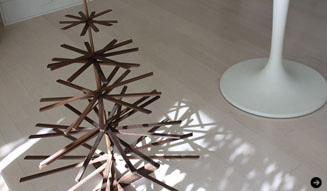
The photo shows the tabletop version in walnut; other options include birch, cherry, and wild cherry. The tree itself is wonderful, but the way it was shipped was also remarkable. All the slender boards for the branches, the metal rod for the trunk, and the round bar were carefully and gently wrapped in a cloth resembling a large luncheon mat. I was immediately struck by the maker's affection for wood. This PossibiliTree can be used by a family for generations, has no shipping impact, and uses thinnings—it might just be the ultimate tree for the future.
Actually, I keep the PossibiliTree up year-round, completely undecorated, in its natural state. It's a tree that looks beautiful even in the dappled sunlight of daytime, more like an objet d'art.
The "more trees" project has also launched many wonderful products with great ideas and designs. It's in this season, as 2010 draws to a close, that I truly feel concepts like PossibiliTree and more trees will become commonplace with each passing year.
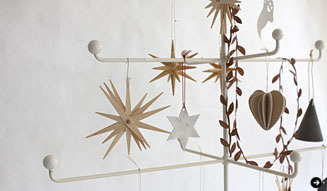
P.S. Come to think of it, I have another year-round tree. I hang wooden motifs and ornaments on it as the mood strikes. It's less a tree and more a "hanging thing"... Possibility is everywhere... I like that way of living.
