Series | Hiroshi Yanagimoto | Part 26: A Conversation with Akiko Ueki on "Ideas and Product Design" (Part 2)
Series: Kōichi Yanagimoto | Part 26: Asking Akiko Ueki about "Ideas and Product Design" (Part 2)
In this second part, we welcome product designer Akiko Ueki. She discusses her approach to creating products with an architectural mindset, the actual production background, and her future outlook.
Text by Kōichi Yanagimoto
I'm now creating full-scale objects that I can touch
YanagimotoYanagimoto: You mentioned that during university, you heard from those around you that "architecture encompasses everything." Now that you're creating objects yourself, could you tell us about the aspects of architectural thinking that you've been able to apply, and those you haven't?
UekiUeki: I still believe the "thought process" in my work is architectural. I create the overall picture first, then proceed step by step... that's become my method. What I haven't been able to apply, or rather, what feels distinctly different, is the "sense of scale." When I was an architecture student, my biggest struggle was with the concept of scale. My classmates would look at a 1:200 drawing and try to grasp the actual size. I, on the other hand, would build a model and show it to the professor, only to be scolded, "Can you imagine this becoming 200 times larger?!" (laughs). Now, I'm creating full-scale objects that I can touch. This difference in scale is significant. Another point is the "sense of speed." In architecture, it's normal for a single project to take several years to complete. My current work suits my personality, I think.

YanagimotoYanagimoto: In my product design work, I often interact with architects, interior designers, and other product designers. Architects and interior designers have a conceptual approach and excel in spatial recognition. Product designers, on the other hand, refine details down to the "millimeter." When you create mock-ups, the difference is stark. When it comes to "objects," I believe product designers have the edge.
By the way, you seem to enjoy traveling. How does travel inspiration influence your work?
UekiUeki: When I travel, I often feel like I am nobody, and that nothing is expected of me. It makes my work feel very small (laughs). It doesn't directly influence my work, but... I develop a sense for finding "interesting things" within human behavior, and I often become aware of people's genuine feelings. It's like my "senses open up."
YanagimotoYanagimoto: For me, my grandmother's house abroad is a source of inspiration. Photos of her family are displayed in a remarkable layout, and even a tacky tablecloth is coordinated skillfully. None of it is intentional, but there's an appeal that transcends logic. Japan lacks this kind of thing. In Japan, we tend to define categories and create "XX style."
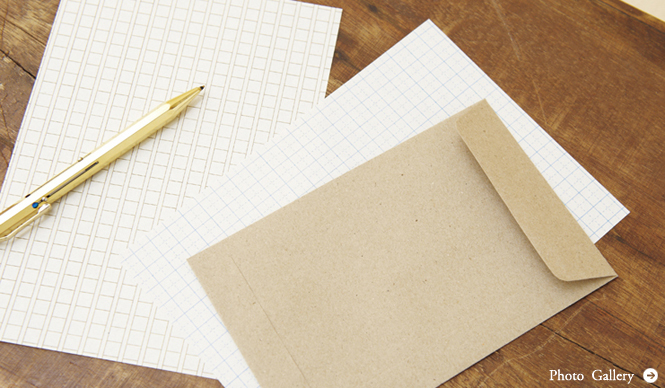
Yanagimoto: Speaking of travel, I once traveled with the representative of a certain stationery brand, and he was adept at using his senses. He wasn't a designer, but he tried to translate the humidity, air, temperature, and human warmth of a place into stationery. He believed that if you could imbue an object with the "excitement of being there," people who hadn't visited the place could still feel it. It sounds somewhat spiritual, but he elevated these sensations to the paper quality and even a single line of text, using a method clearly different from graphic designers. These feelings can be conveyed even through a single ruled line. There's an interesting anecdote: we created two notebooks with identical exteriors and textures, the only difference being the ruling on the pages. One had computer-generated lines, and the other used scanned lines drawn with a ballpoint pen. You wouldn't notice the difference unless you looked closely, but the notebook with ballpoint-drawn lines sold overwhelmingly better. Indeed, the ballpoint lines felt warm. Users probably intuitively grasp these nuances without any explicit announcement.
UekiUeki: That's a very interesting story.
Series: Kōichi Yanagimoto | Part 26: Asking Akiko Ueki about "Ideas and Product Design" (Part 2)
It's enjoyable to ponder "Why didn't it sell?"
YanagimotoYanagimoto: Once architecture is complete, clients don't criticize it much. However, products at an accessible price point are easily judged as "buy or not buy." That's the evaluation. In a sense, it's a heavy responsibility.
UekiUeki: Even if I create something I love, it's tough and lonely if it doesn't sell. Unlike architecture, we create products with our own money and handle distribution. Furthermore, the results are clear in the data... I didn't intend to become one, but I now have aspects of a manufacturer.

YanagimotoYanagimoto: That's precisely why you're close to your customers and can see their reactions in real-time. Most product designers probably don't have that level of insight; they only know broadly if something is selling or not. Because you create and distribute yourself, the burden of inventory is significant, but it's clear how things sell. I also have manufacturing functions, and when I participate in department store events, the reactions are obvious. It's particularly educational to see how "ordinary housewives" interact with and choose design products. It helps me gauge the balance of design and sometimes leads me to think that minimizing design might make products more accessible to a wider audience. It serves as a trigger for "realization."
UekiUeki: Ultimately, when considering what sells and what doesn't, the question that always follows is, "Why didn't it sell?" When I start thinking about that, various factors (packaging, display, color, etc.) come to mind. I find it enjoyable to ponder, "Why didn't it sell?" While the answer isn't immediate, I try to consider all possible elements.
YanagimotoYanagimoto: Formulating hypotheses is crucial, isn't it?
UekiUeki: In the past, I couldn't see "where, who, or how people were buying," so there was no sense of "selling" reality. However, by spending time with our retailers, I've had major discoveries. Just as I was visiting, a regular customer of the shop was purchasing our products. There's a shop, and within it, there are people and community connections. Our products serve as a medium for communication to arise. It's obvious, but seeing it up close was incredibly rewarding. It provided a benchmark for how much we should be producing, not too little, not too much.
Series: Kōichi Yanagimoto | Part 26: Asking Akiko Ueki about "Ideas and Product Design" (Part 2)
I want to create products in an environment where I can oversee the entire process, including shipping
YanagimotoYanagimoto: I'd like to ask about the products you handle, Ueki-san. They feature a coexistence of low-tech graphics and modern fluorescent colors. Is this intentional? When launching a brand, people tend to stick to a single worldview, but I don't get that impression with your work.
UekiUeki: There's no intention or specific aim (laughs). Regarding "Mizushima," there wasn't a concept initially, but after three and a half years, I feel like I'm finally starting to see what "Mizushima" should be.
YanagimotoYanagimoto: You use orthodox patterns, yet the colors and textures make them appear different.
UekiUeki: I'm not particularly good at graphics. But I like patterns, so for "Mizushima," I decided to focus only on polka dots and stripes, things I personally like.

YanagimotoYanagimoto: Even with polka dots or stripes, the ones used by packaging material suppliers worldwide differ. I once wrote a piece for a Tokyo guidebook about "Shimojima" (a manufacturer and shop based in Asakusabashi, Taito-ku, dealing in packaging materials and store decorations). When I travel abroad, I thoroughly shop at places like "Shimojima." I thought graphic designers visiting Japan would definitely be interested. They still sell wrapping paper from around the 1960s, the kind you see in fruit parlors.
UekiUeki: Conversely, I would be thrilled too (laughs).
YanagimotoYanagimoto: By the way, what is the typical production lot size for your business?
UekiUeki: Currently, it starts from 100 units. We handle all the OPP bag insertion and stamping for sales in-house. All inventory is also kept internally. People often ask, "Aren't you renting a warehouse?" but I feel uneasy if I can't see the flow of the products. I want to create products in an environment where I can oversee the entire process, including shipping. In fact, I spend more time thinking about tasks like "OPP bag insertion and stamping" than about design itself. If you're making just one item, you can do anything. If you're making ten thousand, it's different. But if you're making 500 items, that's something we can do. I feel this capability of making around 500 items is reflected in the design. Our production heavily involves local home-based workers. This might be unique to our community, but they pick up materials from the company, work at home, and then bring back the finished products, often staying for tea. We'd be lost without them. Recently, we've even been considering specifications that make it easier for them to transport the items. And someday, if I have children, I'd like to join their team of home workers too (laughs).
YanagimotoYanagimoto: It's interesting how ideas emerge from this division of labor.
UekiUeki: I worry about occupying an entire room in their homes. Before even thinking about design, we start by considering whether the manufacturing method is feasible.
YanagimotoYanagimoto: What are your future prospects?
UekiUeki: For the "Mizushima" brand, I'm collaborating with the owner of the stationery store "Sublo." We create products by blending her knowledge, sensibility, and keen eye for interesting items with my ideas, which stem from not fully grasping the market. The name "Mizushima" comes from a designer who loves polka dots and a stationery shop owner who loves stripes; we want to continue exploring the interesting approaches that emerge from the combination of these two elements. Also, vaguely, I want to make the company a more pleasant space. A place with objects, people, a place for creation, a place for shipping, where even the home workers look forward to visiting. "Inventory equals minus" is a common perception, but I prefer to see "inventory equals being with the products" in a positive light, treating our products like living things. I want to continue creating a space with good airflow. That's all.
YanagimotoYanagimoto: Thank you for your time today.

Akiko Ueki | UEKI Asuko
Designer. Representative of phrungnii. Born in Saitama Prefecture in 1977. Graduated from the Department of Architecture, Faculty of Science and Engineering, Meiji University in 2001. Completed graduate studies at Tokyo University of the Arts in 2003. Established the product brand "phrungnii" at Apartment Co., Ltd. in 2004. Since 2006, has been operating the original stationery brand "Mizushima" with the owner of the stationery store "36."
http://www.apartment.gr.jp/phrungnii