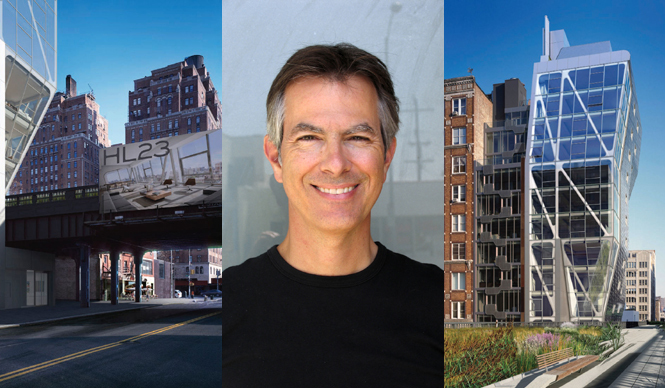
Series | Matthew Waldman | Vol. 16 Architect Neil Denari Interview
An Interview with Matthew Waldman
Vol. 16: Architect Neil Denari (1)
Neil Denari is an architect and principal of Neil M. Denari Architects (NMDA, Inc.), an internationally recognized firm with offices in Los Angeles and New York. He studied at the University of Houston and Harvard University and is currently a visiting professor at UCLA and Harvard University’s Graduate School of Design. He has received numerous awards, including a fellowship from United States Artists Organization in 2009 and the American Academy of Arts and Letters’ Academy Award in 2008. His firm is currently working on a variety of projects, both large and small, in the United States, Eastern Europe, and Asia. Denari is also the author of two best-selling books, Interrupted Projections (TOTO, 1996) and Gyroscopic Horizons (Princeton, 1999). He is currently working on a new book scheduled for publication in 2011.
Text by Matthew Waldman

The Fact That Architecture Transforms Space and Life
MatthewI noticed that most artists and designers are good at talking about the “inspiration” they receive, but not so good at talking about their “motivation.” What is your motivation for what you are doing now and what you will continue to do?
NeilMy own motivation for becoming an architect is, in many ways, strongly related to the era and the place. From the 1960s to the 1970s, the D-FW Metroplex was a region that relied heavily on the development of the military-industrial and sports entertainment industries, and it was one of the most controversial areas in the country due to its large-scale suburban expansion. Watching these developments, I simply felt that the designed world was something that helped shape everything from the anonymous to the spectacular.
Beyond self-satisfaction or personal expression, motivation often intersects with larger social or political ambitions in several ways. Here, the scale of architecture and the unavoidable public discourse become extremely effective means of shaping these motivations. In other words, the basis is for the good, to advance culture, and so on.
Therefore, my past and present motivations are complex, but they also maintain a productive relationship with the fact that architecture, regardless of its actual function or appearance, is something that transforms space and life, and with the individual emotions (pure love for design and the will to express it).
More specifically, my current motivation is to create architecture that functions in conjunction with other media, rather than confronting them. This is because I don’t believe we should simply use architecture as a guardian of “reality” or “space.” On the other hand, digital media currently has a greater impact on defining our daily lives than reality. Architecture is a bit behind in this area in terms of being more useful and relevant.
MatthewIt seems to me that the digital revolution has made the palette for expressing ideas infinite. So, what technologies do you feel are lagging behind?
NeilThe scale of architecture and its inherently manual process create certain problems, especially in relation to the technologies we wish to adopt from other industries. Moving beyond the construction of site-based buildings to more integrated information-sharing systems, and acquiring machinery based on material production even without a site, will be the goal in our field.
To enable this level of prefabrication, larger machinery is needed to meet the scale of architecture. Most of this machinery already exists in the automotive and aerospace industries. However, they are limited to the scale of parts or components of finished cars and airplanes.
While architects’ ambitions are fueled by global market trends, ultra-large machinery for laminating glass, pressing metal, and injection molding (of recycled polymers, etc.) is now being developed in China and other countries.
Even in the current economic situation, which I feel has been similar for the past two years, there is no downturn in our ambitions. It’s just that there are fewer opportunities to explore higher levels of technological integration.
An Interview with Matthew Waldman
Vol. 16: Architect Neil Denari (2)
It Feels Like New York Has Rediscovered Its Design Sensibility
MatthewI was very excited about your project, “High Line,” which covers the city of New York with elevated walkways. In fact, that was the main reason I decided to contact you for this interview. Most of the Chelsea district is already complete. Do you feel that New York is at a turning point towards the future?
NeilI think so. As your question implies, since the 1960s, New York has not experienced anything that has refreshed the city’s identity through architecture. However, in another sense, this has been limited visually and materially. Of course, New York is one of the world’s great cities, but I am convinced that, more than the recent architectural boom, it has become the most obvious embodiment of certain aspects of its current image as a global economic center.
Internally, at least, this city was a more complex place. I vividly remember when I lived in the East Village in the 1980s, the art and music scenes were even more powerful. But on the outside, in the rest of the city, older architectural monuments, such as the Empire State Building and the Chrysler Building, and especially the tragic loss of the World Trade Center (along with the Citicorp Tower, New York’s most beautiful design from the early 1970s), had to symbolize New York’s architectural identity.
For decades, this city has not seen the invention of museum architecture, new housing typologies, or new forms of public space. That is probably why the “High Line” was welcomed as a new architectural development in the Chelsea district. Like many other outstanding projects, such as private offices and condominiums in the neighborhood, I am convinced that the public nature of the “High Line” has been added as an extension of the public realm to buildings like our “HL23.”
I have called this building, “HL23,” a public project because it is spatially and materially more deeply related to the “High Line.” Some might say that these buildings represent the peak of the architectural boom era. Not as a peak of architectural thought, but as a symbol of international wealth and misguided prosperity. The economy has now sunk to epic lows, but beyond who funded the companies, no one can discount the results of this work as architectural experimentation.
So, it is. I feel that New York has rediscovered its design sensibility beyond utilitarian elements. And it seems to be shifting towards perception, becoming more attractive to people, and perhaps even more argumentative.
MatthewI understand. It’s very difficult to resist asking this question, but as an architect based in Los Angeles, there’s a rivalry between NY and LA. How do you see the relationship between NY and LA?
NeilWell, I lived in New York for five years before moving to Los Angeles, and I always felt I paid little attention to green spaces or the superiority of one city over another. Of course, LA is where I live, and I actually chose to move there because I wanted the environment I lived in to physically influence my thinking.
But NY has always been the standard of my experience. For over 22 years, at many parties, events, and in many cities, I have had conversations about NY versus LA. While there were occasional debates, conflicting impeachment speeches, and humble comments, they were mostly the result of exploring the unique characteristics of each city.
Personally, I think the East Coast-West Coast rivalry and the claims of superiority of each city are fading now. This may be evidenced by the fact that significant projects completed by Frank Gehry, Thom Mayne, and myself exist in NY, and these projects are welcomed by many New Yorkers. And it seems there is more cross-pollination of people, knowledge, and energy than ever before.
Perhaps the most enduring division, both now and in the future, will always be about the shape of the city (horizontal and diffuse vs. compact and footprint-oriented). Or factors like walking vs. driving, human interfaces vs. mechanical interfaces, and so on. Believe me, in fact, I think New York is more logical than Los Angeles in terms of sustainable urban structure. I don’t drive my car much, and I commute to the office or UCLA by Vespa.
Nevertheless, Los Angeles is American, and as such, it is a place where one can study to understand how general North American cities can change for the better. There is no better study than living here for that purpose.
An Interview with Matthew Waldman
Vol. 16: Architect Neil Denari (3)
The Scale of the Russian Public Housing Project is Exciting
MatthewI feel it is unfortunate that some of your ambitious projects have not been realized. Does this trouble you in any way?
NeilI can say “yes” and “no” to this question. In terms of the feeling of wanting to influence the environment in a material way, which I touched upon in the question about motivation, I would say “yes.” It is extremely troublesome to face the fact that many ideas remain unrealized.
However, if you ask me if it troubles me more than it should, I would say “no.” Because I am constantly disappointed (laughs). Whether the architecture is actually built or not, the next project is always the best – that is professional work. This is not just a cheerful, optimistic mantra. It is the truth.
The evolution of thought, where things can be verified virtually, is in many ways no different from realization. In this regard, books will become even more important. I want to realize as much architecture as possible. But this is not out of a desire to build something. I believe that NMDA’s work reflects a certain ethic in this regard.
MatthewHave you seen the movie Inception? If so, what did you think of it?
NeilI’m sorry, I haven’t seen it yet.
MatthewWhat projects are you most excited about right now?
NeilWe are working on a public housing project in Pushkin, about 20 km south of St. Petersburg, Russia. It will accommodate 45,000 residents and involves building a large number of apartments on a vacant site all at once. It’s a truly suburban, instant city with four-story apartment buildings and plenty of parking for people commuting to the city by highway. The scale of this is very appealing because this type of project simply doesn’t exist in the United States. However, we will incorporate our understanding of housing, automobiles, and terrain into specific cultures and climates.
MatthewPlease freely associate about “Tokyo.”
NeilVisually chaotic. Infrastructurally precise
Melancholy
Tall foreigners
Yasujiro Ozu
Anywhere, anytime
Central void (Imperial Palace)
Uniforms
Robotics
Workplace away from home
Quest for excellent tonkatsu
MatthewThank you very much.
