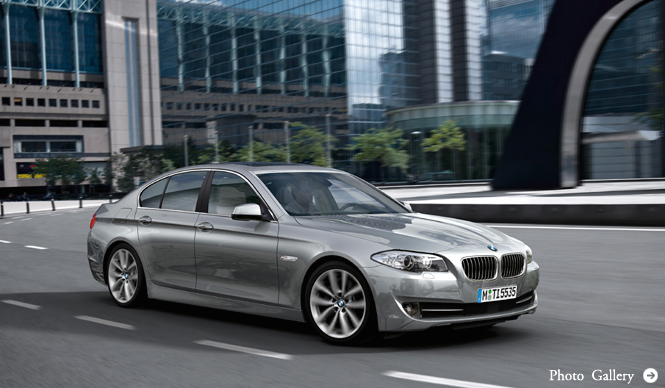
BMW 5 Series: Inheriting a Sporty DNA While Enhancing Environmental Performance
BMW 5 Series
Inheriting a Sporty DNA While Enhancing Environmental Performance
The BMW 5 Series undergoes a full model change. It will be released in Japan starting April 2010, handled by BMW Japan Corp. One of its key features is a reported approximately 40 percent improvement in fuel efficiency compared to its predecessor.
Text by Fumio OgawaPhotos by BMW
Three Model Lineups
The sixth-generation new 5 Series will be introduced to the Japanese market in three variants: the BMW 528i (¥7.15 million) equipped with a 3-liter inline-six engine, the BMW 535i (¥8.35 million) with the same engine enhanced by a turbocharger, and the BMW 550i (¥10.4 million) featuring a V8 twin-turbo engine. Compared to the previous model, it achieves equivalent power while reducing displacement, a testament to the efficiency improvements designed to meet modern demands for environmental consciousness.
BMW collectively refers to its unique combination of technologies for environmental performance as 'Efficient Dynamics.' In essence, it's technology aimed at achieving higher performance with less energy. For the new 5 Series, this includes an 8-speed automatic transmission that enhances power transfer efficiency through more gear ratios, direct injection for improved combustion efficiency, BMW TwinPower Turbo technology for high power output with reduced displacement, weight reduction contributing to better fuel economy, and a brake energy regeneration system that contributes to a smaller battery.
The characteristic feature is achieving high performance and low fuel consumption through forced induction, realizing power equivalent to larger displacement engines of the past with a smaller displacement. The 3-liter inline-six engine in the BMW 535i (¥8.35 million) also achieves high output and low fuel consumption through a turbocharger and direct fuel injection system. Its output is equivalent to the previous generation's 4-liter V8 in the 540i. Meanwhile, the BMW 550i (¥10.4 million), positioned at the top of the lineup, features a 4.4-liter V8 with twin turbochargers, producing 407ps and a substantial 61.2kgm of torque between 1750 and 4500rpm. Combined with a direct fuel injection system, it successfully achieves efficient high performance.
A Slightly Larger Body
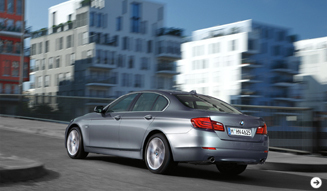
The exterior dimensions of the new 5 Series are 4,910mm (length) x 1,860mm (width) x 1,475mm (height), representing an increase of 55mm in length and 15mm in width compared to the previous model. The wheelbase has been extended by 60mm to 2,970mm. The tire size is 17 inches for the 528i, while 18-inch wheels are standard on the other models.
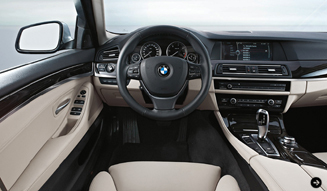
The new 5 Series also inherits the sporty handling DNA from its predecessor. The adoption of the 'Central Theme,' where the cockpit fascia is angled 7 degrees towards the driver, is also a skillful touch.
In terms of technology, it features Active Steering, which provides steering angles to both the front and rear wheels, making parallel parking easier at low speeds while enhancing agility on winding roads by appropriately controlling the steering angle based on speed. It also includes Active Drive to control body roll, and Dynamic Damping Control, which aims to provide an optimal ride for occupants whether driving on winding roads or uneven surfaces. Furthermore, Dynamic Driving Control allows drivers to switch between three modes—engine response, shift timing, and steering power assistance—via a button in the cabin.

BMW 528i
Body | Length 4,910 x Width 1,860 x Height 1,475mm Wheelbase 2,970mm
Engine | 2,996cc Inline-six DOHC
Max Output | 190kW [258ps] / 6,600rpm
Max Torque | 310Nm [31.6kgm] / 2,600-3,000rpm
Drivetrain | Rear-wheel drive
Transmission | 8-speed AT
Tires | 225/55R17
Price | ¥7.15 million
BMW 535i
Body | Length 4,910 x Width 1,860 x Height 1,475mm Wheelbase 2,970mm
Vehicle Weight | 1,820kg
Engine | 2,996cc Inline-six DOHC + Turbocharger
Max Output | 225kW [306ps] / 5,800rpm
Max Torque | 400Nm [40.8kgm] / 1,200-5,000rpm
Drivetrain | Rear-wheel drive
Transmission | 8-speed AT
Tires | 245/45R18
Price | ¥8.35 million
BMW 550i
Body | Length 4,910 x Width 1,860 x Height 1,475mm Wheelbase 2,970mm
Engine | 4,394cc V8 DOHC + Twin Turbocharger
Max Output | 300kW [407ps] / 5,500rpm
Max Torque | 600Nm [61.2kgm] / 1,750-4,500rpm
Drivetrain | Rear-wheel drive
Transmission | 8-speed AT
Tires | Front: 245/45R18 Rear: 275/40R18
Price | ¥10.4 million
BRAND HISTORY
BMW's distinctive front mask, characterized by its "kidney grille" and quad round headlights, makes it instantly recognizable. While consistently popular in the Japanese imported car market, surprisingly few people can immediately explain what its name signifies.
Bayerische Motoren Werke. Literally translated, it means "Bavarian Motor Works." Its predecessor, Rapp Motorenwerke, was an aircraft engine manufacturer founded in 1913 in Bavaria, Germany, by Karl Friedrich Rapp. Rapp partnered with fellow Bavarian aircraft manufacturer Otto Flugmaschinenbau to achieve business success. In 1916, it was renamed Bayerische Motoren Werke GmbH. Two years later, it reorganized into a stock corporation and registered its propeller logo, inspired by Bavaria's blue skies and white clouds.
BMW continued to enhance its presence through innovative technology. However, following Germany's defeat in World War I, BMW was forced to cease aircraft engine production. Consequently, BMW channeled its expertise into motorcycles, gaining attention with the launch of the shaft-driven "BMW R32" in 1923. Not content with this, they acquired Dixi, a company licensed to produce the Austin Seven. This acquisition provided a foothold in the automotive business, and in 1929, BMW launched the "BMW 3/15 PS," marking the start of its history as an automobile manufacturer.
Incidentally, the Otto company, which had a close relationship with BMW, was founded by Gustav Otto, the son of Nikolaus August Otto, who established the theory of the internal combustion engine. This historical connection might explain BMW's continued focus on internal combustion engines.