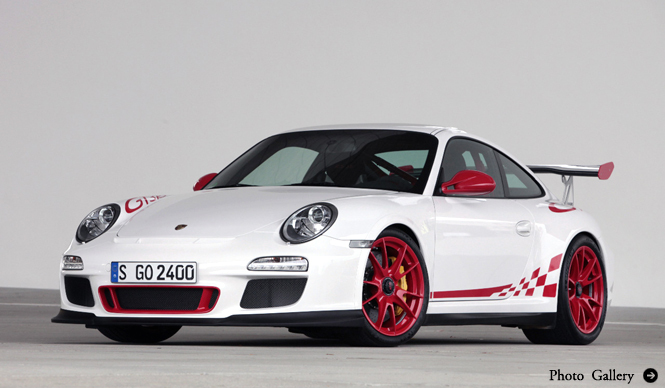
PORSCHE 911 GT3 R | The Main Stage is the Racetrack
PORSCHE 911GT3 R
The Racetrack is the Main Stage
Porsche officially unveiled the racing version of the 911, the "911 GT3 R," at the "Autosport International" racing car show held in Birmingham, UK.
Text by Giraffe
Aggressive Adoption of High-Tech Features
This "911 GT3 R" is a model that further enhances the performance of the "911 GT3 Cup," the one-make race specification of the 911 that debuted in September 2009. It is powered by a 4-liter flat-six engine with an increased displacement of 200cc, delivering 30 ps more than the GT3 Cup. This engine is paired with a 6-speed sequential dog-type transmission.
The biggest difference between this "911 GT3 R" and last season's machine, the "GT3 Cup S," is said to be in drivability and handling. Indeed, high-tech features such as ABS, traction control, and electronic throttle control have been aggressively introduced.
The suspension utilizes Sachs adjustable coilovers on both the front and rear, and the rear suspension is fixed to a subframe, reportedly further enhancing rigidity.
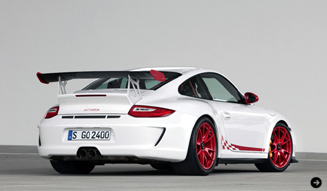
Price from €279,000 (approx. ¥36.45 million)
Visually, the car's wider track is achieved by flaring the front and rear fenders. Evolutions from the previous model are also evident in the adoption of LED taillights and the inclusion of a diffuser and an adjustable large rear wing.
Another significant feature of this new model is its reduced weight of 1200 kg, achieved through the use of materials like carbon and Kevlar.
As the "911 GT3 R" complies with the FIA's GT3 regulations for international competition, it is possible to race it in its current configuration. Production is carried out by hand at Porsche's motorsport development center in Weissach. Prices start from €279,000 (approx. ¥36.45 million), but the 2010 models are reportedly almost sold out.
BRAND HISTORY
PORSCHE, a leading German sports car brand, commands overwhelming support from skilled drivers worldwide. Its origins trace back to 1931. Ferdinand Porsche, a prodigy who distinguished himself as an automotive engineer in his twenties, established "Porsche Design Studio" in Stuttgart, Germany, after a tenure as technical director at Daimler, to embark on his independent venture. From then on, he was entrusted with the development of various vehicles by automobile manufacturers. Among these, the "Volkswagen Beetle," which significantly contributed to motorization as Germany's "people's car," is particularly famous.
The first car to bear his name as a manufacturer was the "356," which appeared in 1948. Since then, Porsche has introduced sports cars such as the "911," "924," and "928" to the world, while also focusing on motorsport. For instance, they achieved 16 victories in the 24 Hours of Le Mans, arguably the world's most grueling race, and contributed to three series championships as an engine supplier in Formula 1, marking a brilliant track record. It goes without saying that their technological prowess and dedication to driving performance continue to live on in their products today.
Currently, the "911," which has maintained its reputation as a top-tier sports car even 45 years after its debut, along with the open-top sports car "Boxster," its coupe counterpart the "Cayman," and the premium sports SUV "Cayenne," all boast immense popularity.