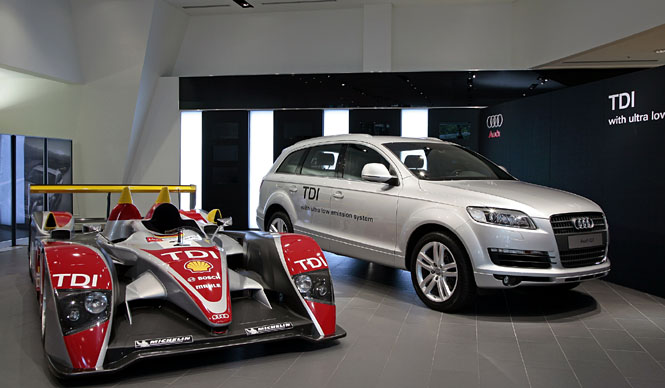
The Truth About Clean Diesel (Part 2): The Near Future of Diesel
The Truth About Clean Diesel (Part 2)
The Near Future of Diesel
Diesel regulations are becoming stricter worldwide year by year. In Japan, in particular, they were considered the most difficult to clear, but this year, major automakers have overcome them with their latest diesel models. Following suit, various manufacturers are now stepping forward. Behind this progress are remarkably advanced technologies and national environmental policies.
By Masayuki Moriguchi
BLUETEC is Daimler AG's (Mercedes-Benz) technology for reducing NOx in diesel engines.
It is already in practical use in countries like the United States.
It is said to comply with the strict regulations of various countries, and its use in hybrid systems combined with electric motors is also planned for the future.
What is "Clean Diesel"?
Clean Diesel. Do you know what this term, which you hear so often lately, means? Many people might answer that it refers to diesel cars that emit almost no harmful substances like NOx and PM, with clean exhaust gases. Of course, that is also correct. However, in Japan, this term has recently come to carry an additional meaning.
Clean Diesel
Clean Diesel. Do you know what this term, which you hear so often lately, means? Many people might answer that it refers to diesel cars that emit almost no harmful substances like NOx and PM, with clean exhaust gases. Of course, that is also correct. However, in Japan, this term has recently come to carry an additional meaning.
"New Short-term," "New Long-term," "Post New Long-term." When you look into the latest diesel engines, you'll come across these terms. They all refer to exhaust gas regulations: New Short-term for the 2002 regulations, New Long-term for 2005, and Post New Long-term for 2009.
The government decided to call vehicles that comply with the Post New Long-term regulations "Clean Diesel" and to offer subsidies and tax incentives. This signifies the nation's recognition of diesel as an eco-friendly option.
Strict Japanese Regulations
Japan's diesel vehicle regulations are stringent. For instance, compared to the Euro 5 regulations implemented in Europe this year, the New Long-term regulations enacted three years ago have stricter limits for PM. However, for other emissions like CO, HC, and NOx, the New Long-term regulations set a higher bar. With the Post New Long-term regulations, the PM limits are aligned with Euro 5, while the NOx levels are further tightened.
Diesel engines have cleared regulations by successively introducing new technologies such as common rail direct injection, variable geometry turbochargers, and particulate filters. However, initially, many opinions suggested that meeting the NOx regulations of the Post New Long-term standards would be "simply impossible." Yet, advancements in technology have made even the impossible achievable.
Nissan announced the "X-Trail" SUV this year, which complies with these regulations. Among imported cars, Audi announced in 2010 its intention to launch the "Q7" equipped with a clean diesel engine. Meanwhile, Mitsubishi announced a New Long-term compliant "Pajero" in October and plans to develop a Post New Long-term compliant model within two years. Honda's "Accord" is scheduled for debut next year. Mercedes-Benz, which currently sells New Long-term compliant vehicles, is also considering the launch of the "M-Class" that meets Post New Long-term standards.
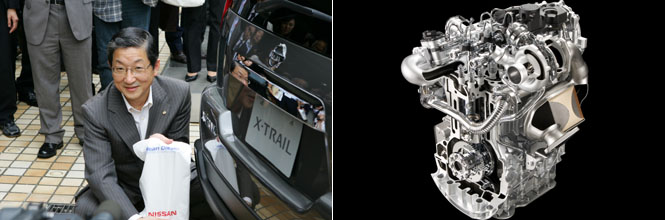
Left: The "X-Trail" diesel, the first model to comply with Japan's "Post New Long-term Regulations." Nissan Motor Co., Ltd. COO Toshiyuki Shiga demonstrated the absence of exhaust gas by holding a towel to the exhaust pipe.
Right: The "M9R" 2-liter diesel unit installed in the X-Trail. The vehicle boasts a fuel efficiency of 15.2 km per liter, torque comparable to a 3.5-liter V6 gasoline engine, and quiet operation.
The Breakthrough: "AdBlue" and "NOx Trap"
Two new technologies were behind the achievement of clearing the Post New Long-term regulations, which were initially deemed impossible. One is "AdBlue." AdBlue is the name for an aqueous urea solution. By injecting this solution just before the NOx catalyst, it decomposes NOx within the catalyst into nitrogen (N2) and water (H2O).
The other is the "NOx Trap." This technology uses a trap catalyst that temporarily adsorbs NOx. By momentarily performing a rich fuel burn, it causes the exhaust gas components to combine with NOx, producing nitrogen, carbon dioxide, and water.
Clean diesel vehicles use one of these two methods. Interestingly, German manufacturers like Audi and Mercedes-Benz clearly favor the AdBlue system, while domestic Japanese manufacturers predominantly use the NOx trap system. However, even among Japanese manufacturers, commercial vehicles are already equipped with AdBlue-based trucks available on the market.
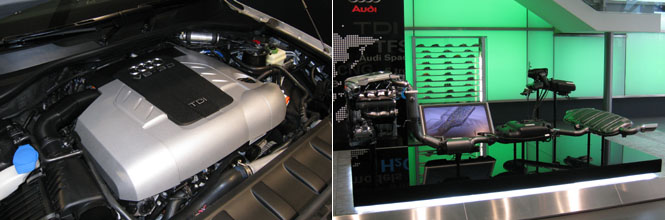
Left: The "Audi Q7," scheduled for launch in 2010 with next-generation diesel technology, also utilizes AdBlue technology.
Right: Exhaust gases from the engine shown on the left are purified through various catalysts and AdBlue. It has the capacity to remove up to 90% of nitrogen oxides (NOx).
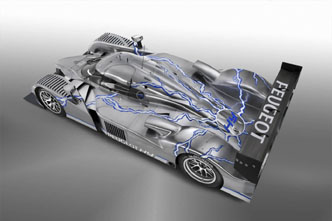
Peugeot's racing car "908 HY," which combines a diesel engine with an electric motor.
The development of "diesel hybrids" is also progressing.
The development of "diesel hybrids" is also progressing.
Not Just Eco-Friendly, But Also Fun
Another notable observation among the clean diesel vehicles currently on sale or planned for release is that, with the exception of the Accord, they are all SUVs.
This is because the diesel engine's characteristic of producing high torque at low RPMs is well-suited for powering heavy SUVs. In fact, the proportion of diesel vehicles is higher among SUVs than sedans or wagons in Europe. Furthermore, in Japan, many diesel SUVs were previously sold, making it easier for users to accept them without feeling out of place.
Whether this trend will expand to other body types and vehicle classes in the future depends entirely on user response. Personally, I remain optimistic about the future of diesel.
Clean diesel is different from the diesels of the past. They are quiet, produce no black smoke, have no odor, offer excellent fuel efficiency, and are environmentally friendly. Moreover, the acceleration, with its strong pull from low RPMs, provides a driving pleasure distinct from gasoline cars. They are not just eco-friendly, but also fun.