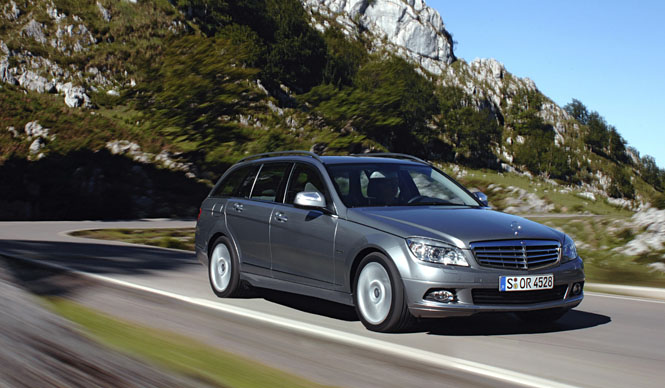
Mercedes-Benz C-Class Wagon: Part 2 of 20 – "Defining the True Station Wagon"
The 20th Mercedes-Benz C-Class Station Wagon (Part 2)
Questioning the True Station Wagon
The wagon boom of the early 1990s was relegated to history with the rise of minivans after the bubble burst. And now, it's 2008.Mercedes-BenzWe took the new C-Class Station Wagon for a spin, and once again pondered the very essence of the station wagon.
By Yasushi ShitanoPhoto by Mercedes Benz
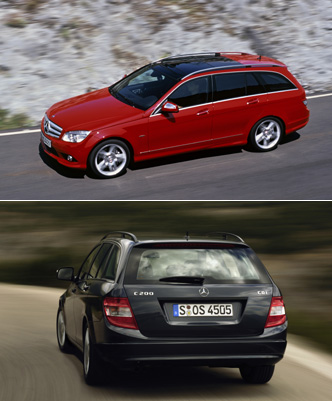
Agile handling comparable to the sedanDriving the "C200 Kompressor Avantgarde" with its 1.8-liter engine paired with a supercharger was a truly pleasant experience.
What impressed me most was the handling; in that regard, it was completely on par with the sedan, which debuted with agility as its selling point.
Naturally, a wagon with an extended roofline weighs more than its sedan counterpart. The C-Class is 60kg heavier in the same trim level – about the weight of one adult. The suspension is also tuned to be firmer than the sedan's to accommodate cargo.
Nevertheless, it's remarkable that it maintains the same agile handling as the sedan. The ride quality also felt smoother and more comfortable than the "Avantgarde" and "Elegance" sedans I'd driven previously.
The New C-Class as a Wagon
But what exactly defines a "true" station wagon? While both the Volkswagen Golf-like hatchback and the station wagon share a "five-door" body structure with four passenger doors and a rear tailgate for luggage, what's the difference?
It comes down to whether there's a "threshold" at the lip of the cargo area. A station wagon does not have one. When you open the tailgate, a flat cargo space unfolds.
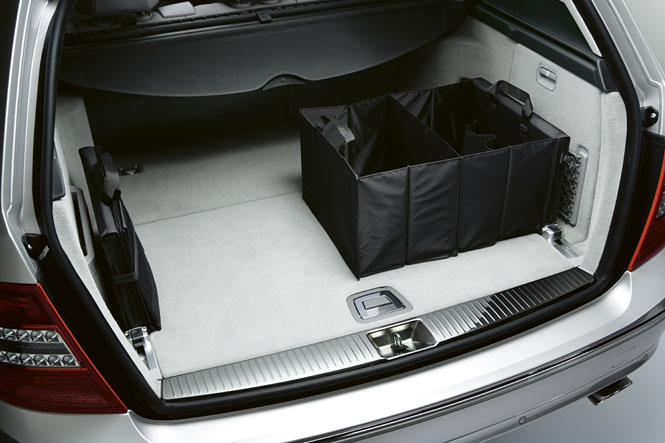
Furthermore, a true station wagon must have a low cargo floor height. With large SUVs like the Range Rover, even without a threshold at the entrance, the floor is inherently high, making it a strain to load and unload bulky, heavy items alone. Of course, the Range Rover does have a "load mode" that lowers the air suspension with the push of a button.
Considering body rigidity, a threshold is preferable. Conversely, it's difficult to ensure structural integrity for a station wagon where the entire rear of the body opens up.
Creating a low cargo floor is also challenging, especially for FR (front-engine, rear-drive) vehicles where the propeller shaft runs beneath the floor. Honda, for instance, heavily promotes its "low-floor platform" even for its FF minivans.
In these respects too, the new C-Class wagon is truly impressive. Mercedes has mastered the art of wagon making. Measured at the cargo opening, the floor height is 57 centimeters – about knee-high for a tall person.
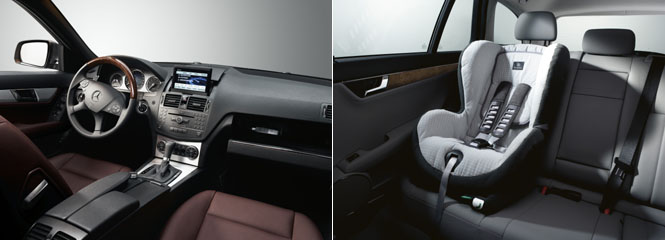
Welcoming You with Open Arms
But why this particular obsession with such details? Just recently, I had to transport a Fender Rhodes electric piano, an instrument that once dominated the 1970s rock scene.
Mine is the smallest 73-key "suitcase" model, but being a weighted-key instrument, it's annoyingly heavy compared to modern digital pianos. Two adults had to hoist it up to the high threshold of a Japanese hatchback, and with the fear of throwing out our backs, we awkwardly managed to place it on the cargo floor.
I truly wished for a new C-Class wagon that would welcome my luggage as if offering a respectful bow.
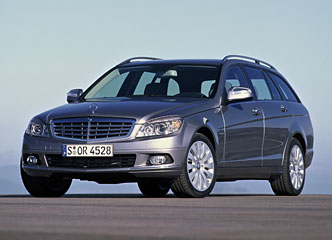
Vehicle Overview | Mercedes-Benz C-Class
Station Wagon
The "C-Class" comprises Mercedes-Benz's compact sedan, wagon, and coupe lineup. The third-generation current model debuted in Japan in June 2007 as a sedan. The "C-Class Station Wagon" introduced here was added to the lineup about 10 months later.
With dimensions of 4600mm in length, 1770mm in width, and 1460mm in height, its maneuverability is a key strength. Naturally, usability as a wagon has also been considered, with a trunk capacity of 450 liters, expandable to 1465 liters by folding down the rear seats.
The wagon body alone offers a rich variety of trims, starting with the "C200 Kompressor Station Wagon" featuring a 1.8-liter inline-4 with a supercharger, followed by the higher-grade "C200 Kompressor Elegance," its sporty "C200 Kompressor Avantgarde," and the 2.5-liter V6-powered "C250 Station Wagon Elegance" and sporty "C250 Station Wagon Avantgarde."
Topping the range is the high-performance "C63 AMG Station Wagon," developed by AMG, which packs a 6.2-liter V8 engine producing 457 horsepower into its compact body. Prices range widely from 4.53 million to 10.5 million yen, indicating its appeal to a broad customer base.
http://www.mercedes-benz.co.jp/