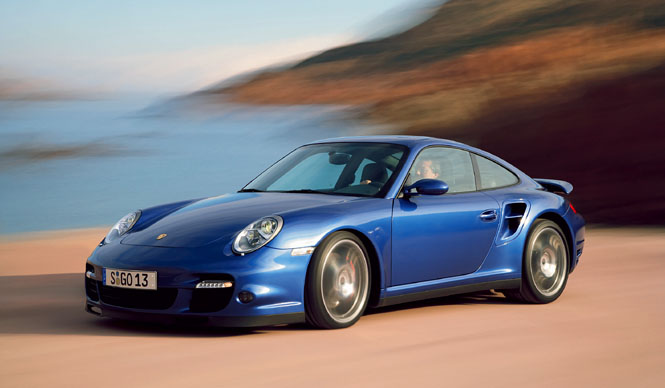
Porsche | Porsche 911 Turbo | Part 15 (First Half) | "The True Essence of the Porsche Turbo"
The 15th Porsche 911 Turbo (Part 1)
The Quintessence of the Porsche Turbo
When you think of sports cars,Porsche, of course. And when you think of Porsche, you think of the "911."
The model that reigns at its pinnacle is the "911 Turbo."
Faced with the latest high-performance car, boasting a 0-100 km/h acceleration of 3.7 seconds, my thoughts flashed back 30 years.
By Yasushi ShimonoPhoto by Porsche
Porsches of the Past Were Nothing Like Today's
When it comes to the "Porsche 911," and especially the "Turbo" variant, one simply must begin with tales of the past. For those of the supercar generation, "Porsche Turbo" surely evokes a particularly nostalgic resonance. This refers to the high-end 911 of the late 1970s, the "930 Turbo."
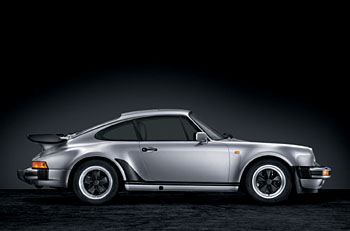
The 911 Turbo, known as the "Type 930" (model year shown is 1977)
Back when Tokyo Channel 12's "Taiketsu! Supercar Quiz" (Confrontation! Supercar Quiz) was immensely popular among elementary and junior high school students, I, already a university student, had the chance to touch a new 930 Turbo shortly after joining an automotive magazine's editorial department. I truly only touched it.
The air-cooled flat-six, a 3.3-liter turbo, produced 300 ps. In today's Japan, this might not seem like an output worth shouting about, but back then, still reeling from the oil shock, the most powerful "Skyline" produced a mere 130 ps.
Furthermore, this was an ultra-powerful 911 with the engine mounted at the rear – the "wrong end" (note) – and naturally, in an era before any thought had been given to drive control systems to prevent spins.
Even veteran senior editors, after just a short drive on the mountain roads of Hakone, would get out of the car exclaiming, "Terrifying!" repeatedly. There was no way a fresh-faced rookie reporter like myself would be permitted to take the wheel. Porsches of the past were nothing like today's. The 930 Turbo was the embodiment of that.
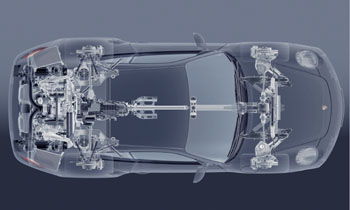
The 911 Turbo, with its engine mounted at the rear of the body (left in the diagram).
The drivetrain is not RR; the current Type 997 is all-wheel drive.
(Note) wrong end
Literally translated as "incorrect end," this term describes the disadvantages of the RR (Rear Engine, Rear Drive) layout, where the weight of components like the engine concentrates towards the rear of the vehicle.
This generally leads to a tendency towards oversteer (the rear of the vehicle swinging out), which can compromise handling stability.
Conversely, the significant weight over the drive wheels can also be an advantage, contributing to nimble handling. The RR layout also has merits, such as the sound source (engine) being behind the driver.
911's "930," "996," "997"
Thirty years have passed, and today's 911 Turbo is a car that even a novice driver with a fresh license can handle.
You might be told that this is a rather anticlimactic way to introduce it, but I believe this very aspect is the true essence of the latest Porsche Turbo, which evolved through the water-cooled first generation "996" to the second generation "997."
By the way, these numbers like "930," "996," and "997" are development codes that identify the generations of the 911.
Since they are three-digit numbers starting with 9, it can be a bit confusing with the 911, but since Porsche itself names them, there's nothing to be done about it.
From those who casually ask, "Does Porsche make anything other than the 911?!" to enthusiasts who naturally refer to them by their development codes, the 911's depth appeals to an incredibly wide range of fans. If you stop calling it a 911, one could say a 911 fan has truly fallen ill.
The 16th Porsche 911 Turbo (Part 2)
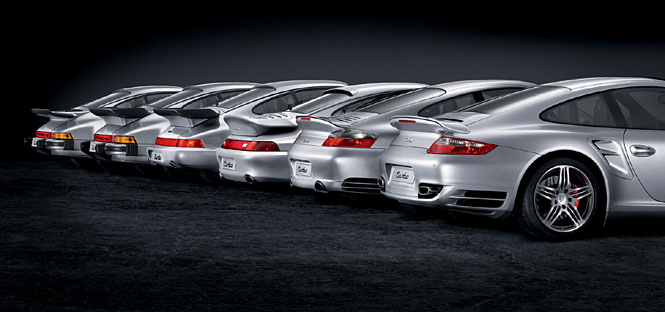
The current Type 997 marks the sixth generation.