The 'Seven 160' Debuts in Japan, Built to Kei Car Standards | Caterham
Caterham Seven 160 | Caterham Seven 160
Equipped with a Suzuki 660cc 3-cylinder turbo engine
Seven 160 makes domestic debut under Kei car regulations
Caterham held a press conference in Tokyo at the British Embassy for the "Seven 160," an entry-level model equipped with a Suzuki 660cc 3-cylinder turbo engine.
Text by OTANI Tatsuya
Weighing in at just 490kg (!)
Caterham's "Seven" is a road car that traces its roots back to the "Super Seven" launched by Lotus in 1957. When Lotus decided to discontinue the Super Seven in 1973, Englishman Graham Nearn, who had been handling Lotus car sales, acquired the manufacturing rights and has been selling it under the Caterham name ever since.
This year marks its 57th anniversary, and perhaps the only other "active sports car" with a similarly long history is the Morgan "4/4," born in 1936.
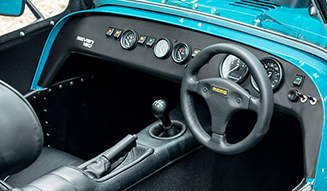
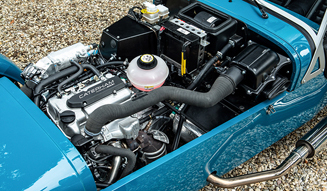
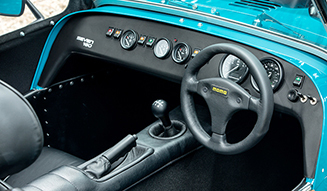
The Lotus DNA of being lightweight, simple, and prioritizing balanced handling over engine power is surely passed down to the modern Seven. Indeed, with the arrival of the Seven 160, the spirit of its debut feels more clearly and intensely revived.
At its core is the aforementioned Suzuki 660cc turbo engine. The Seven 160 uses a generation older K06A as its base, rather than Suzuki's latest R06A unit. However, the K06A's shorter stroke might be more favorably received by sports car enthusiasts than the R06A's longer stroke.
With Caterham's tuning, this engine produces 80ps at 5,500rpm and 107Nm at 3,400rpm. It propels the body, weighing a mere 490kg (!), from 0-100km/h in 6.9 seconds and reaches a top speed of 160km/h.
Caterham Seven 160 | Caterham Seven 160
Equipped with a Suzuki 660cc 3-cylinder turbo engine
Seven 160 makes domestic debut under Kei car regulations (2)
A car that makes you feel "this is a car"
What seems to have greatly contributed to achieving this lightweight body is the car's uncompromisingly simple construction.
While the Seven had gradually gained weight with increased engine power and cornering speeds, this time, combined with engine downsizing, the mechanics have also been simplified. The rear suspension, which had previously employed De Dion axles and independent suspension, has been reverted to a simple rigid axle.
However, all Super Sevens produced by Lotus between 1957 and 1973 used a rigid axle, so this Seven 160 can be said to have returned to its origins.
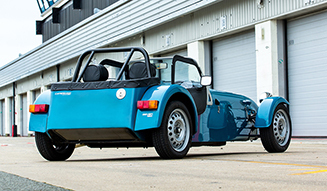
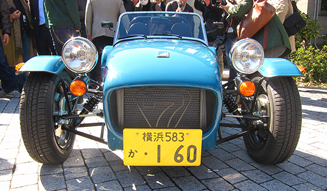
Another notable aspect of the Seven 160 is that it can be registered as a Kei car in Japan. While this might seem obvious given its displacement of 660cc or less, Caterham specifically manufactured narrower rear fenders for the Seven 160, keeping its overall width at 1,470mm to enable Kei car registration.
To be precise, the Seven 160 announced this time is a re-release with an updated model name and price, featuring an increased maximum output from 64ps to 80ps (as in the UK model), which was released on December 1, 2013, as the "Seven 130."
The base price is 3.65 million yen (excluding tax). While exceptionally expensive for a Kei car, Caterham F1 driver Kamui Kobayashi, who attended the announcement, commented, "Unlike modern cars controlled by electronics, this Caterham has almost nothing, so you can drift it hilariously. There aren't many cars like that now, are there? It's a car that really makes you feel 'this is a car.'" His words suggest high expectations.

Caterham Seven 160
Body Dimensions | Length 3,100 x Width 1,470 x Height 1,090 mm
Wheelbase | 2,225 mm
Tread Front/Rear | 1,220 / 1,301 mm
Minimum Ground Clearance | 100 mm
Weight | 490 kg
Engine | 658 cc Inline 3-cylinder DOHC Turbo
Bore x Stroke | 68 x 60.4 mm
Max. Output | 58.8 kW (80 ps) / 5500 rpm
Max. Torque | 107 Nm / (10.9kgm) / 3400 rpm
Transmission | 5-speed MT
Drivetrain | FR
Suspension Front | Double Wishbone
Suspension Rear | Rigid Axle
Tires | 155/65R14
Brakes Front | Solid Disc
Brakes Rear | Drum Brakes
Top Speed | 160 km
0-100km Acceleration | 6.9 Seconds
Price | 3.65 Million Yen
Caterham Cars Japan
Tel. 03-5754-2227