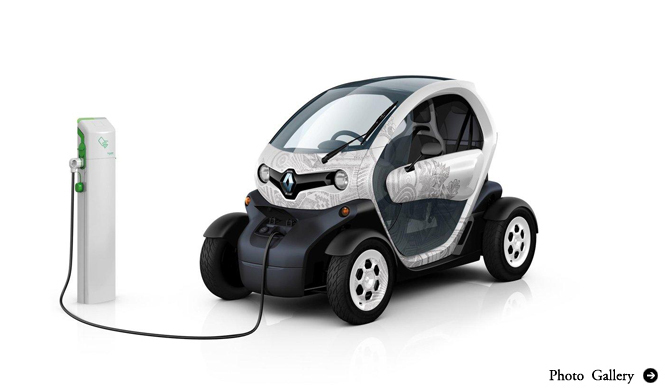
Renault Twizy | Introducing the Renault Twizy
RENAULT TWIZY
Renault's First Mass-Produced EV: Ultra-Compact!
At the Paris Motor Show, Renault unveiled the production version of the Twizy, an ultra-compact city commuter EV.
Text by Giraffe
Unique Playfulness Meets Solid Driving Performance
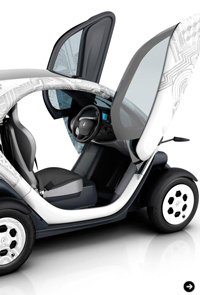
This model is the production version of the Twizy Z.E. Concept, which was exhibited at the 2009 Frankfurt Motor Show. Its styling largely adopts the design of the concept car. Unique features are found throughout, such as the hexagonal cabin, cycle fenders, and side doors that hinge upwards for entry and exit.
The body dimensions are compact: 2,320mm long, 1,191mm wide, and 1,461mm high, with a wheelbase of 1,684mm. The tandem seating for two is also unique.
The EV powertrain produces a maximum output of 20ps and a maximum torque of 5.8kgm. While these figures might suggest insufficient power, they are more than adequate for this 450kg model. The top speed is 75km/h, and it can travel up to 100km on a single charge with zero emissions. Charging takes 3 to 4 hours using a standard 220V household outlet.
The Twizy is scheduled to go on sale in Europe by the end of 2011. Although pricing has not been announced, Renault has stated that it will be "released at a price comparable to a three-wheeled scooter."
This can be seen as Renault's proposal for a new way to enjoy cars, a feat made possible by a brand that consistently aims for the near future through innovative styling, continuously attracting consumers.
BRAND HISTORY
A French passenger car manufacturer established in 1898. Founded by Louis Renault, the state acquired its shares after World War II, making it a quasi-state-owned enterprise. Nevertheless, to survive in the global market, it has developed numerous appealing models and actively participated in F1 and the World Rally Championship. It was fully privatized in 1996.
Renault is a full-line manufacturer, producing everything from small cars to large sedans, but it has always kept originality in mind when developing its products.
The 4 (Quatre), released in 1961, featured a hatchback that opened from the bumper level. The 16 in 1965 used an elaborate mechanism called a crossflow engine and provided a sliding mechanism for the rear seats. The 5 (Cinq) in 1972 had a straightforward concept as a two-door hatchback.
In recent years, the Espace (1984), a pioneer of minivans, garnered attention for its innovative concept. Furthermore, the Scénic (1997), a compact minivan with three independently sliding second-row seats, became a major hit in Europe. The small car Twingo (1993) also featured a sliding mechanism for its rear seats, allowing for either cargo space or seating for four, a concept praised by automakers worldwide.
Concurrently, Renault also produced bold models like the 5 Turbo, which sacrificed the rear seats of the 5 and installed a 1.4-liter turbo engine. In many respects, the originality of its ideas and the boldness of its management in realizing them have helped differentiate it from other manufacturers.
As a full-line manufacturer, Renault has produced vehicles ranging from practical cars for rural use to official cars for the president. Its forte lies in mass-market cars; since the 1970s, it has produced numerous front-wheel-drive hatchback cars, keeping an eye on competitors like the Volkswagen Golf. While generally featuring a soft suspension with considerable body roll, they excelled in cornering performance and offered ample luggage capacity, which was characteristic of Renault.
As mentioned with the 5 Turbo, Renault is also adept at creating sporty variants. The company acquired the racing car manufacturer Gordini, which had a distinguished racing history before the war, in 1968, and the rally-active Alpine in 1973, subsequently releasing numerous sporty models. Recently, cars such as the Clio (Lutecia in Japan) RS and Twingo RS, bearing the sub-name "RS" (meaning Renault Sport), have been highly acclaimed. Regardless of prestige, Renault excels at building cars that are enjoyable to drive.
In 1999, Renault acquired shares in the struggling Nissan Motor Corporation. Under the leadership of Carlos Ghosn, both companies have actively pursued technological cooperation and chassis sharing. Due to frequent and significant changes in exterior design themes, Renault remains somewhat unique among European car manufacturers for its less clearly defined brand image.
(Updated August 2010)