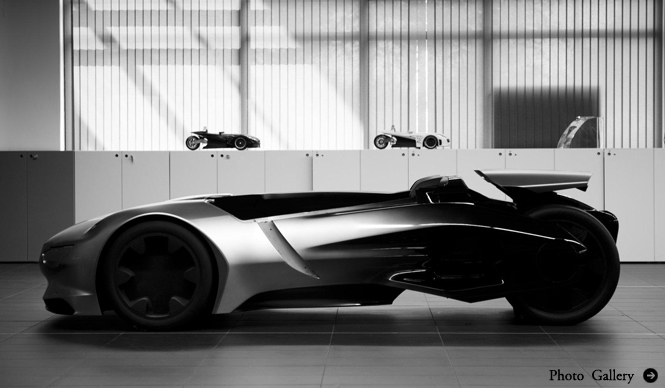
Peugeot EX1: Finally Revealed
Peugeot EX1
Peugeot's EV to Celebrate its 200th Anniversary
The Peugeot EX1, a concept car for which only teaser images were previously released, is finally unveiled. It was revealed at the Paris Motor Show.
Text by Giraffe
Updates FIA EV Acceleration Records! Maximum Output 340ps
The Peugeot EX1 was developed as a concept car to celebrate Peugeot's 200th anniversary, proposed as a sports car for a new era, heralding the arrival of the EV age. Its body design is reminiscent of the "SR1" concept car, with a speedster type from the cabin back, lacking a windscreen. It also features a rear tread that is considerably narrower than the front, and with a width of 1,770mm and a height of 900mm, it is more compact and has a lower center of gravity compared to the SR1.
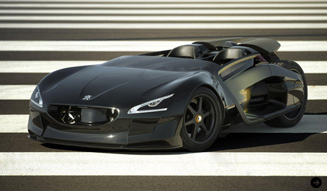

The body, made of carbon fiber meticulously crafted by artisans, is also considerably lightweight due to its compact size.
The powertrain combines motors mounted on the front and rear axles with a lithium-ion battery. It achieves a maximum output of 340ps and a maximum acceleration of over 1G, realizing astonishing power and acceleration performance.
Truly Peugeot's "Electric Dream Car." Living up to its name, the EX1 has already broken FIA (Fédération Internationale de l'Automobile) EV acceleration records and plans to challenge various other records in the future.
BRAND HISTORY
Peugeot, one of France's leading brands, also owns Citroën. It is a full-line manufacturer that produces everything from mass-market cars to presidential limousines, and is actively involved in the 24 Hours of Le Mans and the World Rally Championship.
Peugeot began manufacturing automobiles in 1890. Ten years after Gottlieb Daimler developed the world's first internal combustion engine car (the precursor to the Mercedes-Benz), Peugeot was already actively involved in automobile manufacturing, receiving engines from Daimler.
Peugeot is also characterized by its solid product development, consistently creating orthodox models without being overly experimental. Its close relationship with the Italian coachbuilder Pininfarina also contributes to the elegant design that is a hallmark of Peugeot cars.
In Japan, due to a smaller dealer network and its relatively understated, orthodox design, Peugeot was once a brand known only to enthusiasts. However, the sporty hatchback 205 GTI, introduced in 1986, ignited its popularity. Subsequently, with the 306 and 307, targeted at VW Golf competitors, the brand significantly expanded its market share. It gained particular attention as an urban vehicle highly favored by women.
Peugeot's product planning prowess is another key characteristic; the brand was also proactive in introducing open-top models with retractable hardtops, now commonly known as CC (Coupe Cabriolet).
Another factor behind Peugeot's growing market presence is its active involvement in motorsport and its consistent success. Peugeot secured titles in the World Rally Championship in 1985, 1986, 2000, 2001, and 2002. They achieved overall victory at the 24 Hours of Le Mans twice in the 1990s and once in 2009, with a diesel-powered machine that year.
As of October 2010, the lineup in Japan includes the 207 (hatchback, station wagon, coupe cabriolet), 308 (hatchback, station wagon, coupe cabriolet), and 407 (sedan, station wagon, coupe). Also available are the crossover 3008 and the sporty compact coupe RCZ.