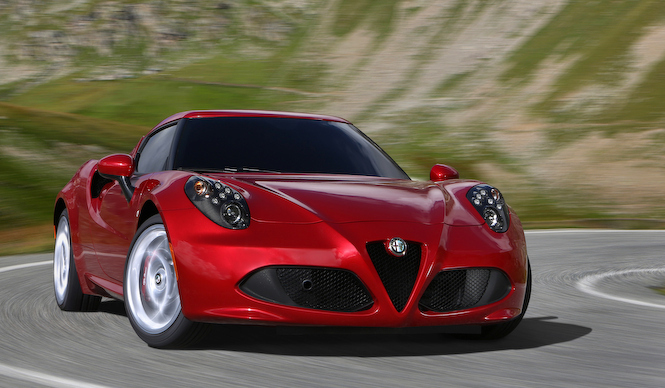
Alfa 4C European Deliveries Begin
Alfa Romeo 4C
Finally Begins Driving on European Roads
Alfa's Lightweight Mid-Engine Car "4C" Begins Delivery
The Alfa Romeo 4C, a two-seater lightweight mid-engine car that houses a 1.75-liter inline-4 turbo engine producing a maximum output of 240ps, inherited from the "Giulietta," in the center of the chassis, is finally beginning its European delivery. Let us bring you the details of this new model, born as an homage to the "Tipo 33 Stradale," ahead of its arrival in Japan.
Text by SAKURAI Kenichi
The "Tipo 33 Stradale" Reborn in the 21st Century
This March,Geneva Motor Showthe world premiere of theAlfa Romeo "4C"will soon begin delivery at Alfa Romeo dealerships in Europe. The 4C was born as an homage to the "Tipo 33 Stradale," of which only 18 units were sold in 1967. We have previously reported on the test drives of the pre-release model on the circuit,and the moment of its world premiere,but ahead of its European order acceptance, more detailed information has been released.the moment of its world premierebut ahead of its European order acceptance, more detailed information has been released.
The Alfa Romeo 4C is a rear-wheel-drive model that mounts a 1.75-liter inline-4 turbo engine, producing a maximum output of 240ps inherited from the "Giulietta," transversely in the mid-engine position. The cabin is for two people, and to put it simply, it is a lightweight mid-engine model with dimensions and origins similar to the Lotus "Elise."
In terms of being mid-engined,PorschetheCaymanmight also fall into the competitor category, but considering its concept of emphasizing sportiness while maintaining a luxurious image, it seems to be a presence close to the Lotus "Europa S" that was sold in the past.
Let's take a look at the basic structure of this lightweight sports car born in the 21st century.
An Exterior That Unmistakably Declares "Alfa Romeo"
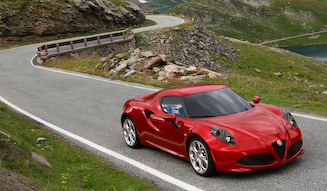
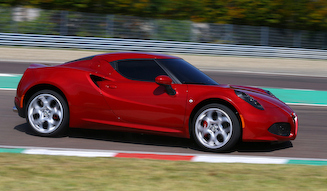
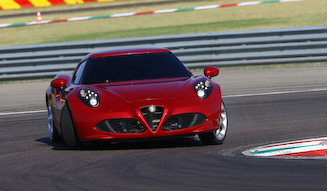
Since the "8C Competizione" released in 2007, the appearance, which shares the design taste common to "MiTo" and " Giulietta" is distinctive and immediately recognizable as an "Alfa Romeo" by anyone. The compact body size measures 3,989mm in length, 1,864mm in width, and 1,183mm in height. The wheelbase is 2,380mm. It is considerably more compact in person than it appears in photos or videos. While the width is substantial, the overall size is very close to that of the Lotus Elise series.
The design was handled by Alfa Romeo's Centro Stile. Large air intakes are provided on either side of the traditional front grille, and full LED headlights (optional) are housed on the line connecting the fenders above them.
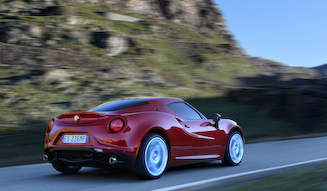
The doors are equipped with door mirrors with thick stays in the center. Just behind the doors and before the rear fenders, there are left and right air intakes, a testament to its mid-engine configuration. The windows consist of four panes: front, side doors, and rear. Therefore, after the A-pillar, the B-pillar supporting the rear gate follows immediately. The fuel lid is integrated into this B-pillar.
The rear features distinctive round taillights positioned on each side. This design also strongly conveys a connection to the "8C Competizione" and "MiTo." However, its roots can be traced back to the "Tipo 33 Stradale," indicating that this model also inherits Alfa's racing DNA and spirit. To optimize aerodynamic performance, a large diffuser is placed under the rear spoiler and exhaust pipe. The rear spoiler can be chosen as an option.
Alfa Romeo 4C
Finally Begins Driving on European Roads
Alfa's Lightweight Mid-Engine Car "4C" Begins Delivery (2)
A Sports Car-Like Interior
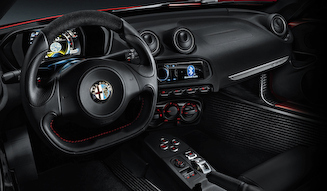
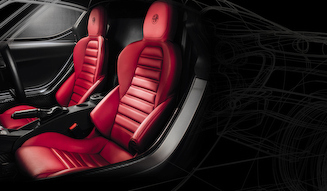
The interior of the Alfa Romeo "4C" is characterized by its sports car-like layout and design.Concept CarWhile the futuristic elements of the concept car have been toned down, the accents of carbon and aluminum, along with the combination of genuine leather, create a finish befitting Alfa Romeo. Utilizing the shape and design of the carbon monocoque tub, the carbon itself is left exposed on the door sills, making occupants acutely aware of the high-performance sports car they are entering.
The dashboard has a simple design, but within the small meter nacelle, a pseudo-analog meter is displayed, and its design changes depending on the selected mode. This design is said to be inspired by motorcycles. The D-shaped steering wheel is extremely small, perfectly sized to allow clear visibility of the meters. Due to the dual-clutch transmission only, there is no shift knob; only the DNA system selector and TCT transmission selector are placed on the center console.
A Body and Chassis Thoroughly Optimized for Lightness
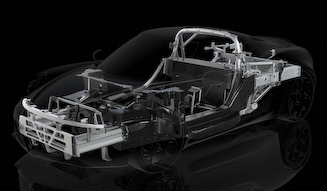
The dry weight is a mere 895kg. This is the source of the Alfa Romeo 4C's exceptional performance. Twenty-five percent of the entire vehicle volume is a carbon monocoque tub. This is a technique used in the construction of F1 car bodies, and is also known to be used in Ferraris such as theFerrari"F50" and "Enzo Ferrari," and more recently in the McLarenMP4-12C. The weight is only 65kg. This carbon monocoque tub forms the center of the body, connected to front and rear aluminum frames. Aluminum is also used for the frame supporting the rear bulkhead and roof. The front-to-rear weight distribution is announced as 38 percent front and 62 percent rear.
The body panels are made of SMC (Sheet Molding Compound). Compared to conventional steel plates, this achieves a 20 percent weight reduction while offering high design freedom, allowing for unique styling. Furthermore, unlike aluminum, it is a stable material that does not deform even in minor collisions.
PUR-RIM (injection polyurethane) is used for the bumpers. This also achieves a 20 percent weight reduction compared to steel. Additionally, the windows themselves have been slimmed down, reducing their average weight by 15 percent. This results in a windshield thickness of only 4mm.
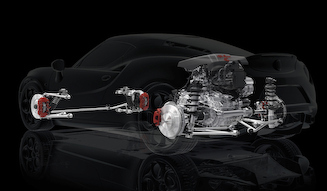
The suspension features double wishbones at the front and struts at the rear, mounted on aluminum subframes. The tires are 205/45R17 at the front and 235/40R18 at the rear, with the option to expand to a maximum of 205/40R18 at the front and 235/35R18 at the rear. The brakes are from Brembo, with 305x28mm drilled disc rotors at the front and 292x22mm at the rear. The calipers can be selected from four colors.
Alfa Romeo 4C
Finally Begins Driving on European Roads
Alfa's Lightweight Mid-Engine Car "4C" Begins Delivery (3)
Powertrain Evolved for the 4C
The engine is a 1,750cc inline-4 direct-injection turbo with an aluminum block, also used in the Giulietta. However, for the "4C," this engine has been made 22kg lighter than the one in theGiulietta Quadrifoglio Verde.
With a maximum output of 240ps/6,000rpm and a maximum torque of 350Nm (35.7kgm)/2,200-4,250rpm, this enhanced base engine boasts performance that translates to 137ps and over 200Nm (20kgm) per liter, making it the strongest in its class. The top speed is 258km/h, and it accelerates from 0 to 100km/h in 4.5 seconds. This profile aligns with the 21st-century supercar concept: a lightweight body equipped with sufficient performance from its engine, rather than a large displacement engine, to achieve high speeds and acceleration.
A 6-speed Alfa TCT dual-clutch transmission is used for the gearbox. The shift program has been newly rewritten for the "4C," and like all latest-generation Alfa Romeos, it is equipped with the DNA selector.
However, this driving mode selection system has been evolved for the 4C. In addition to the three driving modes: "D" for Dynamic driving, "N" for Normal (or Natural in the home market) for city driving, and "A" for All Weather for slippery conditions like rain or snow, a new "R" for Race mode has been added.
"Race" mode is the most extreme performance mode and is activated by moving the mode selector to the "Dynamic" position and holding it for 5 seconds. In this mode, electronic system intervention is minimized, and driver inputs are maximally respected, leaving room for vehicle control. The ESC becomes active only during sudden braking, and the ASR intervenes only during acceleration or braking. Alfa Romeo confidently explains that this allows the 4C to perform drifts freely, as expected of a rear-wheel-drive mid-engine machine.
Production in Collaboration with Maserati
Alfa Romeo has established a new workshop for the 4C, specifically the body shell manufacturing and assembly line, within the Maserati factory in Modena. The testing and final inspection lines are also shared with Maserati's production. Only painting is performed outside the Maserati factory.
This marks a collaboration between Alfa Romeo and Maserati since the "8C Competizione." The production of this unique car is supported by the craftsmanship that produces the highest quality, utilizing the latest technology and materials.
Starting in October, along with the delivery of the first 1,000 units called the "Launch Edition," full-scale production of the standard model will also commence. The price is announced to start from 56,000 Euros.

Alfa Romeo 4C
Body Size | Length 3,989 x Width 1,864 x Height 1,183 mm
Wheelbase | 2,380 mm
Weight | 895 kg
Engine | 1,742cc Inline-4 Direct Injection DOHC Turbo
Maximum Output | 177 kW (240 ps) / 6,000 rpm
Maximum Torque | 350 Nm / 2,200-4,250 rpm
Transmission | 6-speed Automatic (6-speed Alfa TCT)
Drivetrain | MR
Front Suspension | Double Wishbone
Rear Suspension | Strut
Tires Front/Rear | 205/45R17 / 235/40R18
Front Brakes | Ventilated Disc 305x28 mm
Rear Brakes | Ventilated Disc 292x22 mm
Top Speed | 258 km/h
0-100km/h Acceleration | 4.5 seconds
100-0km/h Deceleration | 36 m
Fuel Consumption (NEDC Value) | 6.8 ℓ/100km (approx. 14.7km/ℓ)
CO2 Emissions | 157 g/km
Fuel Tank Capacity | 40 ℓ
Trunk Capacity | 110 Liters
Price | 56,000 Euros