Why Volkswagen Continues to Focus on Diesel | Volkswagen
Volkswagen
Keynote Address on the Introduction of the Passat TDI
Why Volkswagen Continues to Focus on Diesel
Volkswagen Group Japan,Introduction of the Diesel Model Passatheld a keynote address with international motor journalist Mr. Kazuo Shimizu and Dr. Eckhard Pott, Head of Advanced Diesel Engine Development at Volkswagen AG, who traveled from Germany for the occasion. During the event, they discussed the company's strong commitment to diesel engines, its technological research, and future outlook.
Text & Photographs by UCHIDA Shunichi
Keynote Address Held to Deepen Understanding of Diesel
At the outset, Mr. Share, President of Volkswagen Group Japan, explained the positioning of the keynote address: "The automotive industry is currently undergoing significant change. Particularly in the field of powertrains, internal combustion engines have dominated for years, but electrification and plug-in hybrids are now emerging, and society as a whole is focusing on energy supply challenges. Within this context, we want to discuss the role of the diesel engine."
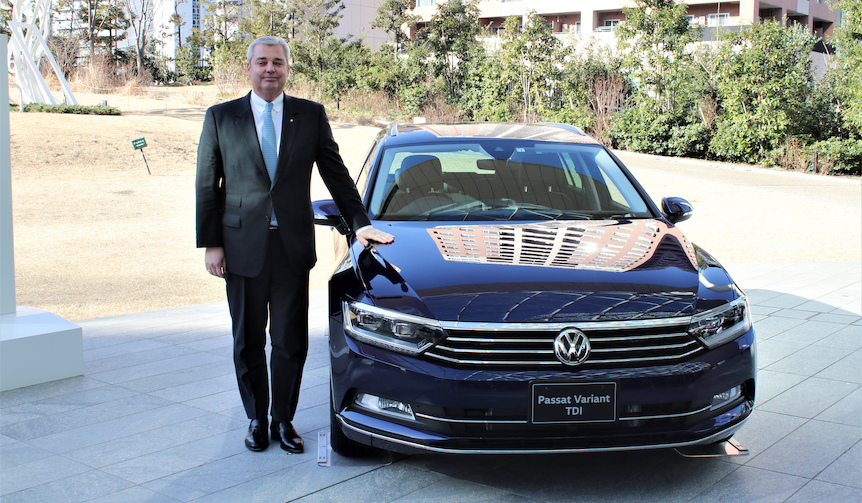
Volkswagen Group Japan President Share
Japan's Sky is the Bluest
Mr. Shimizu spoke on the theme of sustainable mobility, discussing global commonalities and how we should consider traffic issues and the next generation of automobiles within Japan.
He stated that global warming is a global issue, affecting people in all countries with similar damage and disasters, but air pollution is a problem in urban areas with heavy traffic, a local issue. "We are exploring various solutions to air pollution problems through national and city policies. However, simply cleaning the air when it becomes polluted is a past approach, merely symptomatic treatment. But we experienced this thoroughly during the exhaust gas issues of the 1970s, stemming from the US "Massey Law," and Japan's pollution problems. Therefore, we must move from symptomatic treatment to prevention."
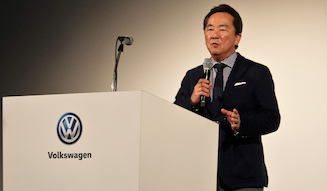
International Motor Journalist Kazuo Shimizu
During his various reporting trips abroad, Mr. Shimizu noticed that the sky over Tokyo was the bluest. He attributed this to Japan's strict NOx regulations, implemented under the 53-year standard in response to the "Massey Law" exhaust gas regulations. He further explained that during the oil shock around 1980, the theme of energy conservation led to low-carbon and CO2 reduction efforts.
In essence, "Japanese automakers have been developing technologies to reduce both NOx and CO2 from a very early stage." In contrast, the US prioritized NOx over CO2, while Europe prioritized CO2 over NOx. Japan's policy and technological challenges in reducing both have resulted in "the bluest sky over Tokyo."
Diversification of Powertrains
Mr. Shimizu then stated, "Heavy vehicles benefit from continuous high-speed driving. In other words, they are strong under high load. For example, only a diesel engine can achieve about 16 km/liter while traveling at 160 km/h on the Autobahn. On the other hand, gasoline engines lose efficiency during continuous driving under heavy load, making gasoline hybrids optimal for stop-and-go city driving in smaller vehicles. Therefore, we must consider where each powertrain is best utilized. This is where powertrain diversification comes in."
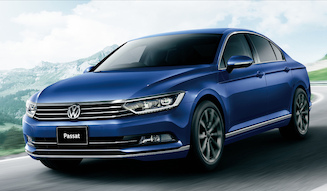
Volkswagen Passat TDI
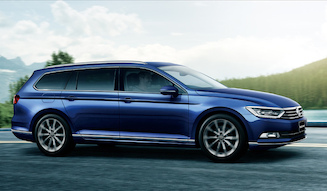
Volkswagen Passat Variant TDI
Gottlieb Daimler and Karl Benz invented the gasoline engine in 1886. Just six years later, Rudolf Diesel invented the diesel engine. The impetus for his research was the desire for an engine that could run in the German countryside where gasoline was scarce. He was developing an internal combustion engine that could run on peanut oil, which could be grown in local fields, when he accidentally invented an engine that ignited spontaneously.
This led to the patent for the diesel engine. Mr. Shimizu remarked, "Diesel engines have used biomass energy since their inception. In other words, they were eco-conscious engines from birth. I am interested to see how they will evolve into diesel engines suitable for the modern era while retaining that DNA."
He concluded, "Recently, GM has been developing diesel combustion by modeling it using a supercomputer called Titan. Diesel engines ignite spontaneously, so there are aspects that are not fully understood. Therefore, research into combustion is ongoing. There is still potential for diesel if we continue these efforts."
Volkswagen
Keynote Address on the Introduction of the Passat TDI
Why Volkswagen Continues to Focus on Diesel (2)
Two Advantages of the Diesel Engine
Dr. Eckhard Pott then focused on the diesel engine, delivering a lecture on its general advantages, highlights of the current generation of diesel engines, and long-term prospects.
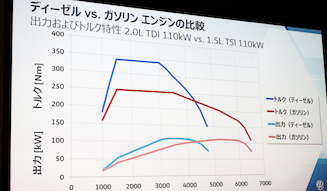
Dr. Pott identified two advantages of diesel engine technology. "When comparing torque characteristics at the same output, diesel engines generate higher torque from low RPMs, around 1,000 to 3,500 RPM. This allows drivers to feel the torque effectively, not only for driving pleasure but especially in congested conditions and urban driving," he explained, considering the Japanese road environment.
Regarding fuel efficiency, he cited a German online site, stating, "When comparing diesel and gasoline engines with the same output, diesel engines achieve approximately 20 percent better fuel economy. This is particularly effective for long-distance travel." He also commented that diesel cars account for 80 percent of sales on this site and that this trend is similar in German sales figures, indicating diesel's mainstream status.
Achieving Low Fuel Consumption, Driving Enjoyment, and Low Emissions
Regarding the characteristics of the current generation of diesel engines, Dr. Pott stated, "We are developing them to achieve three goals: low fuel consumption, driving enjoyment, and low emission levels."
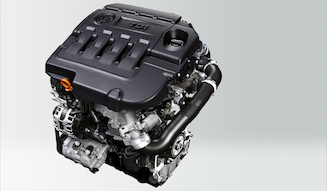
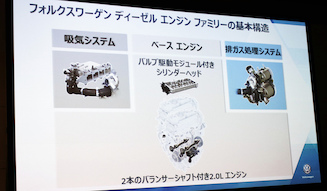
The Japanese specification models feature two balancer shafts, a cylinder head incorporating valve and drive train modules, a new intake system with an integrated intercooler, and a highly efficient exhaust gas after-treatment system.
To reduce emissions and fuel consumption, the intake air is mixed with exhaust gas via EGR (Exhaust Gas Recirculation).
"This technology has been employed for many years, and we use two EGR systems to achieve maximum performance," said Dr. Pott.
The first is high-pressure EGR. Exhaust gas is routed from upstream of the turbocharger, taking the shortest path to the intake manifold between the intercooler and the cylinder head. The second is low-pressure EGR. This system routes purified exhaust gas from the DPF (Diesel Particulate Filter) upstream of the turbocharger.
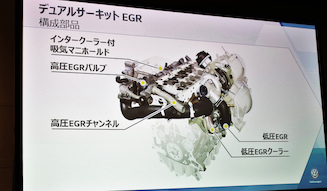
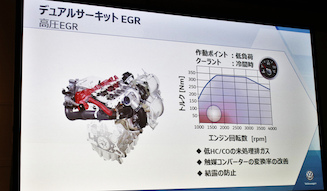
Immediately after a cold start, high-pressure EGR operates, heating the intake air with warm exhaust gas, which offers significant benefits. When the temperature rises, HC (hydrocarbons) and CO are substantially reduced. Furthermore, as the exhaust gas becomes hotter, the performance of the catalytic converter is enhanced, and condensation is prevented.
Once the engine warms up, both high-pressure and low-pressure EGR are utilized. "We gradually increase the proportion of low-pressure EGR. This optimizes CO2 emissions and supports temperature management for exhaust gas treatment," explained Dr. Pott.
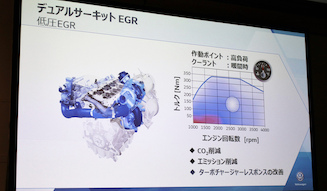
When the engine is operating at normal temperature, high-pressure EGR is no longer needed, and only low-pressure EGR is used. This reduces emissions and CO2 while also improving turbocharger response.
Dr. Pott stated, "Controlling cylinder pressure during the combustion stroke is an effective method for reducing emissions and improving fuel efficiency." He added, "This is realized in all of our diesel engines." The first generation used four pressure sensors for combustion control, while the second generation utilized an engine speed sensor. This not only controlled speed but also reduced combustion noise.
"However, to meet stringent emission standards, more efficient exhaust gas after-treatment was necessary," Dr. Pott continued. "Therefore, we completely revamped the exhaust gas after-treatment concept." Specifically, all components were placed as close to the engine as possible to minimize temperature loss and maximize the functionality of the after-treatment system.
Volkswagen
Keynote Address on the Introduction of the Passat TDI
Why Volkswagen Continues to Focus on Diesel (3)
Excellent Results in Practical Demonstrations
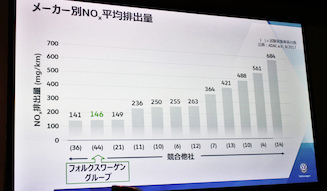
These technologies are widely used by Volkswagen globally. What are their effects in real-world driving? Dr. Pott asserted, "For the past two years, numerous independent organizations have compared competing vehicles with Volkswagens on both test benches and public roads. In the summer of 2017, Germany's ADAC published the results of exhaust gas tests conducted in self-driving mode on approximately 200 different vehicles. The Volkswagen Group ranked among the top three. This proves that Volkswagen vehicles perform strongly not just in simulations but also in real-world driving."
He concluded, "In recent years, Volkswagen has learned much from unfortunate events. We have proven that we can meet the strictest emission standards without modifying the engine ECU. Volkswagen will meet the stringent standards of countries like Japan and fulfill customer expectations."
Towards Stricter Emissions
Regarding Volkswagen's future efforts with diesel engines, Dr. Pott stated, "Emission standards will be further tightened. To address this, we are evaluating methods, possibilities, and challenges for adapting diesel engines for the future." A key point is whether the much stricter NOx target standards can be met.
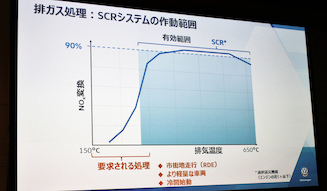
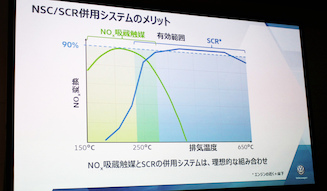
Volkswagen is working to further improve the high potential of its SCR system. "When exhaust gas temperatures drop below 220 degrees Celsius, further optimization of the admixture conversion is necessary. This is particularly true during cold starts and city driving, where low exhaust temperatures prevent the SCR system from functioning at its full capacity." Therefore, "by combining the SCR system with an upstream NOx storage catalyst, we have expanded the NOx treatment range to operating conditions below 150 degrees Celsius, significantly improving treatment capacity after cold starts and during city driving. We will continue development, including other measures."
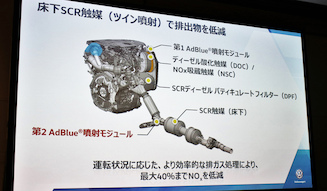
Another significant challenge is "prolonged high-load engine operation. This results in high NOx emissions and simultaneously requires high processing temperatures. Consequently, there is a risk of operating outside optimal temperature ranges," he explained. This concern arises from driving on Germany's unrestricted Autobahn. As a countermeasure, in addition to SCR and the Diesel Particulate Filter, an SCR catalyst with AdBlue is installed underneath the vehicle, along with an additional AdBlue injection module upstream of the underfloor SCR catalyst. This reduces NOx and significantly improves performance. This twin-injection system will be an effective technology for upcoming regulations," he stated, expressing optimism for the future.
Why will stricter emission controls be introduced? Dr. Pott noted, "The air quality in major cities worldwide has not improved much in recent years." He analyzed the reason as "the effect of emission reductions from individual vehicles being offset by the increase in the number of cars." "Therefore, we predict that significantly stricter emission reduction regulations will be implemented in the long term. Volkswagen is preparing for this scenario, which is expected to occur within the next decade," he emphasized, indicating that development efforts will continue unabated.
By 2025, Internal Combustion Engines Will Hold a 75% Share
Volkswagen aims to increase the proportion of electric vehicles to 25 percent by 2025. Hybrid vehicles are expected to account for approximately 30 percent. Currently, electric and hybrid vehicles represent only 3 percent, making this a very ambitious goal.
On the other hand, "Many people ask if Volkswagen will continue developing internal combustion engines as it has for the past few decades. My answer is 'yes.'"
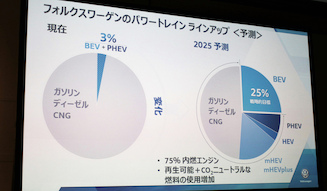
With electric vehicles at 25 percent, internal combustion engine powertrains will constitute 75 percent. Naturally, hybrids, which combine multiple technologies, will also represent a significant portion. However, this 75 percent figure clearly indicates the necessity for further development of internal combustion engines.
Furthermore, for heavy SUVs, commercial vehicles, and long-distance travel, the diesel engine is the most cost-effective drivetrain. Thus, Volkswagen will continue to develop diesel engines with a long-term perspective to meet customer demands and legal requirements. We will not cease our development efforts to meet any stringent emission targets. Finally, and most importantly, the diesel engine will continue to hold a significant position in Volkswagen's long-term powertrain strategy," he concluded, expressing great anticipation for diesel engines.
Volkswagen Customer Center
0120-993-199