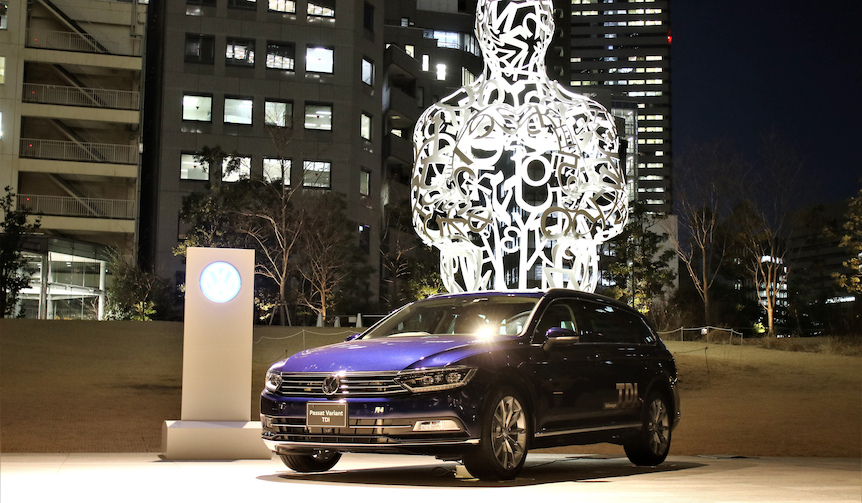
Volkswagen Introduces Diesel Engine to Passat and Passat Variant | Volkswagen
Volkswagen Passat TDI | Volkswagen Passat TDI
Volkswagen Passat Variant TDI | Volkswagen Passat Variant TDI
Diesel Engine Introduced to Passat and Passat Variant
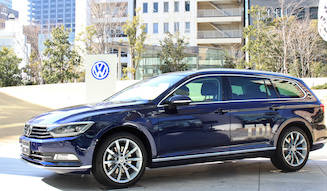
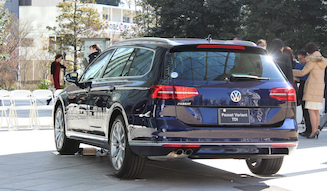
Volkswagen Group Japan (VGJ) has added TDI models equipped with diesel engines to the "Passat Sedan" and "Passat Variant." This marks the return of diesel models after a 20-year hiatus. Prices start from ¥4,229,000.
Text & Photographs by UCHIDA Shunichi
Diesel Finally Arrives
The engine is a 2-liter turbo diesel TDI engine, developed based on the new generation modular diesel "MDB" platform used in the "Passat" and other models. With a maximum output of 190ps and peak torque of 400Nm, it offers strong acceleration, a key benefit of diesel engines, along with excellent running costs (fuel and fuel efficiency) and low CO2 emissions.
Furthermore, to address challenges with diesel engines such as particulate matter (PM) and nitrogen oxides (NOx) in exhaust gas, an after-treatment system incorporating an oxidation catalyst, SCR (Selective Catalytic Reduction), and DPF (Diesel Particulate Filter) has been adopted. This system complies with Japan's stringent Post New Long-Term Emission Standards. As a result, these vehicles are eligible for eco-car tax reductions.
Fuel-Efficient Diesel
A major advantage of diesel engines is their high performance due to significant torque, but they also offer excellent fuel economy. While it varies, it's generally about 20% better than engines of comparable output.
This is because, unlike gasoline engines that ignite a fuel-air mixture with a spark plug, diesel engines ignite fuel injected directly into highly compressed, hot air. Their higher compression ratio means less fuel is needed compared to gasoline engines, leading to superior combustion efficiency.
The turbocharger used in the Passat TDI features variable geometry (a mechanism that controls exhaust gas flow). By adjusting the guide vanes on the turbine side based on engine speed, it optimizes boost pressure for improved efficiency.
Specifically, at low RPMs, the aperture is narrowed to increase exhaust gas velocity and enhance boost efficiency. At high RPMs, the aperture widens to reduce resistance and lower exhaust pressure, minimizing losses. This combination delivers powerful, efficient, and comfortable driving across various conditions, from city traffic to long-distance highway travel, while also reducing CO2 emissions through excellent fuel economy.
Volkswagen Passat TDI | Volkswagen Passat TDI
Volkswagen Passat Variant TDI | Volkswagen Passat Variant TDI
Diesel Engine Introduced to Passat and Passat Variant (2)
Exhaust Purification System Compliant with Strict Japanese Emissions Standards
While diesel engines offer numerous benefits, keeping their exhaust emissions clean is a significant challenge. Diesel combustion produces NOx (nitrogen oxides) at high temperatures and PM (particulate matter) at lower temperatures. However, the Passat TDI meets Japan's Post New Long-Term Emission Standards through a system that includes a common rail fuel injection system, DPF (Diesel Particulate Filter), SCR (Selective Catalytic Reduction), and EGR (Exhaust Gas Recirculation).
The common rail system effectively reduces both NOx and PM. The Passat TDI employs an electronically controlled common rail system that injects diesel fuel directly into the combustion chamber at ultra-high pressures of approximately 2,000 bar. This system allows for precise control over injection timing, enabling multiple injections per combustion cycle. This not only optimizes fuel consumption but also prevents rapid increases in combustion chamber temperature and pressure, thereby suppressing NOx formation and promoting complete combustion to minimize PM.
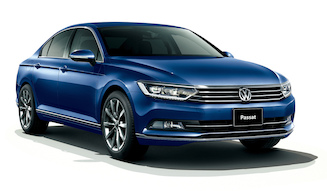
Volkswagen Passat TDI
The DPF is effective in reducing PM. An exhaust pipe catalyst with a DPF adsorbs PM from the exhaust gas. When a certain amount of carbon particles accumulates in the DPF, the engine control system raises the filter's temperature, causing the accumulated PM to burn off through chemical reaction. This maintains the DPF's filtering function while suppressing PM emissions.
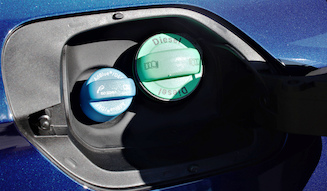
The SCR system is used to reduce NOx. After exhaust gas passes through the oxidation catalyst, a urea-based solution called AdBlue is injected. This causes a chemical reaction that converts NOx into harmless nitrogen (N2) and water (H2O). AdBlue is stored in a 13-liter dedicated tank and requires refilling approximately every 1,000 km (estimated consumption: 1.5 L/1,000 km). When the AdBlue level is low, the driver is alerted through a four-stage warning system of chimes and visual indicators, indicating the remaining driving range before a refill is necessary.
The EGR (Exhaust Gas Recirculation) system is also effective in reducing NOx. EGR works by recirculating a portion of the exhaust gas back into the engine. Since NOx formation increases with higher combustion temperatures, this process lowers the combustion temperature, thereby reducing NOx generation. By mixing exhaust gas, which has less oxygen, with the intake air, the concentration of carbon dioxide, which heats up less readily than oxygen, increases, suppressing combustion temperature rise and preventing NOx formation.
The Passat TDI utilizes a "low-pressure type" EGR system, which draws exhaust gas from downstream of the turbocharger. This type has the advantage of minimizing the loss of exhaust gas flow (exhaust energy) to the EGR system, and it also prevents a drop in turbocharger boost pressure, leading to improved engine response. Additionally, the TDI engine is equipped with an EGR cooler, which further lowers exhaust gas temperature, allowing denser exhaust gas to be sent into the combustion chamber and further suppressing combustion temperatures.
The Long-Awaited TDI
Tilo Scholl, President of VGJ, stated, "The Passat TDI offers a comfortable ride, dynamic driving, and impressive efficiency of 20.6 km/L, promising enjoyable long-distance drives." He further explained the rationale behind this introduction: "The imported diesel car market in Japan has grown significantly over the past few years, and by adding the Passat TDI series to our lineup, we can meet customer demand. Customers are looking for fuel-efficient vehicles, German cars with a 'fun to drive' character, and the peace of mind that Volkswagen provides."

Volkswagen Passat TDI
Body Dimensions (Eleganceline) | Length 4,785 x Width 1,830 x Height 1,465 mm
Body Dimensions (Highline) | Length 4,785 x Width 1,830 x Height 1,470 mm
Wheelbase | 2,790 mm
Weight | 1,560-1,580 kg
Engine | 1,968cc Inline 4-cylinder DOHC 16-valve Direct Injection Turbo
Max. Output | 140 kW (140 ps) / 3,500-4,000 rpm
Max. Torque | 400 Nm (40.8 kgm) / 1,900-3,300 rpm
Transmission | 6-speed AT
Drivetrain | FF
Tires | (Eleganceline) 215/55R17 (Highline) 235/45R18
Fuel Economy (JC08 Mode) | 20.6 km/L
Min. Turning Radius | 5.4 meters
Fuel Tank Capacity | 59 liters
Price | (Eleganceline) ¥4,229,000 (Highline) ¥4,899,000
Volkswagen Passat Variant TDI
Body Dimensions (Eleganceline) | Length 4,775 x Width 1,830 x Height 1,485 mm
Body Dimensions (Highline) | Length 4,775 x Width 1,830 x Height 1,510 mm
Wheelbase | 2,790 mm
Weight | 1,610-1,630 kg
Engine | 1,968cc Inline 4-cylinder DOHC 16-valve Direct Injection Turbo
Max. Output | 140 kW (140 ps) / 3,500-4,000 rpm
Max. Torque | 400 Nm (40.8 kgm) / 1,900-3,300 rpm
Transmission | 6-speed AT
Drivetrain | FF
Tires | (Eleganceline) 215/55R17 (Highline) 235/45R18
Fuel Economy (JC08 Mode) | 20.6 km/L
Min. Turning Radius | 5.4 meters
Fuel Tank Capacity | 59 liters
Price | (Eleganceline) ¥4,429,000 (Highline) ¥5,099,000
Volkswagen Customer Center
0120-993-199