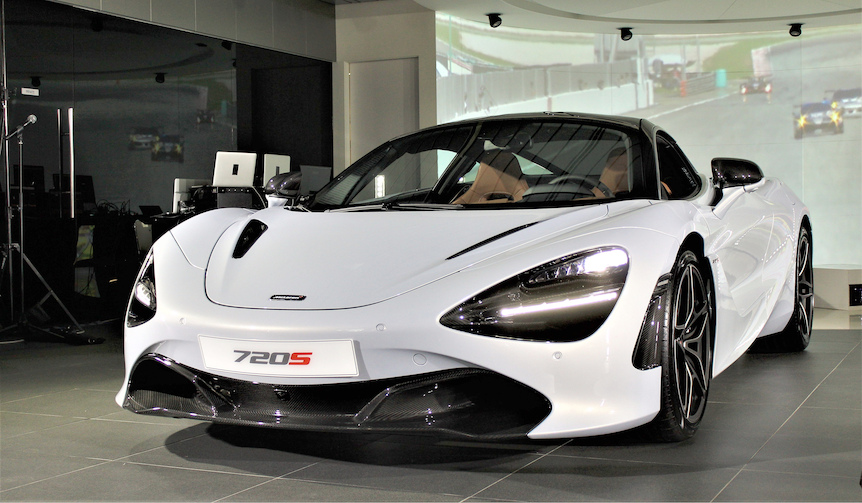
McLaren's 720S Arrives in Japan Almost Simultaneously with its Announcement | McLaren
McLaren 720S | McLaren 720S
Arrives in Japan Just 12 Hours Later
Debut of the New Generation Super Series "720S"
At the Geneva International Motor Show 2017, McLaren unveiled the second generation of its Super Series,New "720S"the "720S". Just 12 hours after its world premiere, the 720S was also announced in Japan. This article focuses on the Japanese launch event and introduces McLaren's new generation model.
Text & Photographs by UCHIDA Shunichi
Significantly Improved Performance
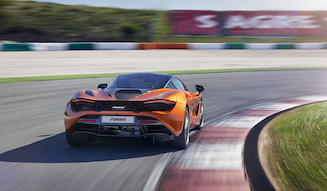
Let's begin with the most intriguing aspect: performance. The newly developed 4-liter V8 twin-turbo M840T engine produces a maximum output of 720ps and peak torque of 770Nm. It propels the 1,419kg body from 0 to 100km/h in 2.9 seconds, 0 to 200km/h in 7.8 seconds, and 0 to 300km/h in 21.4 seconds. The 0-400 meter acceleration is achieved in 10.3 seconds, with a top speed of 341km/h. Comparing 0-200km/h acceleration, it is faster than the Lamborghini"Aventador"by one second, and faster than the Ferrari"488 GTB"by half a second.
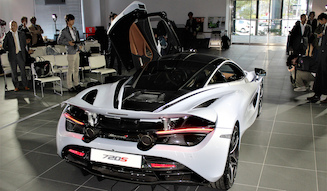
This engine is an evolution of McLaren's existing V8 twin-turbo series. Based on the 3.8-liter engine used in the Sports Series, 41 percent of its parts have been changed.
The 720S also features a revised architecture. Centered around a new carbon fiber tub and the "Monocage II" upper structure, it achieves an 18kg weight reduction compared to the "650S," explained Peter Wells, McLaren Automotive Asia Pacific Regional Sales Manager.
McLaren 720S | McLaren 720S
Arrives in Japan Just 12 Hours Later
Debut of the New Generation Super Series "720S" (2)
Cab-Forward Design and Evolved Aerodynamics Inherited
In line with previous McLarens, the exterior design adopts a cab-forward layout, prioritizing visibility. Its silhouette emphasizes power and dynamism.
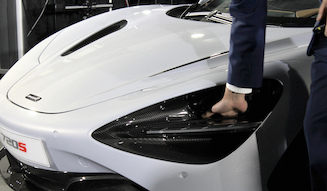
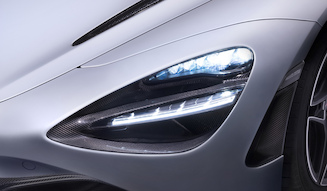
In detail, the headlight area features a gap large enough to fit a hand, housing a low-temperature radiator for effective cooling. The headlights utilize adaptive LED matrix technology. While adaptive lights typically adjust beam angles using motors to switch between high and low beams, the 720S controls the beam by illuminating or extinguishing parts of the light. "This reduces motor weight," noted Wells.
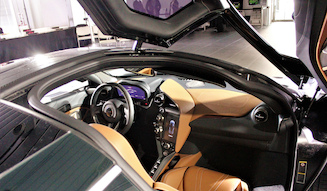
The signature dihedral doors that open upwards are retained, with a larger cut-out extending to the roof to improve ingress and egress. Furthermore, when the doors are opened, they are positioned 15cm further inward on each side compared to the 650S, reducing concerns about parking space.
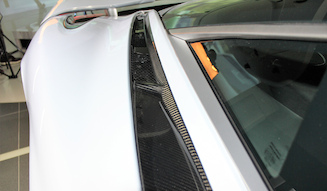
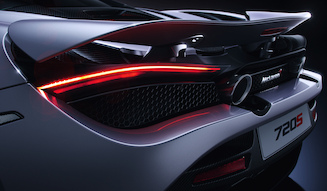
These doors also significantly contribute to aerodynamics, incorporating Formula 1 bargeboards. According to Wells, "High-pressure air from the front wheel arches is utilized and converted into downforce by the bargeboards."
A notable feature is the absence of side air intakes. "Using side air intakes requires redirecting airflow, which is not very efficient. Therefore, we utilize the highly fast and energetic airflow near the car to cool the engine." He explained that the engine is cooled by airflow along the side sills, shoulders, and roof.
The interior has undergone significant improvements in quality. The leather used is the finest from Bridge of Weir in Scotland. Aluminum parts are machined from solid blocks. Additionally, a new device called the Folding Driver Display has been introduced. This new TFT cluster allows the meters to rotate 90 degrees during spirited driving, reducing information to a minimum.
In terms of practicality, a 150-liter luggage space is available at the front. A 360-degree parking camera is also offered as an option.
McLaren 720S | McLaren 720S
Arrives in Japan Just 12 Hours Later
Debut of the New Generation Super Series "720S" (3)
Driving Dynamics That Make Anyone a Hero
With reduced weight and increased power, McLaren's innovations and technologies have also been incorporated to enhance controllability.
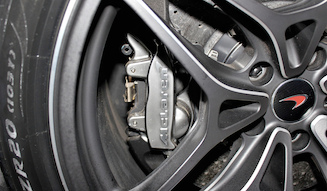
The 720S is based onthe "650S"'s Proactive Chassis, evolved into "Proactive Chassis Control II." "No stabilizer is fitted; everything is controlled hydraulically. Specifically, we have added three new sensors to each wheel, totaling 12 sensors: four accelerometers and eight pressure sensors," he explained. This information is analyzed in milliseconds by the Optimal Controller Algorithm at the system's core, and the damping force of the suspension is immediately optimized based on the results. Wells proudly stated that this algorithm was developed over six years in collaboration with the University of Cambridge.
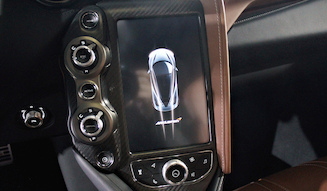
Furthermore, Variable Drift Control has been added. This can be operated via the Dynamic Panel on the center console. "This is made possible by a new level of electronic stability control (ESC)," said Wells. By simply swiping the operation area displayed on the Dynamic Panel, the ESC intervention level can be adjusted, and the drift angle can be set, allowing "anyone to become a hero like Jenson Button or Fernando Alonso (laughs)."
Regarding Variable Drift Control, Wells explained, "This is not a technology focused on lap times. Rather, it's designed to provide more enjoyment for the driver, allowing even average drivers to drift safely and enjoyably by setting the slip angle and drift angle."
McLaren 720S | McLaren 720S
Arrives in Japan Just 12 Hours Later
Debut of the New Generation Super Series "720S" (4)
The 2nd Generation of the Super Series
McLaren's lineup is broadly divided into three categories. The first is the"P1"and"P1 GTR""Ultimate Series.""570S"and"570GT"in the "Sports Series." And then there is the "Super Series," to which the "720S" belongs.
The Sports Series serves as McLaren's entry-level line. The Ultimate Series, on the other hand, is developed as the ultimate McLaren, primarily for sports driving. In between is the Super Series, which began with the"MP4-12C"in 2011. Following the"650S"and"675LT", the 720S, the second generation, has now debuted.
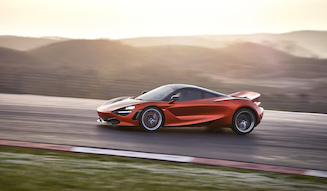
George Biggs, Managing Director of McLaren Automotive Asia Pacific, stated regarding the 720S, "The 720S represents a new evolution for the Super Series. For McLaren, it's not about slight or normal evolution; we make a leap. There has been a dramatic advancement in styling, performance, usability, and engagement. The keyword is 'raising your limit.'" He emphasized the significant advancements.
McLaren 720S | McLaren 720S
Arrives in Japan Just 12 Hours Later
Debut of the New Generation Super Series "720S" (5)
Reason for Launching in Japan 12 Hours Later
"The Japanese market is extremely important to McLaren. Last year, 6 percent of our total production was sold in Japan. We have established a solid foundation in Tokyo, Osaka, Nagoya, and Fukuoka, and we aim for further growth." This statement by Biggs was underscored by Japan being the first market to launch the new model.
Regarding the reason for this, Biggs cited the characteristics of the Japanese market. "The supercar market in Japan is highly mature, with many users who deeply understand what a supercar is. We believe this 720S is a perfect fit for those users," he said.
Furthermore, Masahiro Natori, from McLaren Automotive Asia Japan Branch, added, "We believe that if we succeed in Japan, other Asian countries will follow. This is because we want to create a benchmark, and at the same time, the culture and history of the supercar itself span 40 to 50 years, making it the most mature in Asia. The quality of users here is also very high. A successful track record here will propagate and lead the way in other countries."
Natori expressed confidence in the 720S, stating, "This model will undoubtedly make a strong presence in the Japanese market and further enhance McLaren's brand recognition. We are proud to have developed such a powerful product. McLaren's presence can be significantly strengthened through this model." The evolution to the second generation is expected to drive further success.
The price of the McLaren 720S in Japan is 33,383,000 yen. Deliveries are scheduled to begin in July.

McLaren 720S | McLaren 720S
Body Dimensions | Length 4,543 x Width 1,930 x Height 1,196 mm
Wheelbase | 2,670 mm
Dry Weight | 1,283 kg (DIN value with 90% fluids and fuel: 1,419 kg)
Engine | 3,994 cc V8 Twin-Turbo
Max Output | 537 ps (720 ps) / 7,500 rpm
Max Torque | 770 Nm / 5,500 rpm
Transmission | 7-speed Automatic (SSG)
Drivetrain | MR
Brakes Front | φ390 mm Carbon Ceramic Discs
Brakes Rear | φ380 mm Carbon Ceramic Discs
Suspension | Double Wishbone
Tires Front/Rear | 245/35R19 / 305/30R20
Trunk Capacity | Front 150 liters, Rear 210 liters
Top Speed | 341 km/h
0-100km/h Acceleration | 2.9 seconds
0-200km/h Acceleration | 7.8 seconds
0-300km/h Acceleration | 21.4 seconds
0-400m | 10.3 seconds
200-0km/h Braking | 4.6 seconds, 117 meters
100-0km/h Braking | 2.8 seconds, 29.7 meters
CO2 Emissions | 249 g/km
Fuel Economy (NEDC combined) | 10.7 ℓ/100km (approx. 9.35 km/ℓ)
Price | 33,383,000 yen