Bugatti Chiron Makes Japan Debut | Bugatti
Bugatti Chiron
Bugatti Chiron Makes Japan Debut
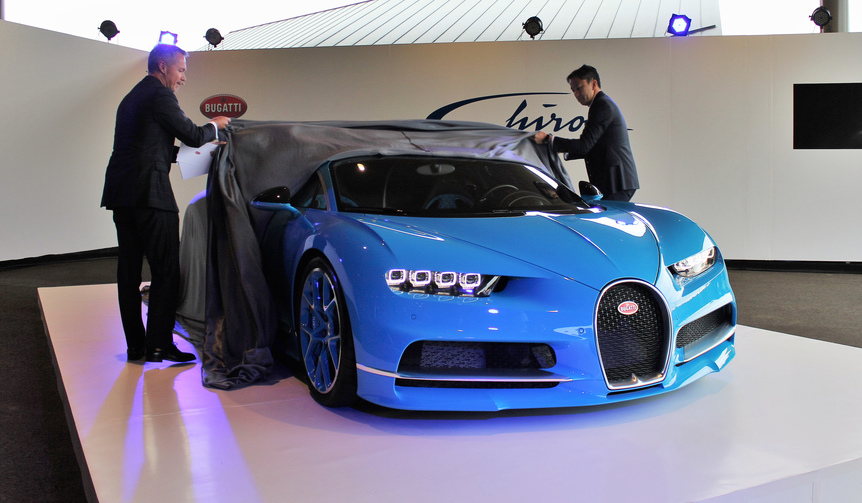
Bugatti Japan unveiled the Chiron, which had its world premiere at the 2016 Geneva Motor Show, in Japan. The vehicle will be on display at the Bugatti Tokyo showroom in Aoyama, Tokyo, until November 16.
Text & Photographs by Shunichi Uchida
1,500ps, 420km/h Achieved
Bugatti's new model, theChiron , the successor to theVeyron, has already landed in Japan.
To begin with its power, which draws more attention than any other car, it is the world's first production sports car to produce a maximum output of 1,500ps. Furthermore, it delivers a maximum torque of 1,600Nm between 2,000-6,000rpm and boasts a top speed of 420km/h (with limiter engaged). It also accelerates from 0-100km/h in under 2.5 seconds.
The engine, a 8-liter W16 quad-turbo, is familiar from the Veyron and other models. However, to achieve the target of 1,500ps, a 25% increase over the Veyron, almost all engine components have been redesigned.
To minimize weight gain associated with increased power, the use of lightweight materials such as titanium and carbon fiber has been increased. For example, carbon fiber is used for the intake tubes, charge air system, and chain housing, and the weight of the new crankshaft has also been optimized.
The four turbochargers operate in two stages. To achieve maximum acceleration without turbo lag from a standstill, only two operate at launch. The other two engage when the engine speed reaches approximately 3,800rpm. This provides linear power from the low 2,000rpm range while generating immense torque and power even at low speeds, resulting in remarkably manageable characteristics.
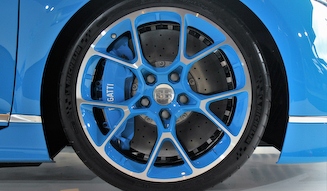
The tires that handle this immense power are jointly developed with Michelin, sized 285/30R20 for the front and 355/25R21 for the rear. Incidentally, Chiron's tire testing was repeatedly conducted at aerospace industry test facilities due to the extremely stringent requirements.
Bugatti Chiron
Bugatti Chiron Makes Japan Debut (2)
From City Streets to the Racetrack
The Chiron's adaptive chassis incorporates five driving programs: "Lift," "EB Auto," "Autobahn," "Handling," and "Top Speed." The aim is to maximize the utilization of its immense power and torque characteristics, which generate over 70% of maximum torque across the entire rev range.
Each driving program interactively controls the ride height, electronic dampers, electronic power steering, 4WD with easy-to-drift function, electronic rear differential, aerodynamic control system, and stability/brake control system.
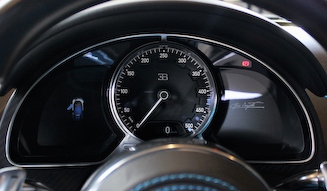
The "Lift" mode is used when towing a trailer or navigating high obstacles. It automatically switches to the default "EB Auto" mode at speeds of 50km/h, ensuring comfort and agility. In "EB Auto" mode, the ride height and damper settings are automatically adjusted by the system according to speed and road conditions.
Above 180km/h, the "Autobahn" mode is automatically selected. The dampers are automatically adjusted to ensure stability and handling at high speeds without compromising comfort. In "Handling" mode, agility and performance are maximized, making it the optimal program for track driving.
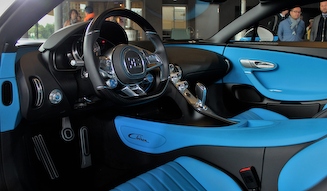
The "Lift," "EB Auto," "Autobahn," and "Handling" programs can be selected using the rotary switch on the steering wheel. The top speed in "EB Auto," "Autobahn," and "Handling" modes is 380km/h.
The "Top Speed" mode reaches a maximum speed of 420km/h but requires activation using a second ignition key. This special key, known as the speed key, also used in the Veyron, emphasizes the extraordinary act of driving at top speed. This mode can only be engaged when all systems are configured for maximum speed operation. This is because "safety first" is Bugatti's motto.
Bugatti Chiron
Bugatti Chiron Makes Japan Debut (3)
Design Underpinned by Functionality, Then and Now
"For Bugatti, design is extremely important," states Stephan Winkelmann, President of Bugatti Automobiles S.A.S. This was also true for past models; many of Bugatti's pre-war cars were designed by Jean, the son of founder Ettore Bugatti, and included numerous iconic models.
Winkelmann cites the "T57 Atlantic" as an example. This Atlantic is characterized by a dorsal fin-like center line running down the middle of the car. Winkelmann explains, "We wanted to use magnesium for the body to make the car lighter. However, welding it was not possible with the technology of the time, so it was bolted together. This is how the center line was born." Similarly, the horseshoe grille, a design icon of Bugatti, was adopted to allow for greater air intake.
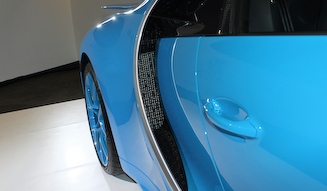
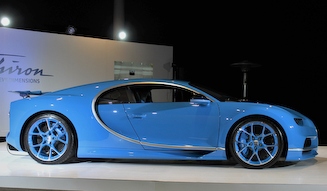
These elements are naturally applied to the Chiron as well. The center line, used in the T57, is reapplied to the Chiron with the aim of improving stability.
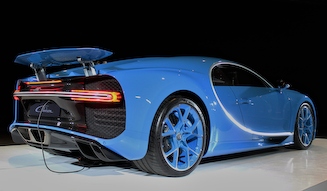
Furthermore, the heat generated by the Chiron's 1,500ps engine is immense, requiring a total of 15 radiators for cooling. These include the horseshoe grille, and air intakes are also located at the rear of the C-shaped line that surrounds the cabin, guiding a large volume of air into the engine compartment.
The C-line, which forms the basis of this functionality, originated from Ettore Bugatti's signature. "He used to sign with an underline, based on the initial 'E' of Ettore. That was the motif," he commented, demonstrating the fusion of function and design here as well.
The Chiron is limited to 500 units worldwide, with approximately 200 pre-orders already confirmed. The price is set at 2.4 million euros.

Bugatti Chiron
Body Dimensions | Length 4,544 x Width 2,038 x Height 1,212 mm
Wheelbase | 2,711 mm
Weight | 1,995 kg
Engine | 7,993 cc W16 Quad-Turbo
Maximum Output | 1,103 kW (1,500 ps) / 6,700 rpm
Maximum Torque | 1,600 Nm / 2,000-6,000 rpm
Transmission | 7-speed Dual-Clutch (DSG)
Drivetrain | 4WD
Brakes Front | φ420mm Ventilated Disc
Brakes Rear | φ400mm Ventilated Disc
Suspension Front/Rear | Double Wishbone / Double Wishbone
Tires Front/Rear | 285/30R20 / 355/25R21
0-100km/h Acceleration | Under 2.5 seconds
0-200km/h Acceleration | Under 6.5 seconds
0-300km/h Acceleration | Under 13.6 seconds
100-0km/h Deceleration | 31.3 meters
200-0km/h Deceleration | 125 meters
300-0km/h Deceleration | 275 meters
Top Speed | 420 km/h (380 km/h in modes other than Top Speed)
Price | 2.4 million Euros (approx. 296 million Yen)