The Second Generation Panamera Arrives | Porsche
Porsche Panamera
Reservations Now Open in Japan
The Second Generation Panamera Arrives
On June 28th, Porsche unveiled the new Panamera in Berlin, Germany. The first generation, which marked Porsche's bold entry into the luxury four-door market, debuted in 2009. Seven years later, the second-generation model has arrived. What kind of design and performance does it possess?
Text by SAKURAI Kenichi
An Established Icon as a GT
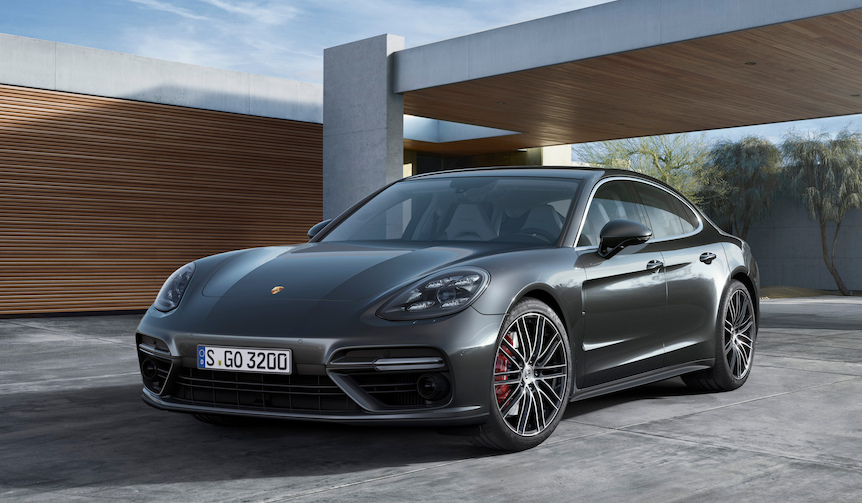
Looking at its design, few would fail to recognize it as a "Panamera" at first glance. While one could simply call it a 'keep concept,' just as the911is, and as theBoxster" and theCayman", andCayenne" are, each Porsche model strongly impresses upon the viewer that it is nothing other than itself, even through model changes.
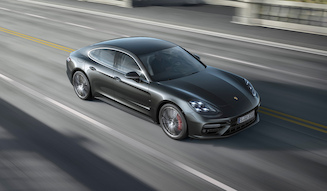
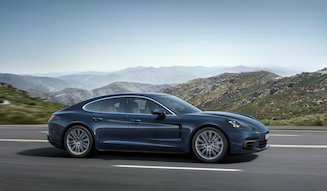
This adherence to design language is a crucial element of brand strategy. While preserving the distinctive characteristics of the previous Panamera, the new model evolves further. The overall silhouette is unmistakably Panamera, and the front bumper, which might appear complex at first glance, is actually dynamic and precise. Signature design cues from the predecessor, such as the two character lines on the hood and the slit extending from behind the front fenders to the doors, remain intact.
Porsche Panamera
Porsche Panamera
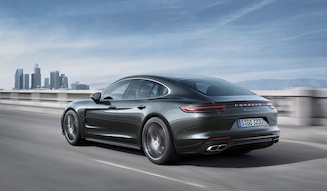
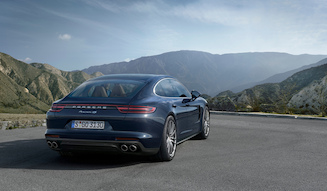
The headlights, like those of the Le Mans-winning "919 Hybrid," feature four LED lights, reinforcing the notion that this manufacturer's origins lie on the racetrack. The taillights use LEDs and adopt a horizontal design, sharing a visual theme with the "Macan" and the new 911.
The body-colored, extendable rear spoiler is integrated into the power-operated luggage compartment lid. On the "Panamera Turbo," it features a new design with a rear wing that splits and extends.
The rear view, with the "Porsche" and model name logo three-dimensionally raised between the taillights, also showcases a new bumper and diffuser design with stainless steel dual exhaust system twin tailpipes on each side. The "Panamera 4S" can be identified by its round tailpipes, while the "Panamera Turbo" features trapezoidal tailpipe finishers, allowing for model differentiation.
Porsche Panamera | Porsche Panamera
Reservations Now Open in Japan
The Second Generation Panamera Arrives (2)
Evolved to a Sportier Proportion
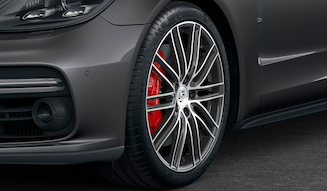
The new Panamera's exterior, with its more solid and high-quality feel, measures 5,049mm in length, 1,937mm in width, and 1,423mm in height. While these dimensions are not drastically different from the first-generation Panamera, a closer comparison reveals an increase of 34mm in length, 6mm in width, and 5mm in height. Despite the increased height, the silhouette appears lower and longer. Porsche explains this is a result of reducing the roofline above the rear seats by 20mm while maintaining ample headroom.
The wheelbase has been extended by 30mm to 2,950mm. By repositioning the front wheels further forward, the front overhang has been shortened, and the distance between the A-pillar and the front axle has been increased. Conversely, the rear overhang is longer, creating a more dynamic proportion that conveys a sense of presence and sportiness.
Porsche Panamera
Porsche Panamera
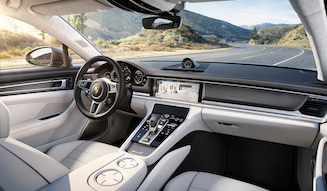
The interior has also evolved with a more refined design. The basic layout of the dashboard and center console in a T-shape remains from the first generation, but physical switches have been replaced with touch controls, giving the center console panel a much cleaner appearance. The analog tachometer is centrally located in the instrument cluster, flanked by two 7-inch displays, maintaining the classic Porsche layout. The overall finish feels high-quality, masterfully balancing the image of a sports car and a luxury vehicle.
Furthermore, the center console features a 12.3-inch touchscreen, the core of the next-generation Porsche Communication Management (PCM) system. Drivers and front passengers can individually configure this display. The large screen displays online navigation, Porsche Connect online services, and smartphone integration via Apple CarPlay, along with a new voice control system that responds to spoken commands in various languages.
Porsche Panamera | Porsche Panamera
Reservations Now Open in Japan
The Second Generation Panamera Arrives (3)
Balancing Performance and Fuel Efficiency
The initial lineup for the second-generation Panamera will consist of two all-wheel-drive gasoline models, the "Panamera 4S" and "Panamera Turbo," along with the "Panamera S Diesel" (not planned for Japanese introduction), which marks the first all-wheel-drive diesel model.
The Panamera 4S is equipped with a new 8-speed PDK dual-clutch transmission paired with a 2,894cc V6 twin-turbo engine, producing a maximum output of 440 hp (324 kW) at 5,650-6,600 rpm and a peak torque of 56.1 kgm (550 Nm) at 1,750-5,500 rpm. The high-performance Panamera Turbo features an 8-speed PDK mated to a 3,996cc V8 twin-turbo engine, delivering a maximum output of 550 hp (404 kW) at 5,750-6,000 rpm and a peak torque of 78.5 kgm (770 Nm) at 1,960-4,500 rpm. This V8 twin-turbo engine incorporates Porsche's first application of adaptive cylinder control, which deactivates cylinders under certain driving conditions.
Porsche Panamera 4S
Porsche Panamera 4S
While its introduction to the Japanese market is unlikely due to its "un-Porsche-like" nature, the V8 diesel engine, combined with all-wheel drive for the first time, is a noteworthy power unit, generating a maximum output of 422 hp (310 kW) at 3,500 rpm and a peak torque of 86.7 kgm (850 Nm) at 1,000-3,250 rpm. Its performance, with a top speed of 285 km/h thanks to twin-turbocharging, sets a benchmark for top-tier production diesel engines.
The Panamera Turbo accelerates from 0 to 100 km/h in 3.8 seconds (3.6 seconds with the Sport Chrono Package) and reaches a top speed of 306 km/h. The Panamera 4S achieves 0-100 km/h in 4.4 seconds (4.2 seconds with the Sport Chrono Package) and a top speed of 300 km/h. Fuel economy figures are 10.6-10.7 km/L for the Panamera Turbo, 12.1-12.3 km/L for the Panamera 4S, and 14.7-14.9 km/L for the diesel Panamera S Diesel (all European combined figures). The new Panamera appears to offer the optimal solution, balancing performance and fuel efficiency at a level that stands out even within the luxury car segment.
Porsche Panamera 4S
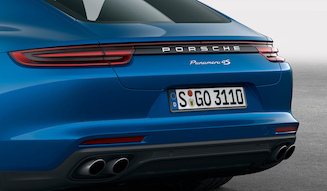
Porsche Panamera 4S
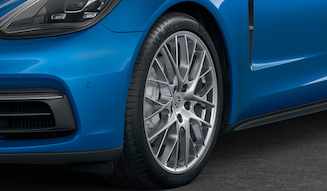
The chassis incorporates new rear-axle steering, inherited from the "918 Spyder" and the "911 Turbo". Additionally, it features the latest available Porsche technologies, including optional adaptive air suspension with new three-chamber technology and Porsche Active Suspension Management (PASM), Porsche Torque Vectoring Plus (PTV Plus), active roll stabilization with Porsche Dynamic Chassis Control Sport (PDCC Sport), and a new electromechanical power steering system.
Orders began in Japan on July 28th. The announced prices are 15.91 million yen for the Panamera 4S and 23.27 million yen for the Panamera Turbo. Both models are primarily available in right-hand drive, but left-hand drive versions of the Panamera Turbo will be available for order on a limited-time basis.