The Fifth-Generation E-Class Arrives | Mercedes-Benz
Mercedes-Benz E-Class
Fifth-Generation E-Class Debuts
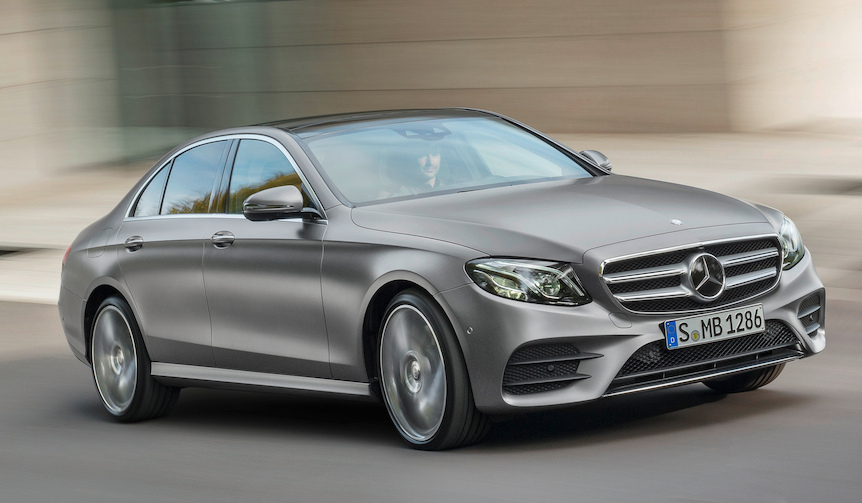
Mercedes-Benz unveiled the all-new E-Class, fully redesigned, at the North American International Auto Show (NAIAS), also known as the Detroit Motor Show, on January 11th local time. Key highlights include an exterior designed with the same latest design language as the flagship S-Class sedan and C-Class compact model, an interior with enhanced luxury, and the advanced "DRIVE PILOT" safety and driver assistance system, which incorporates features like automatic lane changes.
Text by SAKURAI Kenichi
Design Unified with S-Class and C-Class
Amidst the many new models and concept cars, perhaps more than expected, that electrified this Detroit Motor Show, few would dispute that the star of global attention was the completely redesigned new E-Class. The new E-Class, publicly revealed at this show, truly made its world premiere the day before the show's opening at a New Year reception.
Codenamed "W213," the fifth generation of the E-Class, which debuted in 1995 as the first model, belongs to the E-segment, positioned between the C-Class and S-Class. With the three core models now unified in form under the latest design language originating from the S-Class, the car's positioning, once known as the "medium class," is naturally brought to mind.
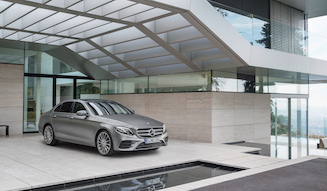
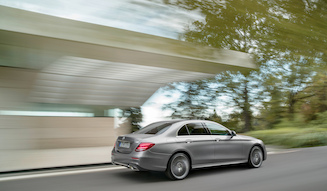
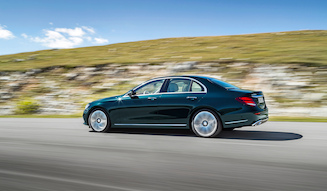
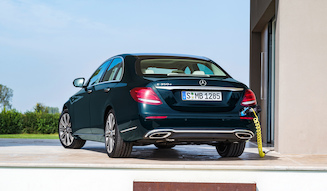
As mentioned, the design of the new model, which everyone is curious about, possesses a coupe-like fluidity, inheriting the lineage of both the C-Class and S-Class, with a captivating appearance that is unmistakably a Mercedes. The curves from the three-dimensional front grille, extending through the headlights, hood, and along the body sides, create a greater sense of unity and a sculpted, solid feel. The taillight design, similar to the C-Class, is compactly housed on either side of the trunk lid. Unity with the C-Class and S-Class must have been a major development theme.
The dimensions of this sporty design have been extended: the overall length has increased by 43mm, from 4,880mm in the previous model to 4,923mm, and the wheelbase has grown by 65mm, from 2,874mm to 2,939mm. The stylish and dynamic short overhangs, long wheelbase, and flared fenders housing large wheels further refine the exterior design cues seen in the C-Class and S-Class.
Mercedes-Benz E-Class
Fifth-Generation E-Class Debuts (2)
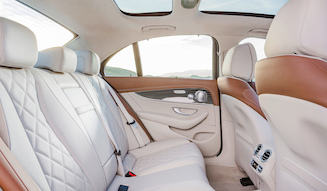
A More Luxurious Interior
The base version features a classic Mercedes radiator grille with a three-pointed star on the hood, while the "Avantgarde" and "AMG Line" models have a larger three-pointed star in the center of the radiator grille with a sports grille. These two can be easily distinguished.
The interior, revealed prior to the vehicle's world premiere, suggested a resemblance to the more luxurious S-Class, but the actual design imparts an even more luxurious impression than the images released at the time.
The dashboard, with its vertically split round design, can be equipped with (as an option, in the case of the Japanese specification) a second-generation, high-resolution 12.3-inch widescreen display. Visually, it serves as a central element emphasizing the wide horizontal orientation of the interior design. It seems reasonable to conclude that this contributes to the interior feeling both detailed and spacious. Three distinct design themes are available: "Classic," "Sport," and "Progressive."
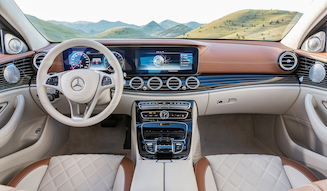
Furthermore, the touch-sensitive control buttons on the steering wheel, a first for the new E-Class, allow the driver to control the entire infotainment system with finger swipes, similar to a smartphone interface, without removing their hands from the wheel. Mercedes explains that this enhances driver operability and contributes to safer driving by minimizing eye movement.
The infotainment system, as before, includes a touch pad with handwriting recognition and a controller located in front of the center console, as well as a voice control system. The interfaces for navigation, audio, and climate control have also been further evolved as part of the driver assistance systems. Of course, separate switches are also provided for intuitive operation, so owners who are not comfortable with smartphone-like controls can rest assured.
Additionally, the interior lighting utilizes durable and energy-efficient LEDs, offering personalization in 64 colors. LED lighting is provided in the trim on the center console, the central display area, the front storage compartment and door pockets, the front and rear footwells, the overhead console, and even the speaker tweeters.
Mercedes-Benz E-Class
Fifth-Generation E-Class Debuts (3)
The Path to Autonomous Driving Nears
The powertrain lineup for the newly announced E-Class includes one gasoline and one diesel inline four-cylinder engine, one gasoline and one diesel V6 engine, and one plug-in hybrid model.
Specifically, the gasoline engine models are the rear-wheel-drive "E 200" equipped with a 2.0-liter inline four-cylinder turbo engine producing a maximum output of 135 kW (184 hp) and a maximum torque of 300 Nm (30.5 kgm), and the all-wheel-drive "E 400 4MATIC" equipped with a 3.0-liter V6 engine producing a maximum output of 245 kW (333 hp) and a maximum torque of 480 Nm (48.9 kgm). The diesel models consist of the "E 220 d" with a 2.0-liter inline four-cylinder engine producing 143 kW (195 hp) and 400 Nm (40.7 kgm), and the "E 350 d" with a 3.0-liter V6 engine producing 190 kW (258 hp) and 620 Nm (63.2 kgm).
In addition, a plug-in hybrid model, the "E 350 e," is available from launch. This model combines a 2.0-liter inline four-cylinder gasoline engine with a maximum output of 155 kW (211 hp) and a maximum torque of 350 Nm (35.6 kgm) with an electric motor producing 65 kW (88 hp) and 440 Nm (44.8 kgm), for a total system output of 210 kW (286 hp) and 550 Nm (56.0 kgm). All of the aforementioned models utilize the latest nine-speed automatic transmission, "9G-TRONIC."
Meanwhile, Mercedes is focusing significant effort on developing its advanced driver assistance systems, which have evolved into the next-generation "DRIVE PILOT." With this system, the adaptive cruise control "DISTRONIC" operates at speeds up to 210 km/h, maintaining an appropriate distance behind the preceding vehicle. Furthermore, at speeds up to 130 km/h, it can operate cruise control by considering the spacing with surrounding vehicles, even if lane markings are unclear or absent. This system is said to particularly reduce driver burden in traffic jams and congestion.
The DRIVE PILOT also includes the "Active Lane Change Assist" for the first time, which automatically changes lanes. On multi-lane roads, radar sensors and cameras confirm that there are no other vehicles in the adjacent lane before assisting the driver in steering back into the selected lane after completing an overtake. This is, of course, an application of Mercedes' extensive testing and near-practical implementation of fully autonomous driving technology.
The new E-Class is not merely a fully redesigned model; it also serves as a bridge to the next step in automotive evolution that Mercedes is pursuing: fully autonomous driving. With significant advancements in design, safety, comfort, and environmental performance, the new E-Class carries a substantial role in shaping the future of automobiles.