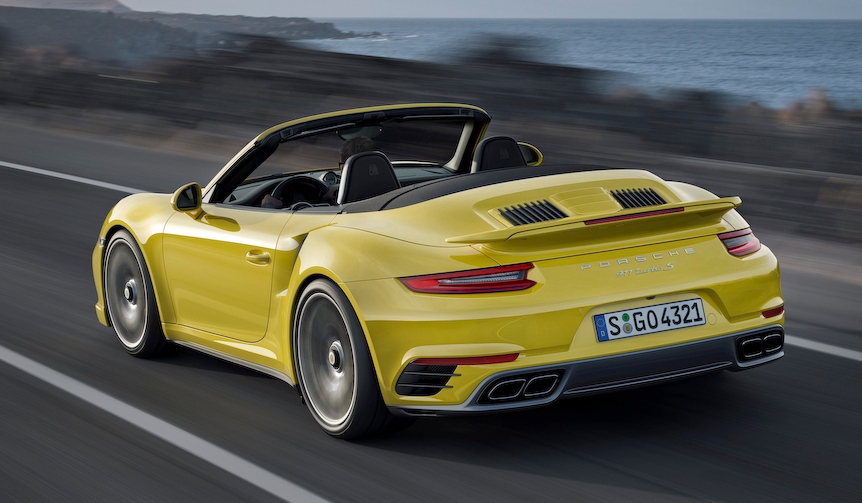
The 911 Turbo Evolves into the 991 II | Porsche
Porsche 911 Turbo | Porsche 911 Turbo
Porsche 911 Turbo Cabriolet | Porsche 911 Turbo Cabriolet
The 911 Turbo Evolves to the 991 II
The "911" series has undergone a major minor change, primarily featuring the adoption of a downsized turbo. The evolved new model of the flagship "911 Turbo" will have its world premiere at the Detroit Motor Show in January next year. In addition to the veiled 911 Turbo, the high-performance "911 Turbo S" and the open-top "911 Turbo Cabriolet" and "911 Turbo S Cabriolet" will also be announced simultaneously. Orders have already begun in Japan since December 1st.
Text by SAKURAI Kenichi
The 991 II Lineup is Finally Complete
It is still fresh in our memory that the latest model of the Porsche "911," codenamed the 991, received a minor change, and its first installment, the rear-wheel-drive "Carrera" and "Carrera S," were globally unveiled at the Frankfurt Motor Show held this autumn. However, without taking a moment's rest, Porsche has added "Carrera 4" and "Carrera 4S" as new variations to the 991 II, the second generation of the 991, which is its evolved version. These all-wheel-drive models had their world premiere at the recent Tokyo Motor Show and are now on public display.
However, Porsche did not rest, and hurried to complete the 991 II lineup. At the upcoming Detroit Motor Show in January 2016, the "Turbo," the most high-performance model in the 911 series catalog, will be announced as an addition. This marks the transition of the entire 911 series catalog models, excluding special editions like the "GT3" and "RS," to the new generation. Incidentally, the "911 Turbo" series announced its order start in Japan on December 1st.
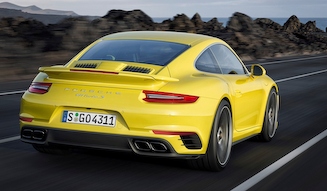
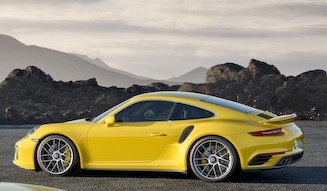
The "Turbo," reigning at the top of the new 911, codenamed 991 II, will be available in two body styles, coupe and cabriolet, following the existing lineup. The exterior design adheres to the recently released 991 II, featuring headlights with four-point daytime running lights, door handles without recess covers, a redesigned rear lid with vertical louvers, and newly designed taillights that give a sharper impression. These features, characteristic of the second generation, are also common to the evolved "Turbo."
The adoption of new 20-inch wheels is likely another distinguishing point from the previous 991. The Turbo S replaces the previous 10-spoke double-spoke design with a 7-spoke double-spoke center-lock wheel design. The wheel size for the Turbo is 9Jx20 for the front and 11.5Jx20 for the rear, each widened by 0.5 inches, making them the same size as the Turbo S.
Furthermore, radar-based lane change assist and a front axle lift system that raises the front spoiler lip by 40mm at low speeds are newly available as options for all Turbo models, enhancing safety and practicality.
Porsche 911 Turbo | Porsche 911 Turbo
Porsche 911 Turbo Cabriolet | Porsche 911 Turbo Cabriolet
The 911 Turbo Evolves to the 991 II (2)
More Powerful 3.8-Liter Flat-Six Twin-Turbo Engine
More noteworthy than these interior and exterior refinements is the engine. While each car in the second-generation 991 II features a downsized (or light-sized, as Porsche calls it) 3-liter flat-six twin-turbo engine, the Turbo continues to be powered by a 3.8-liter flat-six. As before, the high-performance Turbo S will also be part of the lineup.
This 3.8-liter flat-six twin-turbo engine delivers 15 kW (20 hp) more performance than its predecessor for both the Turbo and Turbo S. The Turbo achieves a maximum output of 397 kW (540 hp) through revised cylinder heads with revised inlet ports and new injectors combined with higher fuel pressure. The Turbo S, on the other hand, produces 427 kW (580 hp) with new turbochargers featuring larger compressors. The transmission remains the 7-speed PDK (dual-clutch transmission) as before.
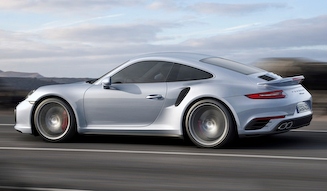
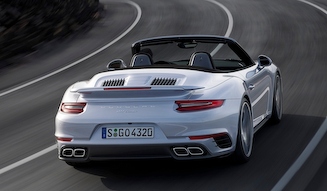
This engine is also equipped with a "dynamic boost function," which is said to further improve engine response when more power is needed than usual or during increased accelerator input. This new function, which maintains boost pressure even during load fluctuations, such as when the accelerator pedal is slightly released, is achieved by keeping the throttle valve open while cutting fuel. This results in responsive engine reaction when the accelerator pedal is pressed, along with the secondary benefit of reduced fuel consumption.
Performance has also significantly improved. The 0-100 km/h acceleration time for the Turbo is 3.0 seconds, and its top speed is 320 km/h, 5 km/h higher than the previous model. For the Turbo S, the 0-100 km/h acceleration time is 2.9 seconds, and its top speed reaches 330 km/h, 12 km/h higher than the previous model (all data for the coupe).
Despite these performance enhancements, fuel consumption has been improved to just 9.1 L/100km (10.98 km/L) for the coupe and 9.3 L/100km (10.75 km/L) for the cabriolet. This represents a reduction of 0.6 L/100km in fuel consumption across all grades. These improvements were achieved through engine and transmission management with modified gear shift mapping.
Porsche 911 Turbo | Porsche 911 Turbo
Porsche 911 Turbo Cabriolet | Porsche 911 Turbo Cabriolet
The 911 Turbo Evolves to the 991 II (3)
Latest Infotainment Compatible with Google Earth and Street View
The interior also features changes consistent with the previously released 991 II. A unique feature is the mode switch located on the new 360mm diameter GT Sport steering wheel. This allows for the selection of four different driving modes: "Normal," "Sport," "Sport Plus," and "Individual."
Furthermore, the Sport Chrono package includes a "Sport Response Switch" in the center of this mode switch, similar to a boost function. When the Sport Response Switch is activated, the engine and transmission response reach their highest level, optimizing acceleration for 20 seconds for situations like overtaking.
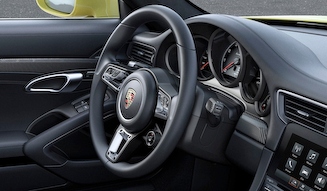
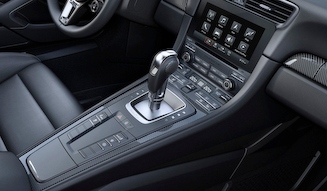
The infotainment system has also evolved to a new generation. The PCM with online navigation and a multi-touch monitor is now standard on all Turbo models, enabling the display of Google Earth and Google Street View images, as well as destination searches via handwriting input.
In Japan, the pricing is set at 22.36 million yen for the base 911 Turbo, 25.02 million yen for the 911 Turbo Cabriolet, 25.99 million yen for the high-performance 911 Turbo S, and 28.65 million yen for the 911 Turbo S Cabriolet. All models come exclusively with the 7-speed PDK, and both left-hand and right-hand drive options are available.
Porsche Customer Care Center
0120-846-911
http://www.porsche.co.jp