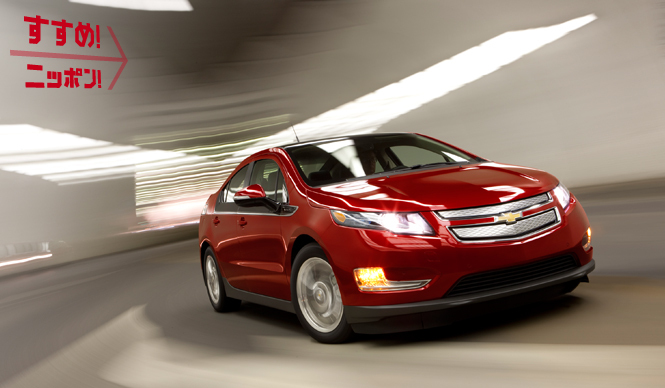
CHEVROLET VOLT: The American Plug-in Hybrid Car
CHEVROLET VOLT
America's Plug-in Hybrid Car with Constant Electric Drive (1)
The "Chevrolet Volt," touted as a new generation of alternative fuel vehicle, was unveiled in Japan on May 18, 2011, by General Motors Japan.
By Fumio Ogawa
GM's Strategy for a New Low-Carbon Society
American manufacturers cannot afford to be complacent in the intensifying global race to develop alternative fuel vehicles. This announcement serves as a harbinger of that effort. The Volt is the product of General Motors, which owns the Chevrolet brand. Already running on American roads, it is proof that this American automaker is steadily advancing toward a new low-carbon society.
The hallmark of the Chevrolet Volt, developed in the United States, is that it is an "electric vehicle with extended range capability." As Sumito Ishii, President of General Motors Japan, puts it, "You can drive with peace of mind, without worrying about the social infrastructure like public charging stations, as you would with an electric vehicle."
"The Chevrolet Volt is not a typical hybrid car. It is an unparalleled, constantly electric-driven automobile with a range of up to 379 miles (610 km) in any climate." So says Martin Murray. He belongs to the Hybrid & Electric Powertrain Engineering division at GM International Operations, a subsidiary of General Motors in the U.S., and holds the title of Director. He came to Japan to explain the vehicle at the "Automotive Engineering Exposition 2011, EV Technology Expo, Human and Automobile Technology Expo" held at Pacifico Yokohama.
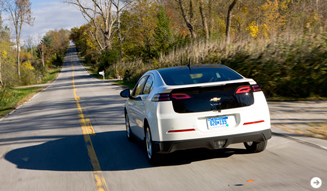
Why the Volt Isn't a Typical Hybrid
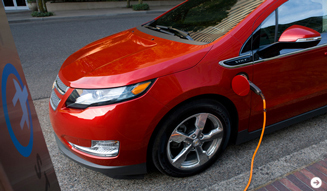
The Chevrolet Volt is equipped with two electric motors and a 1.4-liter gasoline engine. The lithium-ion battery can be charged from a household power outlet. It is a plug-in hybrid that, like the recently announced and releasedToyota Prius Alpha,increases reliance on electric motors. The reason it is not a "typical hybrid car" lies in its driving program.
"The Volt is a pure electric vehicle for the first 25 to 50 miles (40 to 80 km). The engine only starts when the remaining charge in the lithium-ion battery drops below 30 percent," says Murray.
Murray emphasizes that this differs from the Toyota Prius, which uses the THS-II hybrid system that constantly combines electric motors and engines for driving. "When sufficient charge is available, it uses only the electric motor even when traveling at 160 km/h."
Range Extender Focused on Electric Motors
The gasoline engine operates only when the charge level drops below the specified limit or during sudden acceleration. For rapid acceleration, the electric motor initially provides high torque to drive the wheels, and then the engine starts to add further power. The primary power source is the electric motor. By using the gasoline engine only for charging the battery or assisting in situations requiring significant power, the usability as an electric vehicle is enhanced.
Vehicles like this are now called range extenders, because they are equipped with a mechanism to extend the driving range. In an era where charging infrastructure is not yet fully developed, these are alternative fuel vehicles attracting attention as a bridge between future electric vehicles and current gasoline cars.
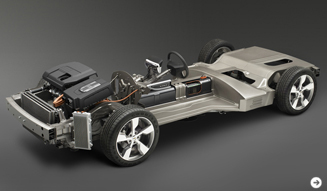
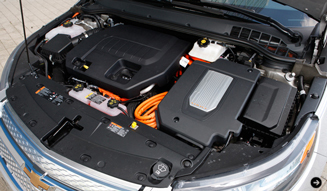
Powertrain Composed of Electric Motors and a Small-Displacement Engine
The Chevrolet Volt's powertrain consists of two electric motors and a gasoline engine. One electric motor functions as the drive motor, producing 111 kW (149 hp) of power and 368 Nm of torque. The other is a small generator-integrated motor. Normally, the large electric motor drives the vehicle, and when cruising, the large motor stops and the small electric motor operates, thereby improving efficiency. The engine is a 1.4-liter, 4-cylinder SOHC, 4-valve unit with variable intake and exhaust valves, producing a maximum output of 63 kW (84 hp) at 4,800 rpm. A clutch is placed between these components, and electronic control allows them to engage and disengage, selecting the optimal powertrain according to driving conditions.
Recent news reports indicate that General Motors is seriously committed to increasing Volt production and sales. The sales region, currently limited to certain states in the United States, will expand nationwide within the year. Concurrently, exports to overseas markets will begin, starting with Canada and China within the year, and with plans for sales in Europe in the near future.
In Japan, "a demonstration experiment is scheduled to begin soon" (according to a spokesperson for General Motors Japan), but the release date is "undetermined." Regarding its potential as an electric vehicle, such as its ability to supply power to homes during disasters or its active role in regional power infrastructure, Martin Murray stated, "There is great potential. I believe it can also support smart grid systems (where electricity generated by vehicles is stored and distributed to homes and factories). We want to consider various possibilities with an eye toward the near future."
CHEVROLET VOLT
Body Dimensions: Length 4,498 x Width 1,788 x Height 1,430 mm
Wheelbase: 2,685 mm
Vehicle Weight: 2,079 kg
Engine: 1.4-liter inline 4-cylinder DOHC
Maximum Output (Engine): 63 kW (84 hp) / 4,800 rpm
Maximum Output (Motor): 111 kW (149 hp)
Maximum Torque (Motor): 368 Nm
Range: 610 km
Fuel Economy (Engine Running): 15.7 km/L
Fuel Economy (Engine and Motor Combined): 25.5 km/L