Lamborghini Aventador | Lamborghini Aventador Chassis Revealed!
Lamborghini Aventador
Lamborghini Unveils Chassis Images of New Model
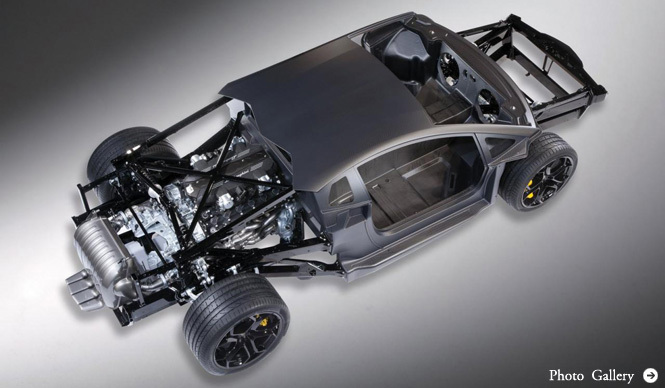
Gradually, images of the engine and transmission, suspension, monocoque, and even a video of the actual car in camouflage paint have been released, heightening anticipation for its debut. This new flagship Lamborghini, expected to arrive as the Aventador LP700-4, has now had its chassis images revealed.
By Dai Matsuo
An Ultra-High-Performance Engine Delivering 515kW and 690Nm
Although chassis images have been released, no new information has been announced. Therefore, we will consolidate the information Lamborghini has previously disclosed to bring you closer to the actual car.
The 6.5-liter V12 engine, producing a maximum output of 515kW (700ps) at 8,250rpm and a peak torque of 690Nm (70.4kgm) at 5,500rpm, was developed from scratch with the latest technology. The crankcase and four-valve cylinder head are made of aluminum-silicon alloy. It features an intake system with four independent throttle valves, and the exhaust system is designed to minimize emissions while producing the signature, sensual Lamborghini sound. Despite this, it weighs a mere 235kg, exceptionally light for a V12 engine, achieving approximately 3ps per kilogram of engine weight.
The transmission is a special unit called Lamborghini ISR (Independent Shifting Rod). This single-clutch, robotized manual gearbox achieves shift times approximately 50% shorter than dual-clutch systems. While conventional gearboxes perform sequential shifting operations, the ISR performs them in parallel. As one shifting rod disengages a gear, another shifting rod engages the next. Notably, it is also extremely lightweight, weighing just 79kg.
Pushrod Suspension: A World First for a Production Car
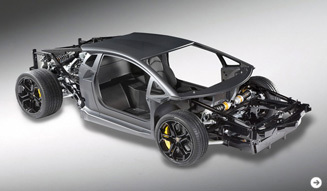
The adoption of a pushrod suspension, a world first for a production car, is also a significant talking point. Inspired by F1 car design, the spring and damper elements are not mounted on the wheel hubs but are connected internally to the bodyshell structure. The springs and dampers are mounted horizontally beneath the front windshield and near the rear engine. A pushrod and relay lever/rocker arm system transmits force from the wheel hubs to the spring and damper elements.
The combination of double wishbones and pushrod suspension allows for independent control of wheel movement and damping, resulting in more responsive handling that is easier to manage at all speeds. Simultaneously, the high rigidity connection to the chassis enhances precision, allowing the springs and dampers to react more naturally. Consequently, the spring stiffness could be slightly reduced, contributing to improved comfort without sacrificing precision.
Weight reduction is also a priority for the chassis. The entire suspension system, including the upper and lower control arms, wheel hubs, and relay levers, is crafted from forged aluminum alloy. The large-diameter discs of the braking system are made from lightweight yet extremely rigid carbon-ceramic composite material. The front axle is equipped with 400mm diameter ventilated discs featuring six-piston calipers, while the rear axle has 380mm diameter discs with four-piston calipers and an electric parking brake.
Furthermore, hydraulic steering is employed to maintain precise handling feel. The suspension features 19-inch wheels with 255/35 tires at the front and 20-inch wheels with 335/30 tires at the rear. The steering assistance level varies in three stages depending on the driver's selected mode, including the 'Corsa' mode, which enables lightning-fast acceleration on the track.
Ultra-Lightweight White Body Weighs Just 229.5kg
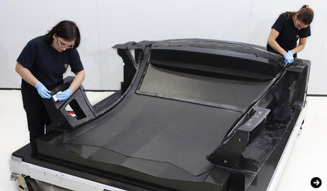
The monocoque is a single shell that functions as a single component, manufactured in-house by Lamborghini using a patented process with carbon fiber reinforced plastic (CFRP). Despite being a single shell, it is composed of numerous parts with specialized functions. One example is the hardened element, which utilizes braiding technology for high performance in absorbing impact energy. After the hardening process, the entire monocoque, including the base known as the 'tab' and the roof, functions as one unit.
This full monocoque solution offers advantages over traditional processes, including the tab where the metal roof is attached in the conventional manner. The monocoque's remarkably low weight of just 147.5 kg is also noteworthy.
The monocoque is fitted with equally rigid aluminum subframes at the front and rear, to which the suspension, engine, and transmission are mounted. As a result, the white body weighs a mere 229.5 kg and boasts a torsional rigidity of 35,000Nm per degree of twist. This robust body enables precise wheel control and delicate feedback. Its ability to respond to minute steering inputs with high accuracy is said to be on par with race cars.