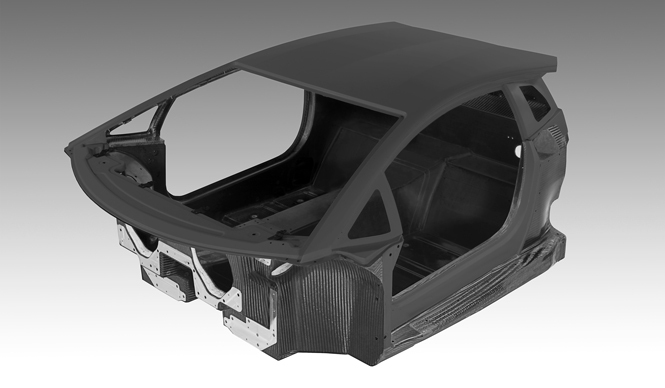
Lamborghini Reveals Full Carbon Fiber Monocoque
LAMBORGHINI Aventador
Full Carbon Fiber Monocoque Revealed
With the Geneva Motor Show just two weeks away, Lamborghini has unveiled the monocoque that will be used in the Murciélago's successor, set to debut there.
By Dai Matsuo
Torsional Rigidity of 35,000 Nm/degree
Even before its debut, Lamborghini has been gradually revealing details about its new flagship model, the Aventador, including its engine and suspension. This time, the monocoque has been unveiled.
The new monocoque is a composite material formed by impregnating carbon fiber with plastic and then hardening it, commonly known as carbon fiber reinforced plastic (CFRP). All of this CFRP is produced in-house at Lamborghini's own factory, utilizing several patented technologies. As is evident from the photos, it forms a single shell from the cockpit to the roof. Given that carbon monocoques have been used in F1 for many years, it's clear that this shell itself is designed to function like a roll cage.
In fact, its torsional rigidity is exceptionally high for a production car, requiring 35,000 Nm of force to twist it by just one degree. This not only ensures robustness but also suggests a remarkably responsive steering feel.
Furthermore, its incredibly light weight must not be overlooked. The monocoque alone weighs just 147.5 kg, and the white body is only 229.5 kg. With the engine weighing 246 kg, the crankshaft 24.6 kg, and the gearbox 79 kg already announced, we can anticipate a vehicle weight close to the "Sesto Elemento Concept," which boasted a curb weight of 999 kg when revealed last fall. High-rigidity aluminum subframes are attached to the front and rear of the monocoque, serving as mounting points for the suspension, engine, and transmission.
CFRP Used Appropriately
To match the shape, function, and requirements of each element, Lamborghini's development team selected three primary CFRP manufacturing methods from its technology toolkit: Resin Transfer Molding (RTM), pre-preg, and braiding. These differ not only in their manufacturing processes but also in the type of carbon fiber, its weave, and the chemical composition of the synthetic resin.
RTM is an evolution of a traditional method, patented as "RTM Lamborghini." The final molds used in this process are made of lightweight carbon fiber rather than heavy, complex metal, and resin injection occurs at relatively low pressure. Pre-preg carbon fiber mats are pre-impregnated with a thermosetting liquid resin and stored at low temperatures. These mats are layered into a mold and cured under high temperature and pressure in an autoclave. Braiding is another component manufactured using RTM technology. It is used to create hollow components with special functions, such as roof pillars and rocker panels, and is constructed by layering multiple diagonally woven carbon fiber sheets.
Epoxy resin foam is also incorporated into the monocoque. This foam acts as a spacer between the carbon fiber composite layers, enhancing rigidity while also absorbing noise and vibration.
By extensively using CFRP, Lamborghini has achieved significant weight reduction, enabling the supercar to deliver excellent fuel efficiency and low CO2 emissions. Of course, the most significant benefit for a sports car is the improved power-to-weight ratio, which greatly impacts the vehicle's overall feel and performance, contributing to agile acceleration, superior handling, and braking capabilities.