May 27, 2015
The AMG C 63 Equipped with a V8 Twin-Turbo | Mercedes-Benz
Mercedes-AMG C 63
W205 C-Class Features AMG GT-Derived V8 Twin-Turbo
Mercedes-AMG C 63 Debuts in Paris
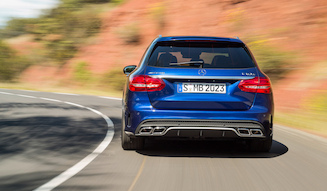
As we previously reported, Mercedes-Benz hasadded the AMG model "C 63 AMG" to the new W205 "C-Class". The highly anticipated powertrain is a new V8 twin-turbo derived from the "Mercedes-AMG GT". The top model delivers a maximum output of 510 ps (375 kW) / 5,500-6,250 rpm and a maximum torque of 700 Nm / 1,750-4,500 rpm, matching the AMG GT. This signifies the birth of the most powerful "C-Class" ever.C-Class.
Text by SAKURAI Kenichi
AMG's Stance Evolves
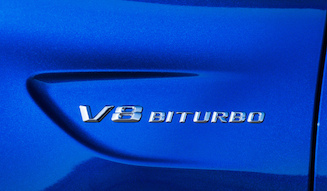
Replacing the naturally aspirated 6.2-liter V8 from the previous model, the new "C 63" is equipped with a 4.0-liter V8 twin-turbo engine derived from the "Mercedes-AMG GT". The "C 63" produces a maximum output of 476 ps (350 kW) / 5,500-6,250 rpm and a maximum torque of 650 Nm / 1,750-4,500 rpm. The more powerful "C 63 S" achieves 510 ps (375 kW) / 5,500-6,250 rpm and 700 Nm / 1,750-4,500 rpm, matching the AMG GT's specifications.Mercedes-AMG GT
Although the displacement has decreased by more than 2 liters compared to the previous generation, even the base model "AMG C 63" boasts a 19 ps increase in maximum output (compared to the 2013 C 63 AMG). The high-performance "AMG C 63 S" surpasses even the final special edition of the W204, the "C 63 AMG Edition 507", by 3 ps (2 kW).C 63 AMG Edition 507.
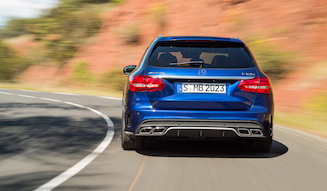

While it's twin-turbocharged, achieving this output from just 4.0 liters of displacement is nothing short of remarkable. The "E 63 AMG", based on the "E-Class", has already downsized to a 5.5-liter twin-turbo. This represents a further step, an evolution of downsizing.E 63 AMG.
We will report on this "M177" power unit in detail later, but before that, there's another topic that demands attention: the name. Until now, with the exception of the flagship "SLS AMG", all AMG models followed a rule: the base model name was appended with a number corresponding to the engine's displacement, followed by "AMG". For example, the aforementioned E 63 AMG, or the previous generation W204-based "C 63 AMG".
However, the W205-based AMG announced this time is different. Its official name is "Mercedes-AMG C 63". You may have noticed that the name, which should conventionally be "Mercedes-Benz C 63 AMG", has been fundamentally changed, with "AMG" replacing "Benz". This new naming convention was also applied to the "Mercedes-AMG GT" that appeared earlier.
Mercedes-AMG C 63
W205 C-Class Features AMG GT-Derived V8 Twin-Turbo
Mercedes-AMG C 63 Debuts in Paris (2)
What the Name Change Signifies
What does this change in nomenclature signify? There are likely two answers.
The first is that Mercedes plans to promote a brand strategy with two major categories: "Benz" for the regular lineup and "AMG" for high-performance versions. This means that Mercedes' high-performance models are not just AMG variants of Mercedes-Benz; rather, Mercedes will be divided into two distinct lineups, "Benz" and "AMG", with clearly different characters. While it may seem similar, the meaning and significance are fundamentally different from before.
The second is a strategy to position "AMG" closer to the core Mercedes brand while maintaining a degree of independence and exclusivity. In simple terms, it's an integration of AMG. The "Mercedes-AMG GT" already exemplifies this.


The design of the Mercedes-AMG GT was overseen by Mercedes' chief designer, Gordon Wagener. Consequently, the AMG GT, compared to the more original SLS AMG, is closer to Mercedes' latest design language and incorporates it appropriately. At the AMG GT launch event held last month in Germany, it was announced during the presentation that "AMG's research and development is now fully integrated with Mercedes-Benz." This integration of R&D is likely essential for reducing development costs and accelerating the process.
While this preamble has been somewhat lengthy, considering these points, the "AMG C 63" also reflects the second installment and new strategy for "Mercedes-AMG", spearheaded by the new generation sports coupe "Mercedes-AMG GT" – the pinnacle of Mercedes (and again, not Benz) – announced recently.
Mercedes-AMG C 63
W205 C-Class Features AMG GT-Derived V8 Twin-Turbo
Mercedes-AMG C 63 Debuts in Paris (3)
The M177 Engine Derived from the Mercedes-AMG GT
The engine mounted at the front is codenamed M177, and it is, of course, based on the M178 engine found in the "Mercedes-AMG GT". It features twin turbochargers mounted within the V-bank and incorporates cutting-edge technologies such as spray-guided combustion and gasoline piezo direct injection, meeting Euro 6 emissions standards. Many of its mechanisms are shared, a testament to the "AMG" family.
In line with AMG tradition, this engine adheres to the "One Man, One Engine" philosophy. A single engineer is responsible for the entire complex process from assembly to completion, ensuring it is brought to fruition with dedication.
The total displacement for both the "AMG C 63" and "AMG C 63 S" is 3,982 cc. The AMG C 63 produces 476 ps (350 kW) / 5,500-6,250 rpm and 650 Nm / 1,750-4,500 rpm. The AMG C 63 S, on the other hand, boasts 510 ps (375 kW) / 5,500-6,250 rpm and 700 Nm / 1,750-4,500 rpm, exceeding the AMG GT's maximum torque by 50 Nm (5.1 kgm). This is likely related to the fact that the AMG C 63 S weighs over 100 kg more (1,665 kg) compared to the lightweight AMG GT (1,540 kg).


Although the top speed is electronically limited to 250 km/h, the 0-100 km/h acceleration figures are reported as 4.1 seconds for the AMG C 63 and a flat 4.0 seconds for the AMG C 63 S. However, what is particularly noteworthy, beyond these performance figures, is the excellent fuel efficiency.
Compared to the previous M156 engine found in the "C 63 AMG", there is a significant reduction in fuel consumption. Compared to the 6.3-liter V8 naturally aspirated engine, fuel consumption is approximately 32 percent lower, achieving an impressive 8.2 liters per 100 km (12.19 km per liter, NEDC value). It's also worth noting that the coasting mode, where the clutch of the AMG Speedshift MCT 7-speed sports transmission disengages from the drivetrain when the accelerator is released between 60 km/h and 160 km/h, plays a significant role in this substantial improvement in fuel economy.
Mercedes-AMG C 63
W205 C-Class Features AMG GT-Derived V8 Twin-Turbo
Mercedes-AMG C 63 Debuts in Paris (4)
Focus on Exhaust Sound
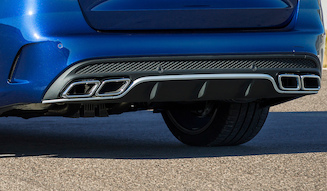
Both the AMG C 63 and AMG C 63 S feature a sports exhaust system with exhaust flaps. The flaps are located between the dual pipes and the main muffler, and the exhaust note changes according to the AMG Dynamic Select drive program. Furthermore, an optional performance exhaust system is a new offering.
This signifies the recognition of the importance of exhaust sound as a sports car brand. The performance exhaust system has switchable flaps in three modes: a low, comfort-oriented volume in "Comfort drive program," and a thrilling V8 sound reminiscent of a touring race car in "Sport+" and "Race" modes. In addition to being set via the drive program, these sounds can be enjoyed individually at any time with the press of a button.
Similar to the AMG GT, the engine and transmission unit are mounted using a dynamic mount system, which reduces vibrations and contributes to comfort and sporty handling. This system is standard on the AMG C 63 S. While conventional soft engine mounts isolate noise and vibration for improved comfort, the dynamic mount system enhances steering response and provides a more direct handling feel. The reduced drivetrain mass due to the smaller powertrain also benefits cornering.
The transmission is the familiar AMG Speedshift MCT 7-speed sports transmission. It offers varying shift speeds in "Controlled Efficiency," "Sport," "Sport+", and "Race" modes, providing appropriate driving dynamics for any situation. Mode selection is easily done via a rotary switch in the cockpit. Additionally, a "Temporary M" mode (paddle shifts only) is available for even more dynamic driving.
Mercedes-AMG C 63
W205 C-Class Features AMG GT-Derived V8 Twin-Turbo
Mercedes-AMG C 63 Debuts in Paris (5)
Chassis and Suspension
Regarding the chassis, notable features include the AMG Ride Control sport suspension with three adjustable damping levels and the electronically controlled rear locking differential on the AMG C 63 S (mechanical on the AMG C 63).
The AMG Ride Control sport suspension is made of lightweight aluminum and balances agility, high cornering speeds, and comfort. Drivers can arbitrarily change the suspension characteristics in three stages, choosing between sporty performance suitable for track driving and a comfort-oriented setting for long-distance journeys.
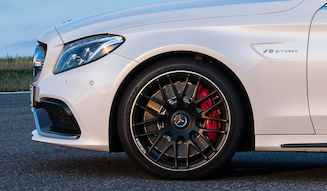

The electronically controlled rear locking differential reduces slip on the inner wheel during cornering, allowing for quicker acceleration out of corners and maintaining stability at high speeds. It also improves traction when starting from a standstill. Compared to a mechanical system, it offers finer adjustment and control, and is networked with the ESP system (available in "ESP ON," "ESP OFF," and "Sport Handling Mode") to enhance dynamic performance. The wheels are fitted with tires sized 245/40R18 at the front and 265/40R18 at the rear, mounted on standard 10-spoke, 8.5 x 18-inch (front) and 9.5 x 18-inch (rear) aluminum wheels in titanium gray. The AMG C 63 S features 245/35R19 front and 265/35R19 rear tires on 8.5 x 19-inch (front) and 9.5 x 19-inch (rear) 5-twin-spoke polished wheels. The high-performance ceramic composite brake system is an exclusive option for the AMG C 63 S.
Mercedes-AMG C 63
W205 C-Class Features AMG GT-Derived V8 Twin-Turbo
Mercedes-AMG C 63 Debuts in Paris (6)
Limited Edition "Edition 1" Also Available
The design is distinctly sporty, setting it apart completely from the base model. Features such as the AMG-specific "twin blade" radiator grille, the front spoiler designed for cooling air intake known as the "A-wing," the power domes on the hood, and the rear diffuser are AMG originals, all inspired by motorsport.
These additions extend the body length by 54 mm compared to the base W205. While the sporty parts and appearance are captivating, it's also notable that the body has been reinforced specifically for AMG models from the white body stage. This means that body rigidity has been considered and implemented from the production stage to handle the over 500 ps performance.
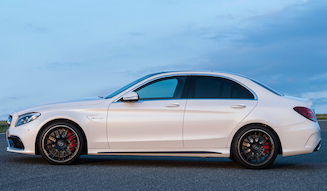
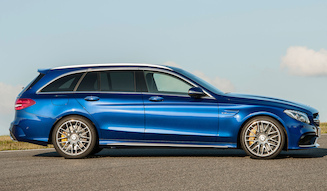
The interior offers an unprecedented sense of premium quality, with first-class materials and meticulous craftsmanship. Similar to the exterior, the "AMG C 63 S" and "AMG C 63" feature different materials and designs. Optional features include a dashboard with crystal-effect gray paint, black artificial leather from Italy's Artico, aluminum trim, and an AMG-exclusive IWC analog clock.
As a launch commemorative model, the "AMG C 63 Edition 1" will also be available, offered in six body colors: Soft White, Designo Diamond White Bright, Iridium Silver Metallic, Palladium Silver Metallic, Obsidian Black Metallic, and Designo Iridium Silver Magno (AMG-exclusive paint finish).
Available for both sedan and wagon variants, this model features forged aluminum wheels (8.5 x 19 inches front, 9.5 x 19 inches rear) with red rims and black matte cross-spoke design, paired with 245/35R19 front and 265/35R19 rear tires. It also includes numerous special equipment such as the Night package (A-wing, high-gloss black trim, high-gloss side mirror housings, black high-gloss window frames, etc.), black chrome twin exhaust pipe finishers, red decals on the radiator grille and wing mirrors, and black Nappa leather performance seats with diamond pattern and red contrast stitching, red Designo seatbelts, and a Dynamica microfiber performance steering wheel.

Mercedes-AMG C 63
Mercedes-AMG C 63 Estate
Curb Weight | (Sedan) 1,640 kg (Wagon) 1,710 kg
Engine | 3,982 cc V8 Twin-Turbo
Compression Ratio | 10.5
Max Output | 350 kW (476 ps) / 5,500-6,250 rpm
Max Torque | 650 Nm / 1,750-4,500 rpm
Transmission | AMG Speedshift MCT 7-speed sports transmission
Drivetrain | FR
Suspension F/R | 4-link / Multi-link
Tires F/R | 245/40R18 / 265/40R18
Trunk Capacity | 490-1,510 Liters
0-100 km/h Acceleration | (Sedan) 4.1 seconds (Wagon) 4.2 seconds
Top Speed | 250 km/h
Fuel Consumption (NEDC) | (Sedan) 8.2 ℓ/100km (Wagon) 8.4 ℓ/100km
CO2 Emissions | (Sedan) 192 g/km (Wagon) 196 g/km
Mercedes-AMG C 63 S
Mercedes-AMG C 63 S Estate
Curb Weight | (Sedan) 1,655 kg (Wagon) 1,725 kg
Engine | 3,982 cc V8 Twin-Turbo
Compression Ratio | 10.5
Max Output | 375 kW (510 ps) / 5,500-6,250 rpm
Max Torque | 700 Nm / 1,750-4,500 rpm
Transmission | AMG Speedshift MCT 7-speed sports transmission
Drivetrain | FR
Suspension F/R | 4-link / Multi-link
Tires F/R | 245/35R19 / 265/35R19
0-100 km/h Acceleration | (Sedan) 4.0 seconds (Wagon) 4.1 seconds
Top Speed | 250 km/h
Fuel Consumption (NEDC) | (Sedan) 8.4-8.2 ℓ/100km (Wagon) 8.6-8.4 ℓ/100km
CO2 Emissions | (Sedan) 195-192 g/km (Wagon) 200-196 g/km