December 4, 2014
Shanghai On-Site Report | Porsche
Porsche Panamera
Second-Generation Panamera Debuts in Shanghai
Since its debut in 2009, for the first time in its fourth yearThe extensively revised Panamerahas arrived at the Shanghai Motor Show. What is this new Panamera, which Porsche calls the "second generation"? A report from the scene by Motohiro Yamazaki.
Text by YAMAZAKI Motohiro
Long-Wheelbase Version Also Appears
Porsche first unveiled the Panamera four-door sedan at the Shanghai Show in 2009, ahead of the rest of the world. Four years have passed since then,Panameraalong with the SUV model"Cayenne"has become a hit that has greatly contributed to Porsche's global sales, as is well known.
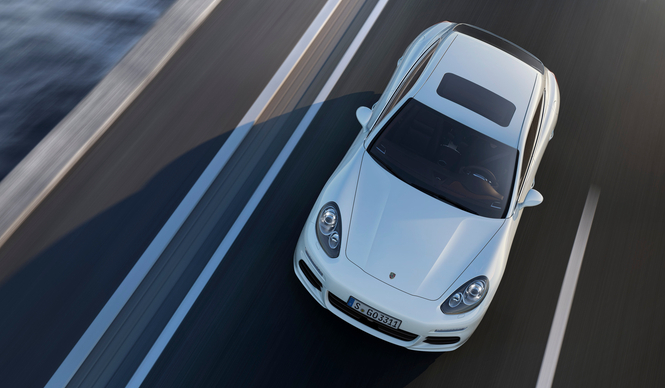
The Panamera has undergone a minor change, the largest in scale since its debut. Porsche itself refers to this minor change version of the Panamera as the second generation, and indeed, the Panamera has achieved a groundbreaking evolution that fully justifies that description.
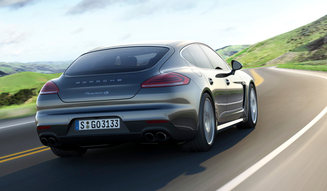
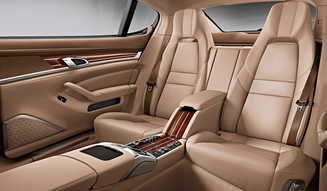
The biggest news in terms of lineup is the birth of a long-wheelbase version, with a 150mm extended wheelbase, under the name "Executive." The direct reason for this is, of course, to further enhance rear-seat comfort, and it is no exaggeration to say that China has been a key market in mind.
The main engine has been replaced by a newly developed 3-liter V6 twin-turbo. While the existing V8 engines will continue to be used in the GTS, the naturally aspirated high-end model, and the Turbo, the maximum output of 310 hp for the standard Panamera/Panamera 4, and 420 hp for the higher-performance Panamera S/4S, represents a 20 hp increase in power despite downsizing from the 4.8-liter V8 engine of the previous S/4S, along with an 18 percent improvement in fuel efficiency.
Hybrid Evolves into Plug-in Hybrid
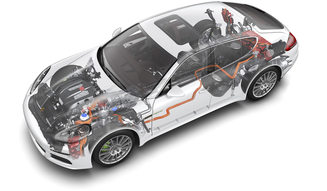
Even more significant news is the existence of a hybrid version, which combines a 333 hp 3-liter V6 twin-turbo engine with an electric motor producing 95 hp, more than double the previous output.
This model, called the "S e-Hybrid," achieves 36 km of zero-emission driving, or full EV driving, in NEDC tests. The battery is now lithium-ion, and it has evolved into a plug-in hybrid that can be fully charged in under 4 hours from a standard 230V household power outlet common in Germany.
The improvement in fuel efficiency is remarkable. While the previous S Hybrid boasted a figure of 7.1 L/100km, the new S e-Hybrid achieves 3.1 L/100km. In situations requiring full acceleration, the E-Boost function, where the electric motor supports the engine, enables a 0-100 km/h time of 5.5 seconds and a top speed of 270 km/h.


