April 15, 2015
NISSAN LEAF | The First Installment
NISSAN LEAF | The Nissan Leaf
Introducing the Nissan Leaf! Part 1
Since March 11th, energy issues have been a subject of active discussion. Beyond the nuclear accident, there are concerns about oil depletion, CO2 emissions, and the separation of power generation and transmission.Smart GridCars are deeply intertwined with all these issues. And as a vehicle that portends the future of automobiles, OPENERS has turned its attention to the Leaf, an EV (electric vehicle) released by Nissan. How will life with the Leaf redefine our image of cars for a new era? To delve into this profound question, OPENERS has introduced the Leaf as our fourth long-term report vehicle.
By Dai MatsuoPhotos by JAMANDFIX, Seiichi Saito (portraits)
Car No. 4
Nissan Leaf X
NISSAN LEAF X
Part 1
Delivery Date: October 4
The Era of the SNV (Social Network Vehicle) Has Arrived
The Nissan Leaf, launched at the end of 2010, has arrived at the OPENERS editorial department. Over the next five months, from October to the end of February, we will report on its performance and usability.
It has been over a century since Karl Benz and Gottlieb Daimler invented the automobile in 1885. At a time when a once-in-a-century great recession is raging and the automotive industry has been severely impacted, a vehicle that proposes a new vision for cars has emerged. This is precisely the time for such a car.
The Nissan Leaf is an EV that uses a battery and an electric motor. However, its appeal lies in its ability to transcend the category of a mere EV.
In a new society where people's lives are sustained by power generated from renewable sources like solar and wind, centered around a smart grid, rather than electricity from thermal or nuclear power supplied by the existing large-scale power grid, the ability to store generated electricity becomes a crucial issue. This is becauseRenewable Energypower generation is unstable, depending on weather conditions. One solution to this challenge is the EV. With the high-capacity, high-performance battery installed in EVs, cars, which have existed solely as a means of transportation, will also serve as storage batteries. In other words, cars will become not just personal tools but also social assets contributing to the local community. This is what OPENERS proposes as theSNV (Social Network Vehicle).
And at this moment, OPENERS believes the Nissan Leaf is the car most fitting to be called an SNV. As reported at the recentCEATEC, Nissan plans to release a power control system (PCS) by next March that allows electricity to be drawn from the Leaf's battery for use in homes. Furthermore, the Leaf's 24kWh battery capacity can supply power for two days for a typical household, a concept proposed as the smart house.
Achieving smart communities still faces many hurdles, including the separation of power generation and transmission, liberalization of electricity trading, improved efficiency of solar and wind power generation, and standardization and development of smart grid infrastructure. OPENERS intends to propose solutions to these and other challenges while driving the Leaf.
NISSAN LEAF | The Nissan Leaf
Introducing the Nissan Leaf! Part 1
Over 1 Million Yen Savings with Subsidies and Tax Reductions
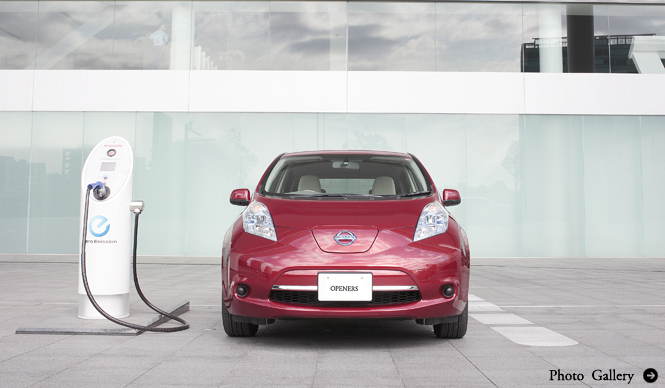
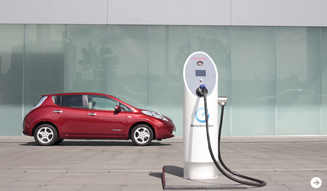
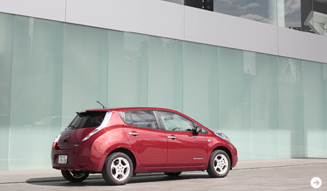
For our five-month long-term test, the Leaf we received at Nissan Motor Corporation's headquarters in Minato Mirai, Yokohama, was painted in Radiant Red, not its signature Aqua Blue or White Pearl. The Leaf, which shines like an ember in the shade and like a blood orange in the sun, looks quite appealing. Though not widely known, the Leaf comes in two grades, and this is the X grade, the base model.
The base price is 3,764,250 yen. However, as you may know, for fiscal year 2011, a national subsidy of 780,000 yen, along with eco-car tax reductions, made the 161,300 yen acquisition tax, 30,000 yen weight tax, and 29,500 yen automobile tax all zero. This results in a saving of 1,013,500 yen compared to the normal price. Please note, however, that these tax benefits are only valid until the end of March 2012.
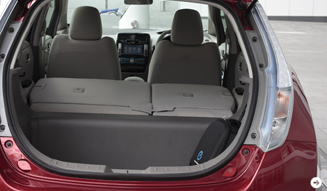
As expected, stepping inside the car does not give the impression of a luxurious vehicle costing over 4 million yen. It's not cheap, but it feels like a family car in the 1.5 to 1.8-liter class.
Superb Motor Control Technology
The ritual to start driving begins by pressing the power button, resembling a PC switch, located on the lower left of the instrument panel. Of course, since only electricity is flowing, there is no sound. When the green indicator shaped like a leaf on the instrument panel lights up, it signals that the car is ready to drive. Shifting to the right, then pulling it towards you, and pressing the accelerator makes the car move, but again, almost no sound is heard during this process.
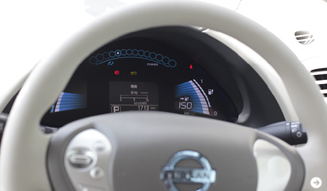
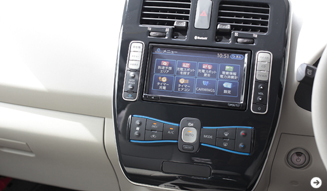
When you press the accelerator, the substantial torque unique to an electric motor effortlessly pulls the 1,520kg body. What impressed me was the motor control technology. According to Toru Abe of Nissan's Zero Emission Business Unit, who was in charge of the Leaf's development, torque is switched on and off in units of 1/100th of a second to achieve a smooth ride. Since EVs generate maximum torque instantly from a standstill, they can tend to have a jarring, rocket-like start. However, this is not the case with the Leaf. It offers a relaxed acceleration feel, similar to a large-displacement engine car.
NISSAN LEAF | The Nissan Leaf
Introducing the Nissan Leaf! Part 1
Wishing for a Longer Driving Range
On the first day of its introduction, we drove approximately 100km. We departed from Nissan headquarters in Yokohama, stopped by the editorial office in Kinshicho, then went to a staff member's home in Koiwa for a photoshoot, and finally headed to CEATEC held at Makuhari Messe. After that, we returned to the editorial office and then visited the staff member's home again.
The Leaf's driving range is rated at 200km in JC08 mode on a full charge. When we received it in Yokohama, the indicator showed a range of 182km. We thought this was sufficient, but the reality was different. By the time we reached the staff member's home, the remaining range was only 9km.
The reason for this discrepancy of about 70km lies entirely in how we drove. The driving range decreases rapidly unless you drive slowly to conserve battery power. Using the air conditioning seems to reduce the range by about 10-20km, and accelerating too hard can deplete the indicated range by several kilometers in just a few hundred meters. On this first day, I realized that getting used to these driving habits would be necessary. However, in the next report, I plan to cover a longer journey.
Regarding the Installation of Charging Equipment
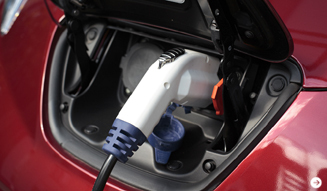
For those considering purchasing the Leaf, the charging equipment presents the biggest hurdle. According to Nissan, they have a track record of installations not only in private homes but also in condominiums. In particular, Daito Trust Construction, which develops Lions Mansions, is actively installing charging facilities in new buildings. However, typically, installing charging equipment in a condominium requires the approval of the management association. Some owners living in condominiums who couldn't get approval have gone to the extreme of renting a separate parking space and running a direct electrical line, but most people wouldn't go that far.
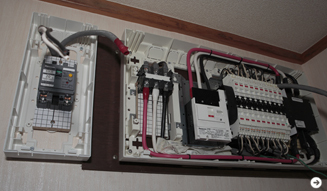
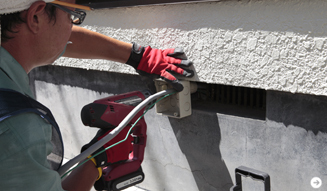
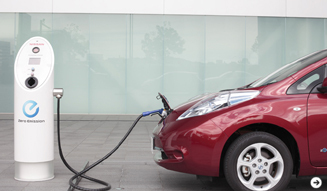
OPENERS decided to use a staff member's home as the charging point. While the installation of charging equipment might seem like a major undertaking, it's actually not that complicated. It involves running a cable from the location of the circuit breaker to the outlet in the parking space, and the work typically takes about two and a half to three hours. In our case, it was completed in about two hours.
The cost of installation varies depending on the conditions, but the basic work is 99,000 yen (including 10 meters of cable), with additional charges for extra work. Each additional 10 meters of cable costs 11,000 yen. Wall-mounted outlets are around 50,000 yen, and stand-type outlets are around 100,000 yen. We recommend checking with your dealer first. Additionally, there is a campaign offering a 50,000 yen discount until the end of this year, so we recommend purchasing before year-end for those seriously considering buying.
Nissan Leaf X Initial Cost Details
| Vehicle Base Price | 3,764,250 yen |
| Manufacturer Options | |
| ETC | 19,950 yen |
| Dealer Options | |
| Charging Cable (15m, 200V) | 89,300 yen |
| Floor Carpet (with deodorizing function) | 25,200 yen |
| Miscellaneous Costs | |
| Registration Fees | 47,740 yen |
| Automobile Tax | 15,000 yen |
| Acquisition Tax | 0 yen |
| Weight Tax | 0 yen |
| Recycling Fee | 0 yen |
| Total | 3,961,440 yen |
FY2011 Clean Energy Vehicle Introduction Promotion Subsidy (National) - 780,000 yen
FY2011 Electric Vehicle and Plug-in Hybrid Vehicle Purchase Subsidy (Tokyo Metropolitan Government) - 390,000 yen
*The subsidy amounts above are the maximum for private use purchases at the manufacturer's suggested retail price. The subsidy amount varies depending on the purchase price. There is also an obligation to own the vehicle for six years.
Total Subsidy Amount: 1,170,000 yen
Estimated Total Payment: 2,791,440 yen

NISSAN LEAF X
| Body | Overall Length 4,445 x Overall Width 1,770 x Overall Height 1,545mm; Wheelbase 2,700mm |
| Vehicle Weight | 1,520kg |
| Drive Battery | Lithium-ion battery |
| Total Voltage | 360V |
| Total Capacity | 24kWh |
| Motor | Electric Motor |
| Max Output | 80kW (109ps) / 2,730–9,800rpm |
| Max Torque | 280Nm (28.6kgm) / 0–2,730rpm |
| Power Consumption (JC08 Mode) | Range per charge: 200km; AC Power Consumption: 124Wh/km |
| Drive System | Front-wheel drive |
| Price | 3,764,250 yen |