April 15, 2015
The Fourth Installment of Our Long-Term Report on the Nissan LEAF!
NISSAN LEAF | NISSAN LEAF
Introducing the Nissan LEAF! Part 4
A 13-Hour Journey Around the Miura Peninsula in the LEAF
This is the fourth installment of our long-term report on the Nissan LEAF. We sense it's almost time to say goodbye to this car, which has created so many memorable moments with the fun-loving staff of our magazine. So this time, we're changing things up a bit: three women from our editorial department, who know nothing about cars, embark on an experiential report in their first electric vehicle (EV)! It's a journey of about 13 hours (!) around the Miura Peninsula in Kanagawa Prefecture. Now, let's see what kind of drama unfolds this time...
Text by JUNKO TANAKA (OPENERS)
Everyone's First Time in a LEAF! How Was the Ride?
A certain day in February. The day before, Tokyo had experienced its second snowfall of the year. Depending on the accumulation, the trip might have been in jeopardy. What would the weather be like on the day? To our surprise, it was brilliantly clear. A refreshing blue sky, unseen for some time, stretched out overhead. It was a truly auspicious start. After preparing drinks and party supplies for the car, we set off!
Now, let us introduce the editorial staff members who test-drove the LEAF. At the wheel, gracefully navigating, is B, a woman in her 40s with about 30 years of driving experience. Perhaps because she primarily handles accounting at work, she is sensitive to numbers. She consistently kept the power meter, which indicates battery output and regenerative braking, within the third mark from the left. "To make the battery last as long as possible, it's best to keep it around the third mark," she recalled, a piece of advice from S, our car specialist and the most knowledgeable about the LEAF in our magazine. It was admirable that she adhered to this advice throughout the drive. However, being notoriously timid, her constant monitoring of the battery level might have made her compatibility with the LEAF somewhat questionable. We aim to report on how B's feelings change as the drive progresses.
A leisurely drive with just the women. Perhaps too leisurely—or rather, thanks to the LEAF's comfortable ride, S, in her 30s, dozed off in the back seat. To be frank, she's a complete "paper driver," having never once taken the wheel since getting her license. She livened up the car with her witty conversation and laughter, living up to her reputation as the "party diva." Also, the exceptionally dependable S, who took the lead in navigating and at our destinations, often guiding this writer who was prone to mistakes. I'd like to take this opportunity to express my gratitude. Warming the passenger seat was myself, a writer in her 20s who has never held a driver's license. I know nothing about cars, but I enjoy gazing at the scenery through the windshield. I'm primarily in charge of SHIFT JAPAN! at our magazine. Having only moved to Tokyo a few weeks ago, I may overreact to some sights, but please bear with me.
9 AM: Starting with a Range of 120 Kilometers
Let's get back to the main topic. It was just past 9 AM. We left the parking lot in Kinshicho, where our editorial department is located, and immediately set off for the Miura Peninsula. B exclaimed at the quiet ride, with barely any engine noise. She found the steering light and acceleration smooth, making for a very easy drive. "It might be good as a second car for driving around town," commented B, who usually drives a minivan.
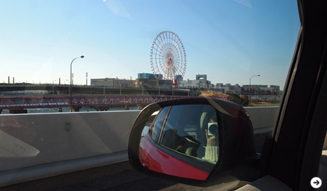
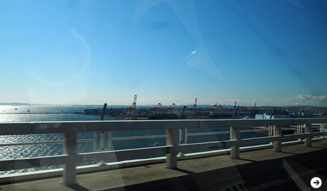
After clearing the traffic jam near the Kinshicho entrance of the Shuto Expressway, we continued on the expressway, maintaining an average speed of 60-70 km/h. Odaiba came into view on our left. It was impossible not to get excited. Crossing the Rainbow Bridge, Haneda Airport appeared before us. While we—or rather, I—leaned out to take in each sight, the LEAF continued its quiet and smooth ride, like a luxury car, effortlessly passing the border into Kanagawa Prefecture on the Bayshore Route. Here, we reached an industrial area, a favorite spot for B. Passing through this area, which looked like a movie set, we soon arrived at our first destination and charging point: Daikoku Futo Parking Area.
10 AM: Arriving at the First Charging Point with 94 km of Range Remaining
"Let's charge," we said, searching for the charging point that should have been in the parking lot, but it was nowhere to be found. After circling the parking lot, we finally located a fast charger at the very edge, with no signage around it. It was hard to find. While the excuse of "few EV users" might be acceptable for now, we hope for some improvement here.
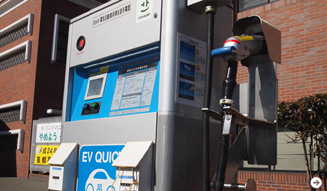
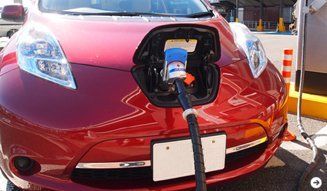
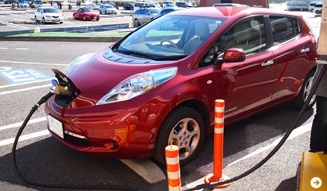
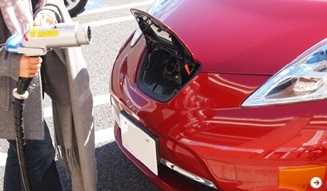
As mentioned, this was the first EV experience for all three of us. Not only was it our first time driving, but it was also our first time charging. We thought this might be the first major hurdle of the day, but in reality, it was quite simple. We just followed the instructions on the charger's touch panel, inserted the nozzle-type fast charging connector, and pressed the start button. Unlike refueling a gasoline car, there was no worry about gasoline spills or dirty hands, nor that unpleasant gasoline smell. Wouldn't anyone who drives a car, regardless of gender, appreciate this? Furthermore, it's worth noting that charging at public facilities like this, outside of dealerships, is currently free in most cases.
As we were charging, another silver LEAF pulled up next to us. It had "Nissan Rent-a-Car" written on it. A couple in their 30s from Chiba had been drawn by a special campaign price of ¥5,000 per day for renting a LEAF, and this was their first time trying an EV. They seemed well-prepared, planning to depart from a rental car shop in Makuhari, charge their battery at Daikoku Futo and Fujisawa City Hall, and then head to Enoshima.
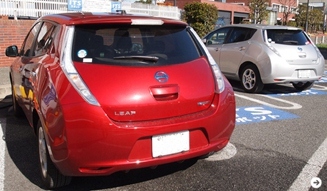
To pass the time, we were at the edge of the parking lot. With the couple waiting behind us, a short walk in a nearby park wasn't an option. So, we decided to interview B. When asked, "Honestly, what's your impression of the LEAF?" B replied, "There's no sudden jolt or roar (Note: the feeling of being pushed forward abruptly) when I step on the accelerator; it moves smoothly. You can really feel it when you go over 100 km/h. I could drive like this forever without getting stressed." She seemed quite pleased with the LEAF.
Although concerned about keeping the couple waiting, we continued our chat, and soon the charging was complete. We charged 7.5 kilowatts at 400 volts, bringing the range back to over 100 kilometers. The process took about 20 minutes. It was faster than expected, but having only one fast charger per charging point is a concern, considering the potential future widespread adoption of EVs.
DATA
Daikoku Futo Parking Area
15 Daikoku Futo, Tsurumi-ku, Yokohama-shi, Kanagawa
Hours: 24 hours
NISSAN LEAF | NISSAN LEAF
Introducing the Nissan LEAF! Part 4
A 13-Hour Journey Around the Miura Peninsula in the LEAF (Part 2)
Noon: To the Yokosuka Museum of Art, EV-Friendly
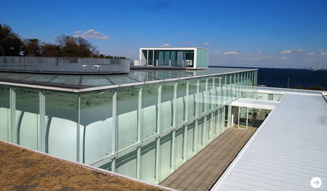
It was just past 11 AM. After the LEAF had its fill, it was time for us to eat. Our destination was the Yokosuka Museum of Art, renowned as one of Japan's most scenic museums, surrounded by sea and forest. Driving a bit faster, close to 100 km/h, we took the Shuto Expressway, then the Yokohama-Yokosuka Road, and exited at the "Mabori Kaigan Interchange." A landscape typical of the coast, lined with palm trees, unfolded before us. The bright sun shining in the blue sky, combined with the weather, made it feel like we were truly enjoying a scenic drive. After passing through a tunnel and continuing along the coast, the museum building appeared on our right.
Surrounded by forest and park on three sides and with the sea stretching out before it, the view was indeed spectacular, living up to its reputation. However, the real reason for our visit to this museum was to check the charging points located in the underground parking lot. Yes, this is also an EV-friendly museum, equipped with standard chargers. Back in the spring of 2011, in the wake of the Great East Japan Earthquake, Yokosuka City began promoting EV infrastructure development to create a system that wouldn't lose power during disasters. As part of this initiative, two free (*) charging points were installed in the underground parking lot here. According to Shotaro Endo, a staff member at the Yokosuka Museum of Art, there have been about 10 uses per month so far.
(*) Parking fees still apply. For standard cars, it's ¥300 for the first hour, then ¥150 for every 30 minutes thereafter. If you purchase an exhibition ticket, the first hour is free.
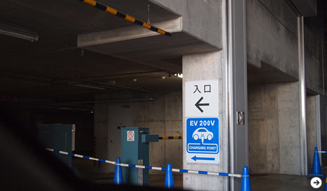
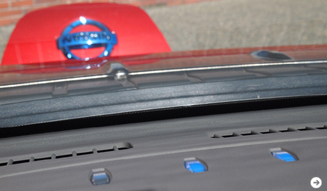
As soon as we entered the underground parking lot, we saw a blue sign that read "CHARGING POINT." First, we parked the LEAF in the charging spot, following the arrow. Thanks to S's efforts, we found the charging cable in the trunk, inserted it straight into the standard charging port until it locked, and we were ready. Once the charging indicator (*) light in front of the windshield started blinking, it was proof that charging had begun normally.
(*) The LEAF uses three indicator lights—lit, blinking, or off—to show the current charging status.
Standard chargers (*), often criticized for their long charging times, might be well-suited for facilities where people tend to stay for extended periods, like museums. This is because with fast chargers, you're often asked to move your EV as soon as charging is complete, due to the short charging time. This can make you conscious of the time, hindering leisurely art appreciation or exploration of the museum. With a standard charger, however, you can leave your EV parked and go about your activities. Of course, a full charge takes time, so it's limited to topping up about 12% per hour. Installing standard chargers at facilities where people stay for long periods, such as libraries or hot springs, could be a viable option. Alternatively, as Mr. Endo suggests, you could enjoy a leisurely day by "having lunch at the museum's restaurant with a terrace while the car charges, or spending time at nearby Kannonzaki Park or a spa"—a relaxed way to spend the day.
(*) For the LEAF, a full charge using a standard 200V charger takes about 8 hours, while an 80% charge using a 400V fast charger takes about 30 minutes. A full charge provides a range of 160-200 km.
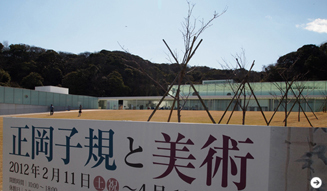
The Yokosuka Museum of Art is currently hosting the exhibition "Shiki Masaoka and Art." After exploring the spacious museum and the rooftop plaza with its ocean view, we enjoyed a seafood-focused lunch at "Acquamare," the museum's Italian restaurant. When we returned to the LEAF, the charging indicator lights had increased from two to three, indicating that the charge had increased from 70% to over 90% while we spent a pleasant two and a half hours basking in the sun.
DATA
Yokosuka Museum of Art
4-1 Kamoi, Yokosuka-shi, Kanagawa
Hours: 10:00 - 18:00
*Parking lot hours: 8:00 - 22:00
Closed: First Monday of every month
Tel. 046-845-1211
http://www.yokosuka-moa.jp/
2:30 PM: Operation Miura Peninsula Traverse, Starting with 126 km Range
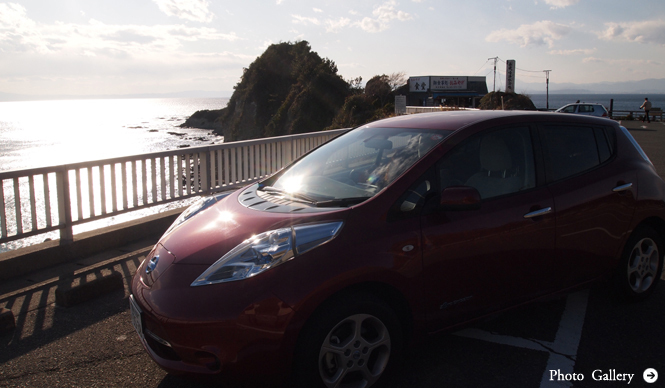
As we were running a bit behind schedule, we decided to take a shortcut. However, we couldn't miss the symbolic "Kannonzaki Lighthouse," famous as Japan's first Western-style lighthouse. After admiring the lighthouse from below, we headed inland, intending to cross the Miura Peninsula towards the opposite coast. Our destination was Chojagasaki, recommended by Y from our editorial department for its beautiful sunsets. After navigating unfamiliar mountain roads and taking a snack break, we finally arrived at our destination after about two hours of driving. Unfortunately, we didn't make it in time for sunset, but we took a photo of the LEAF against the coastal backdrop. Incidentally, in the parking lot where we stopped for this photo shoot, there was a sign that read "EV" and "50% Discount." We learned that this is part of a system by Kanagawa Prefecture, which actively promotes EV infrastructure development. Displaying the "Kanagawa Prefecture Electric Vehicle Certification Card," issued to certified EVs, grants a 50% discount on parking fees at some prefectural facilities.
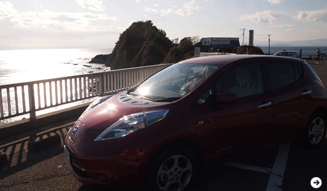
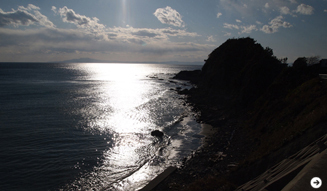
From here, it should have been a straight shot to our next destination, Sajima. However, B's "timidity" kicked in. The remaining battery level indicator (1-12) was above 7, which theoretically meant we could drive over 100 kilometers, but B was still worried about the battery. B's concern was not entirely unfounded. While the Miura Peninsula is well-equipped with charging points, with Yokosuka City alone boasting about 50 fast chargers, they are virtually nonexistent along Route 134 on the west coast, near the southern tip. If you plan to drive along the west coast of the Miura Peninsula, you would have no choice but to enter the Yokohama-Yokosuka Road and charge at the "Yokosuka Parking Area." Since we had already passed that charging point, we had to continue north on Route 134 to stop at a charging point in Zushi City, "Zushi Kikuchi Taxi."
4:40 PM: A Long Fast Charge in Zushi!?
The fast charger here is generally open to the public until 5 PM, but its primary purpose is for their own "EV taxis." Other than that, it sees about 10 uses per month. When we arrived, a red LEAF, belonging to the previous user, had just finished charging. The owner, a couple in their 50s from Kanagawa, had been enjoying the quiet ride, primarily driving around Kanagawa Prefecture where charging spots are plentiful. They had owned their LEAF for about three months.
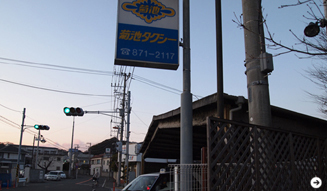
An unexpected development awaited us. As S, now quite adept, inserted the fast charging connector and pressed the start button, the display showed "Remaining time: 60 minutes." We were at a loss, having fully expected the charging to complete in about 30 minutes, as is typical for a full charge from zero. This was a significant setback, especially since we were already behind schedule. There was nothing we could do but wait for the charge at a nearby pasta restaurant. About an hour later, thinking it might be finished, we returned to the LEAF, only to find it still charging. Finally, after what felt like an eternity, charging was complete. It took exactly 60 minutes. We charged 7.6 kilowatts at 400 volts, increasing the range to 126 kilometers. Let's hurry; the sun is already beginning to set!
DATA
Zushi Kikuchi Taxi
1-3-6 Kuki, Zushi-shi, Kanagawa
Hours: 8:00 - 17:00
Tel. 0468-71-2117
NISSAN LEAF | NISSAN LEAF
Introducing the Nissan LEAF! Part 4
A 13-Hour Journey Around the Miura Peninsula in the LEAF (Part 3)
5:40 PM: Catching the Sunset at a Seaside Villa
Heading south on Route 134, we arrived at "Nowhere but Sajima," a weekly villa in Sajima, rented out by the week. Sajima is a relatively unknown gem in Yokosuka, popular with those in the know, offering fresh seafood and marine sports year-round. This white, modern three-story house, standing on the beautiful Shonan coast, is Nowhere but Sajima. It accommodates four people, with two extra beds available, allowing for a maximum of six guests. From inside the building, you can see Mt. Fuji and Enoshima. Its vertical design facing the sea gives the sensation of floating on the water when standing near the windows. According to Ayako Shimizu of Nowhere Resort, the management company, the property is increasingly being used not only for stays but also for weddings and gallery events.
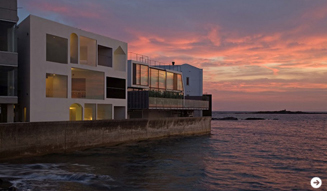
©Chiaki Yasukawa
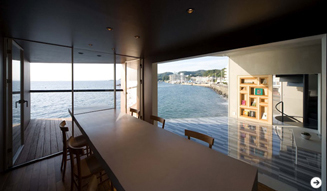
©Chiaki Yasukawa
Incidentally, the parking lot here is equipped with a Tesla fast charger. This was installed about a year ago by Tesla for a promotional campaign that paired a Tesla EV with a stay at Nowhere but Sajima, offered by a department store. Unfortunately, it uses a different standard than the LEAF's CHAdeMO, but it's good news for Tesla EV owners.
DATA
Nowhere but Sajima
3-10-8 Sajima, Yokosuka-shi, Kanagawa
Inquiries: Nowhere resort
Tel. 03-5785-2320
http://www.nowhereresort.com
7 PM: The Nightmare of a 1+ Hour Fast Charge Strikes Again Near the Journey's End
As the journey neared its end, we headed for Kamakura. After savoring delicious soba noodles at "Bonzo," a Michelin-starred restaurant, we planned to make our final charge at the Kamakura City Hall, which has fast chargers. However, our journey was not without its hitches. First, the camera battery died, completely replacing the LEAF's. This was entirely my fault for forgetting the spare battery. Oh dear. Then, when we headed to the soba restaurant, we were met with a sign: "Temporarily Closed." With no other option, we proceeded to Kamakura City Hall to begin charging, only to be greeted once again by the "Remaining time: 60 minutes" display. Determined to stay positive, we decided to warm up and fill our stomachs at a nearby cafe while planning our route home.
By now, those following our drive may have noticed that we had already charged a total of four times: three fast charges and one standard charge. According to S, our car expert who is familiar with the LEAF, an 80% charge using a fast charger typically provides about 100 kilometers of range. Considering we had driven 148 kilometers at this point, the number of charges seemed excessive. Therefore, we decided to drive the remaining 76 kilometers back to Kinshicho without any further charging. Could B handle this pressure?
After about 20 minutes of this strategy session, we returned to the LEAF to find the display showing "Remaining time: 41 minutes." It was taking longer than expected. Later, S confirmed that this particular fast charger model takes over 30 minutes to reach a full 100% charge, similar to the one in Zushi. Still charging, but as it was getting late, we decided to cut the charging short and head home. We charged 5.8 kilowatts at 400 volts, bringing the range back to over 100 kilometers.
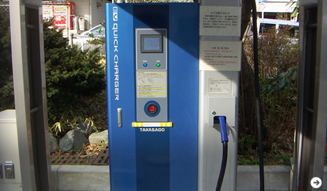
© Kamakura City Hall
Kamakura City Hall installed its first fast charger at the end of 2009. It sees an average of about 6 uses per day, and according to the security guard, the number of users has increased significantly this year. EV taxis account for one-third of the usage, with local residents making up half of the remainder, and tourists who researched it online filling the rest. Having a fast charger available 24 hours a day in a tourist destination like this is a great convenience for EV users.
DATA
Kamakura City Hall
18-10 Onari-cho, Kamakura-shi, Kanagawa
Hours: Weekdays = 8:00 - 16:30, Weekends/Holidays = 24 hours
Tel. 0467-61-3421
Past 8 PM: Aiming for Kinshicho, 76 km Away from Kamakura
We started our journey home shortly after 8 PM. Could we make it all the way to Kinshicho without stopping? As soon as we entered the Yokohama-Yokosuka Road, B's "timidity" resurfaced, with her worrying about the battery level, and the air conditioning was turned off. At this point, with a range of 100 kilometers, the remaining 76 kilometers should have been manageable. This was likely a matter of habit. Having become accustomed to excessive charging on the Miura Peninsula, she felt anxious if the battery level dropped below 7. While we shivered, the LEAF moved steadily forward. B, on the other hand, seemed desperate to charge as we approached the Daikoku Futo Parking Area where we had charged earlier. Despite the lack of air conditioning, she claimed to be "hot."
However, once we passed the most critical point of the day and were only 30 kilometers from our destination, B seemed to calm down considerably. The air conditioning was turned back on, and we could finally converse with her. Feeling a bit more relaxed, I took out my iPod and played Chopin's "Lullaby" against the backdrop of the night scenery. S and I were both impressed by the sound quality from the speakers. This is only possible with a quiet EV like the LEAF, with no engine noise. Let me ask you again: B, do you think you could build a good relationship with this LEAF?
"I was constantly worried about charging. Even though I understood logically that 80% charge would give me about 100 kilometers, I was anxious because I didn't know how far it would actually go. Conversely, if there was a clear indication like 'You can drive this far,' I wouldn't have needed to charge so much and could have driven with peace of mind," B recounted. Indeed, while the LEAF displays the estimated remaining range, this figure fluctuates rapidly based on instantaneous driving conditions. Therefore, it cannot be fully trusted at all times. It seems that B was concerned about the lack of precise, reliable range information. Perhaps this is a hurdle that anyone driving an EV for the first time must overcome. In other words, by gaining experience and understanding the relationship between battery level and driving distance, and by learning to manage the anxiety of potentially running out of charge, one can enjoy driving the LEAF.
However, regarding the ride quality, she was full of praise: "It was very easy to drive, with a tight turning radius. It felt incredibly comfortable how it moved smoothly when accelerating or cornering." Reflecting on the day spent with the LEAF, she added, "The fact that fuel costs were zero was a big plus. Also, when on the highway, I didn't feel the urge to move into the passing lane. It was because I was conscious of the speed and the power meter readings, but as a result, it led to a more relaxed day than I've had in a long time." By the end of the 224-kilometer, 13-hour journey, B seemed to have mastered how to interact with the LEAF.