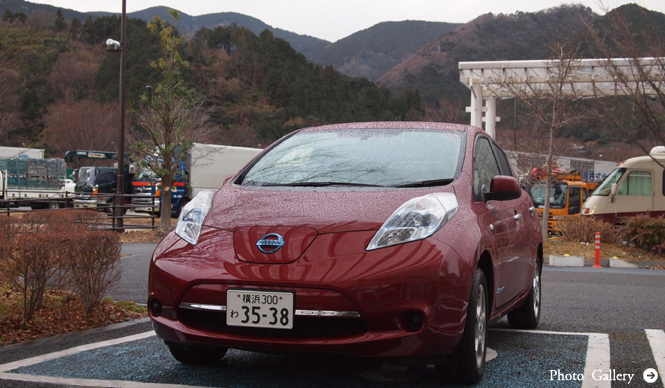
NISSAN LEAF | The Third Installment
NISSAN LEAF | NISSAN LEAF
Introducing the Nissan LEAF! Part 3
Can the LEAF Handle a Weekend Getaway?
Let's take the LEAF on a weekend trip. The idea came up, and three volunteers from the OPENERS editorial team decided to embark on a short journey after finishing work late Friday night. Can the LEAF truly handle a weekend getaway? This is the third installment of our long-term report on the LEAF!
Text & Photo by SUZUKI Fumihiko (OPENERS)
The Tomei Expressway: Our Route
Compared to electric vehicles often described as city commuters, the Nissan LEAF is a bit larger. However, its convenience in urban settings is remarkable. It's been a great help around the office for grocery runs and weekend errands. Upon looking into it further,
it seems many people are traveling with their LEAFs. So, we decided to try a long-distance drive ourselves. The author and two other married men in their mid-thirties left the office late Friday night and headed west. We weren't going home tonight!
First, let me mention that our route this time is the same Tomei Expressway as last time. This is because, when attempting long-distance travel with a LEAF, unless you have an abundance of time, you'll proceed by hopping between facilities equipped with rapid chargers. Currently, the Tomei Expressway is the only highway where this is possible, with rapid chargers available at each Service Area (SA). You could say searching for a husband who's driven off in a LEAF would be easy. This time, we drove from Tokyo to Shizuoka, but Tokyo started to feel like home, so after charging in Shizuoka, we turned back towards Tokyo.
Estimated Range is a Guideline
The LEAF's cruising range often comes under fire, perhaps because it's prominently displayed on the dashboard. So, let's start by presenting some data on this. The estimated cruising range shown on the panel can easily fluctuate depending on inclines, declines, and driving style, which can be misleading.
Assuming our fellow editors, K and O, who were driving the LEAF for the first time, are standard drivers, and using ECO mode at a pace similar to a conventional car, with an average temperature of 3°C and the heater set to auto mode to minimize power consumption, the energy consumption on Tokyo's roads and the Tomei Expressway (without extreme traffic jams) was 1.6 km per 1% of battery on sections with little elevation change. A traffic jam of about 5 km had virtually no negative impact on energy consumption. Even under the most demanding conditions of this trip – an uphill climb between Ebina and Ashigara with an average gradient of 4% and a maximum elevation difference of 420m – we achieved 1.1 km per 1% of battery.
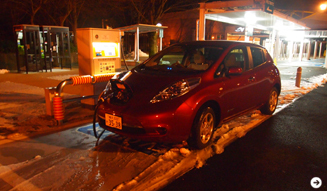
The weather was unfortunately poor. Ashigara Service Area was covered in snow.
Conversely, the section that yielded the best energy consumption was the downhill stretch from Ashigara to Fujikawa, with a maximum elevation difference of 434m and an average gradient of 3.5%. Here, I, who have more experience driving the LEAF, recorded an energy consumption of 2.4 km per 1% of battery.
From this, we can infer that the cruising range for an 80% rapid charge, completed within 30 minutes, is a minimum of 88 km and a maximum of 192 km. On the Tomei Expressway, with SAs offering rapid chargers every 40 to 60 km, there's virtually no risk of running out of power if you charge at every SA. Moreover, if you master the technique of driving to maximize energy efficiency, you might even be able to skip a SA. While charging stops are longer than refueling a gasoline car, charging on the Tomei Expressway costs ¥100 per charge. These charging stops are a trade-off for the lower energy cost.

A beautiful dawn over Suruga Bay viewed from the car window.
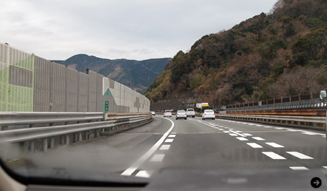
Looking at the front windshield, we were constantly being overtaken as we focused on eco-driving.
The Car Itself is Flawless!
The LEAF has two driving modes: Drive and ECO. ECO mode offers a driving feel closer to that of a conventional car. In Drive mode, the car unleashes its immense torque as if unleashed, accelerating smoothly like gliding on the road. While it's fantastic when you need instant power, it's a bit excessive for normal driving. Furthermore, using Drive mode regularly is disadvantageous for energy consumption. In a drive where Drive mode was actively used, even on the downhill stretch from Ashigara SA to Ebina SA, the energy consumption was about 1 km per 1%.
To maximize energy efficiency, it's important to pay attention to the arc-shaped meter composed of circles at the top of the panel. When stopped, the further the white circle, which lights up on the fifth position from the left, extends to the right, the greater the power consumption. Conversely, if it extends to the left, it means energy is being recovered through regenerative braking. The key to continuous long-distance driving is to avoid extending the meter to the right. Regardless, continuous driving for about 60 km is not an issue.
The interior space is sufficient even for three adult men with some luggage for a trip. During driving, the absence of engine noise makes the cabin remarkably quiet. You can clearly hear music played at a low volume on the highway, a feature not found in gasoline cars. Although the sound quality isn't great, it's still a notable difference.
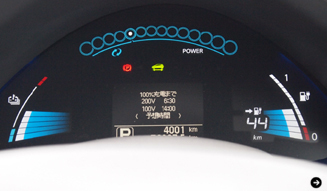
The meter labeled 'POWER' indicates power consumption. To the right are the battery level and estimated range indicators, and to the left is the battery temperature gauge.
If there's one drawback, it's that when fully charged, the regenerative braking is almost non-existent, slightly altering the feel of the brakes. This is something you should check beforehand.
NISSAN LEAF | NISSAN LEAF
Introducing the Nissan LEAF! Part 3
Can the LEAF Handle a Weekend Getaway? (2)
The Issue is Infrastructure
The biggest drawback is undoubtedly the infrastructure. As mentioned earlier, charging on the Tomei Expressway is not an issue. However, one thing to be aware of is that prior registration is required to use the chargers. A man driving a rental LEAF we met on our trip was unaware of this and couldn't use the charger because it was locked. He had to contact the relevant department to have the lock specially removed. If you're unaware, you could potentially be stranded, so further public awareness is needed.
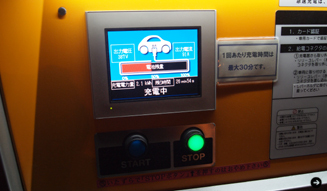
Registration is required to press the START button, but anyone can press the STOP button. Please refrain from pressing it out of mischief.
The LEAF's navigation system is excellent and easy to use, but the information on charging facilities is unreliable. I once found myself in a situation where I urgently needed to charge, with only 20 km of estimated range remaining, only to discover that the charging facility shown on the navigation system didn't exist. It was late at night, so the dealership was closed, and I was left relying solely on an empty parking lot, which was quite unnerving. Even this time, when I used a rapid charger at a Shizuoka Mitsubishi Motors Sales Shizuoka South branch, it wasn't displayed on the navigation system, and the official Nissan LEAF website showed 0 charging stations installed. The information network still feels incomplete. Furthermore, when displaying dealerships as charging facilities, it's crucial to show their operating hours and availability.
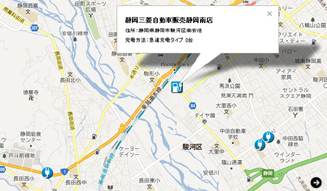
Information on the official Nissan LEAF website. In reality, there was one rapid charger here.
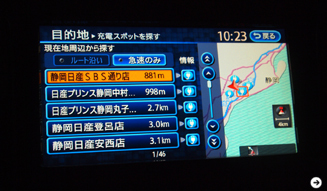
Even when searching for nearby charging facilities on the navigation system, Mitsubishi dealerships don't seem to appear.
Hoping for More Charging Stations
The varying charging fees are also a point of concern. In flat parking lots, while parking fees apply, charging itself is free. It was also free at Mitsubishi dealerships. On the other hand, the Tomei Expressway requires a card and offers rapid charging for a maximum of 30 minutes for ¥100 per session. Nissan dealerships charge ¥525 for a rapid charge up to 80% and ¥105 for 60 minutes of regular charging.
Also, though it might seem trivial, in cold, rainy weather like this trip, I strongly wished that the SA rapid chargers were located closer to the shopping complexes and that there was a roof over the chargers to shield from the rain.
The car itself is so well-developed that there's almost no need to make excuses for it being an electric vehicle. The key to making the LEAF a stress-free car will be how comfortable charging becomes, which is needed more frequently than refueling a gasoline car. We can only hope that the day will soon come when we can enjoy weekend trips with the LEAF, not just along the Tomei Expressway and its surroundings, but also in other areas, while enjoying the increasingly well-equipped service areas and listening to our favorite music at a relaxed pace.