Toyota Prius: Part 5
TOYOTA PRIUS | The 5th Report
A Comparison Drive with the Prius α (1)
For the OPENERS editorial team, which has adopted the Toyota Prius as its long-term test car No. 2, there's one model that has captured their attention. Launched in May of this year, the wagon version of the Prius, the Prius α, has received orders for 52,000 units in just one month – approximately 17 times its monthly sales target of 3,000 units – leading to a waiting period of nearly a year for delivery. What are its true capabilities? We conducted a comparative test drive with our No. 2 car.
Text by OPENERSPhotos by Takahiro Igarashi
Car No. 2 is Running Smoothly
First, an update on our No. 2 car: since the damper replacement last time, we haven't encountered any significant issues. It has now covered over 27,000 km, and its fuel efficiency remains excellent. While it may drop to the 18 km/l range with the air conditioning running, it generally maintains around 19-20 km/l.
It's been two years since its introduction, and our only complaint is the somewhat limited interior space when carrying a full load of passengers. For instance, situations like fitting child seats in the rear and accommodating four adults become quite challenging. The luggage space, at 445 liters, isn't particularly generous either.
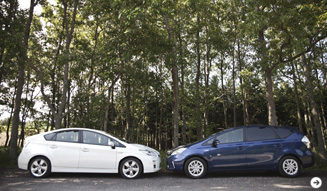
The side profiles share a relatively similar design. Notably, the upward kick-up line below the rear quarter window gives it that distinctive 'Prius' look.
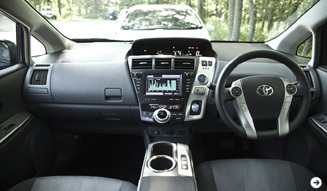
Regarding the dashboard, the energy monitor that used to be displayed on the meters has moved to the navigation screen. This might be disorienting for those switching from a conventional Prius.
A Sibling to the Mark X ZiO?
It is in this context that the Prius α, the wagon version of the Prius, has arrived. However, it's not simply a stretched version of the Prius's luggage space. In fact, its platform is not shared with the Prius; it's shared with the Mark X ZiO. Consequently, its dimensions differ significantly.
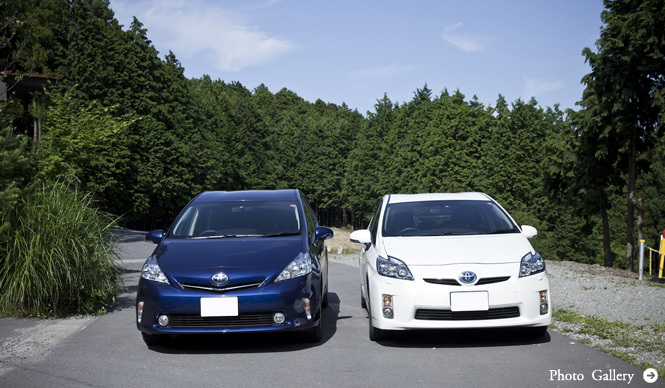
While the Prius measures 4,460mm in length, 1,745mm in width, and 1,490mm in height with a wheelbase of 2,600mm, the Prius α is 4,615mm long, 1,775mm wide, 1,575mm high, and has a wheelbase of 2,780mm. This represents an increase of 155mm in length, 30mm in width, 85mm in height, and 180mm in wheelbase, respectively. When placed side-by-side, the two cars look quite different in shape and size, and upon closer inspection, even their front-end designs differ.
The powertrain is the same as the Prius: a hybrid system called 'THS II,' combining a 1.8-liter gasoline engine with an electric motor. The engine produces a maximum output of 73 kW (99 hp) at 5,200 rpm and a maximum torque of 142 Nm (14.5 kgm) at 4,000 rpm. The motor delivers a maximum output of 60 kW (82 hp) and a maximum torque of 207 Nm (21.1 kgm), for a system output of 100 kW (136 hp). Due to the increased vehicle weight of over 140 kg, the fuel economy in JC08 mode is 26.2 km/l, with CO2 emissions of 89 g/km. This is a decrease of 4.2 km/l in fuel economy and an increase of 13 g/km in CO2 emissions compared to the Prius.
TOYOTA PRIUS | The 5th Report
A Comparison Drive with the Prius α (2)
The Ride is Sedate
Upon test driving, the most noticeable aspect was the clearly increased vehicle weight. This could be interpreted positively as a sense of substance, and indeed, the steering feel and ride comfort at town speeds felt smooth. However, when tackling the mountain roads of Hakone, the lack of power was undeniable. Furthermore, perhaps due to insufficient rear rigidity, the rear end felt somewhat unsettled on rough surfaces, and the sense of grip in corners was occasionally lacking.
However, given the car's character, it's unlikely to be driven aggressively through corners. The priority is likely on comfortable travel for multiple passengers. In that regard, the圧倒的な広さ (overwhelming spaciousness) is a significant advantage.
Our test car was the 7-seater model, which, while reducing luggage space due to the third-row seats, offers headroom that the standard Prius cannot match. The ride comfort, lacking the jarring impact found in the Prius, was attributed to an upgrade to higher-grade shock absorbers. Additionally, a notable improvement is the high-resolution, much clearer display for navigation and other information.
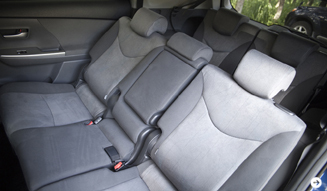
Our test car was the 7-seater model, which has third-row seats, though they are a bit tight for adults. The headroom in the second row is significantly improved.
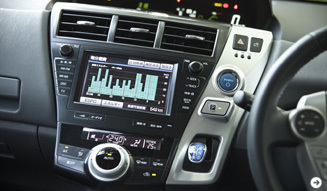
The display, already easy to read, now offers even better visibility.
Fuel Economy Difference of About 10%
Through this comparison drive, we confirmed the obvious fact that the Prius and Prius α are distinct vehicles, apart from their appearance and hybrid nature. The Prius excels with its agile driving feel, while the Prius α is clearly designed for those who need minivan-like utility and still desire a fuel-efficient hybrid. It seems to be the case.
On this occasion, we drove approximately 404 km, with a mix of 30% city and 70% highway driving, at a reasonable speed. The Prius α indicated a fuel consumption of about 16.9 km/l. This represents only about a 10% decrease compared to our No. 2 car, which is certainly not a poor figure.
In conclusion, the choice between the two likely depends on your intended use. However, if you desire the Prius α, you'll have to wait until next spring.
TOYOTA Prius α | Toyota Prius Alpha
Body Size | Length 4,615 x Width 1,775 x Height 1,575mm
Wheelbase | 2,780mm
Vehicle Weight (5-seater) | 1,470kg
Vehicle Weight (7-seater) | 1,480kg
Engine | 1.8-liter inline-4
Max Output (Engine) | 73kW (99ps) / 5,200rpm
Max Output (Motor) | 60kW (82ps)
Max Torque (Engine) | 142Nm (14.5kgm) / 4,000rpm
Max Torque (Motor) | 207Nm (21.1kgm)
JC08 Mode Fuel Economy | 26.2km/l
JC08 Mode CO2 Emissions | 89g/km
Drivetrain | FF
Price | ¥2,350,000 - ¥3,305,000