Able to compete with rivals from Germany – A test drive of the new Lexus RCF | LEXUS
Lexus RCF | LEXUS RCF
A Lexus sports coupé with a distinct taste, unlike its German rivals.
The Lexus sports coupé, “RC F,” received a minor model change in May 2019. This wasn't just a facelift; the model was reportedly enhanced from its engine and suspension to its aerodynamics. Motor journalist Yasuhisa Shimashita test-drove it at Fuji Speedway.
Text by YASUHISA Shimashita
Photographs by HIROHIKO Mochizuki
An evolved version pursuing "high ultimate performance and the joy of intuitive control."
To say that the "RC F" is a high-performance model with a 5-liter naturally aspirated V8 engine crammed into the front of Lexus's two-door sports coupé "RC" is actually incorrect. From its development stage, the RC was a thoroughbred designed with the lineup of an "F" model in mind, boasting exceptionally high body rigidity.
Just over four years since its debut, the new RC F has arrived, pushing its already highly acclaimed performance to even greater heights. Indeed, the new model is not merely a facelift but an evolved version pursuing "high ultimate performance and the joy of intuitive control."
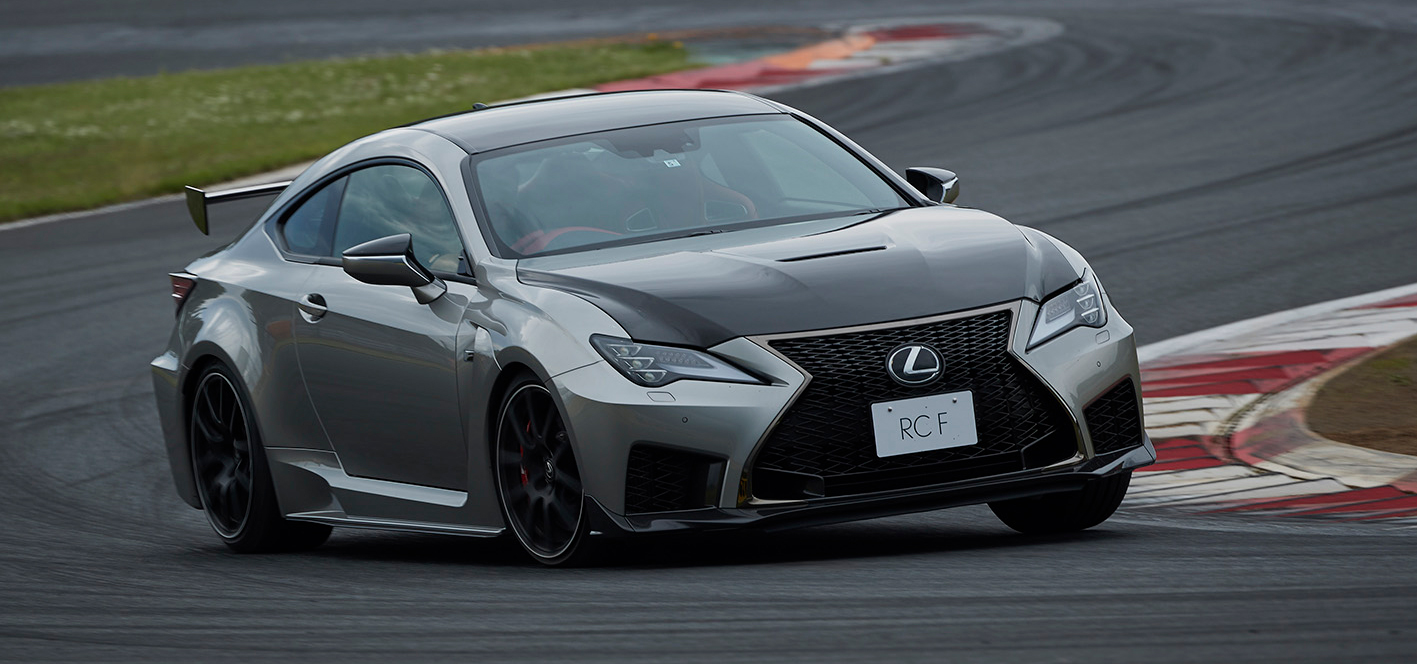
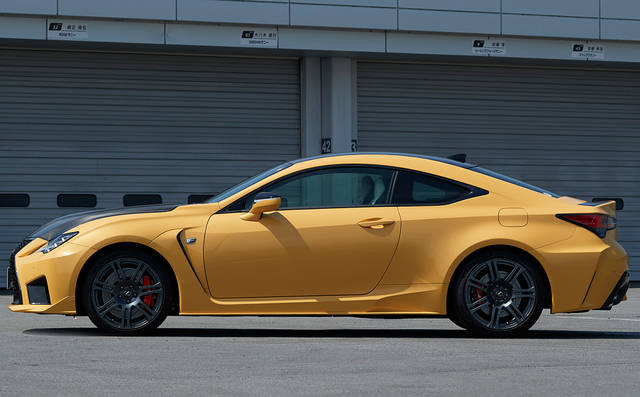
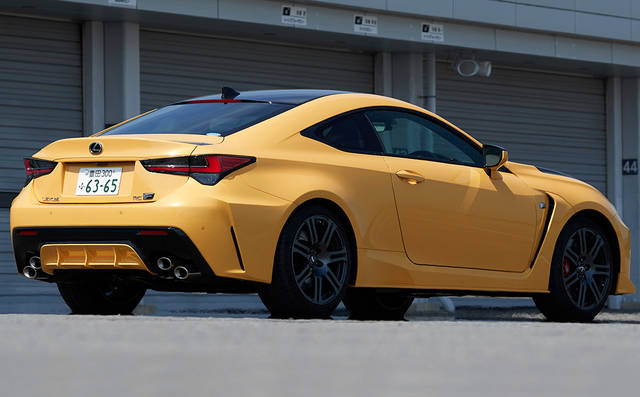
This direction is clearly reflected in the styling. With large air intakes in various locations and a design that thoroughly considers aerodynamic performance, it's inspired by the racing machines the RC F has competed with, such as GT500 and GT3. Elements like the canards with their sharp front lip angles, and the scooped shape at the rear of the side rocker molding, all directly contribute to functional performance—speed, control, and reliability. This approach was apparently a first for Lexus designers.
While further improving body rigidity, the vehicle has achieved a 20kg weight reduction through diligent work, such as converting chassis-related parts, previously made of steel, to aluminum, and shaving excess material from the engine.
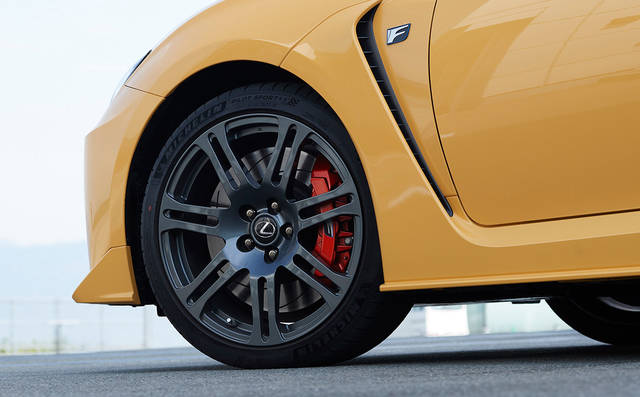
The hardness of the rubber mounts and bushings has also been increased, clearly prioritizing driving over comfort. Naturally, improvements extend to every aspect, including the suspension and electronic controls, and even the Michelin tires feature a new, dedicated design.
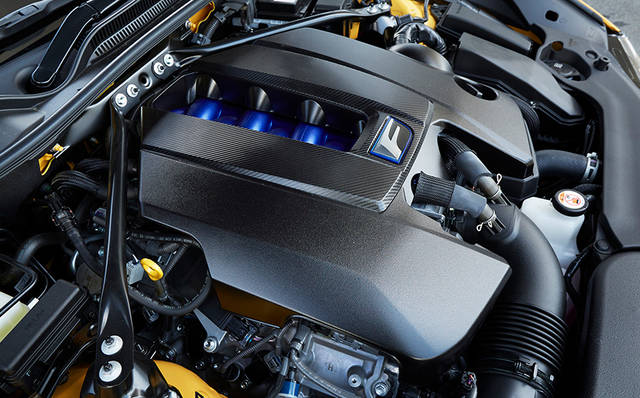
While the maximum output of the now-rare 5-liter naturally aspirated V8 engine remains at 481 hp, a mere 4 hp increase, drivability has been enhanced through improvements to the intake system and refined control. A key point is the adoption of a lower final gear ratio to boost acceleration.
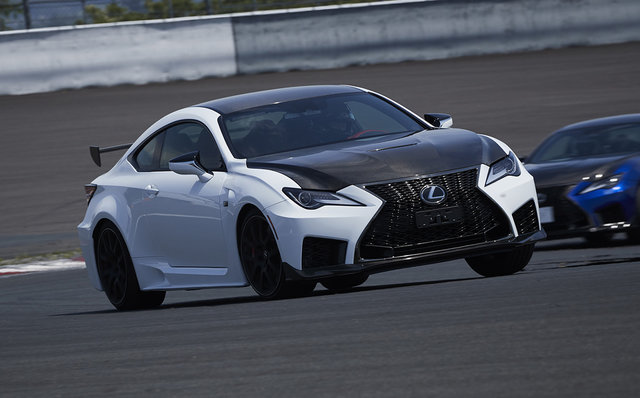
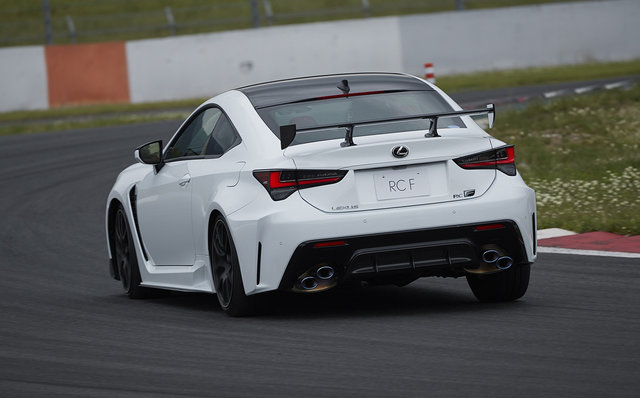
A "Performance Package" has also been newly introduced, uncompromisingly pursuing circuit driving performance. This package features aerodynamic devices such as CFRP exterior parts and a fixed rear spoiler, along with a dedicated suspension, further enhancing aerodynamic and chassis performance. It also achieves further weight reduction through the use of carbon bracing, carbon-ceramic brakes, lightweight forged aluminum wheels, and a titanium muffler. The dedication is astonishing, with even the steering wheel position adjustment changed from electric to manual to shave off hundreds of grams. The result is a vehicle weight of 1,720kg, a full 50kg lighter than the base model.
Fully Enjoy the Charm of a Naturally Aspirated Engine
The test venue was Fuji Speedway. The racing course, with its long straight of nearly 1.5km, was the ideal setting to fully experience the evolution of this high-performance car. We test-drove the base model, the car equipped with the Carbon Exterior package, and the Performance package, switching between them.
What impressed, or rather moved, us across all models was the exhilarating rev-up of the 5-liter naturally aspirated V8 engine and its abundant power. While the engine's response was enhanced by intake system improvements, throttle response has become more linear. Combined with the lower final gear ratio, it delivers even more lively and precise responses, with acceleration that is nothing short of spectacular.
Moreover, the way it unleashes power while producing a pleasing sound towards the top end can only be described as dramatic. While German rivals have turned to turbocharging, here you can fully savor the appeal of a naturally aspirated engine, pursued with unwavering dedication.
In SPORT+ mode, the AI-SHIFT control, which adapts to circuit driving even in D range, further sharpens the shifts of the 8-speed DSP. This will undoubtedly be a significant asset at Fuji Speedway, and even more so on tighter courses with frequent gear changes.
We were also greatly impressed by the evolution of the chassis performance, not just the powertrain. For all models, the car maintains a flatter posture in all situations, and the connection between movements is linear and free of abruptness. Simply put, it's faster, yet it feels easier to drive and easier to extract its performance from. That's the impression it leaves.
The optional TVD, which varies torque distribution between the rear wheels to enable agile control of vehicle attitude, is also a key element characterizing the RC F's driving dynamics. Setting it to "CIRCUIT" enhances stability, while switching to "SLALOM" allows for nimble footwork, as if the car had shrunk.
Excellent Control, Making Drifting Effortless
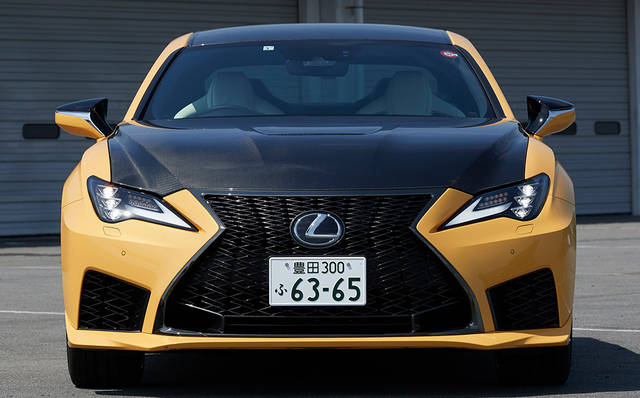
The Carbon Exterior package reduces weight by a total of about 10kg in areas far from the center of gravity, such as the hood, roof, and trunk lid. The handling is noticeably sharper, and once you experience it, it's hard to imagine choosing otherwise.
And the star of the show is the Performance Package. According to Chief Engineer Yuichi Genmoto, the Sport S+ mode is precisely tuned to deliver peak performance on flat circuits like Fuji Speedway.
The driving experience is even more agile and solid. Steering response is quick and precise, allowing for truly intuitive control. The high stability, particularly with the rear end firmly planted, greatly contributes to this. It's precisely because you can feel unwavering stability that you can confidently turn the steering wheel and press the accelerator with full force.
Indeed, with 481ps of power, it's easy to induce a tail slide in most corners at Fuji Speedway, and the control during such moments is superb, making drifting far from difficult. I thoroughly enjoyed it myself on the day. The previous RC F had a noticeable lack of rear stability, especially on wet surfaces, but this version should have significantly improved that. I'd like to try it if I get the chance.
"This car is a redefinition of F," Chief Engineer Genmoto states with pride. Its overwhelming circuit performance and the depth of its capabilities, accessible to drivers of all levels, truly elevate the "F" driving experience to a higher plane.
The new RC F can compete head-to-head with rivals from Germany, such as the Mercedes-Benz "AMG C63," BMW "M4," and Audi "RS5," while possessing a distinct, rich flavor entirely its own. For those who truly love driving, this is undoubtedly the arrival of a compelling choice.
Spec
Lexus RCF | LEXUS RCF
Body | Length 4,710 × Width 1,845 × Height 1,390 mm
Wheelbase | 2,730 mm
Vehicle Weight (EU) | 1,770kg
1,760kg (Carbon Exterior package)
1,720kg (Performance package)
Engine | 4,968cc V8
Max Output | 354 kW (481 ps) / 7,100rpm
Max Torque | 535Nm (54.6kgm) / 4,800 rpm
Transmission | 8-speed AT
Drive System | FR
Front Suspension | Double Wishbone
Rear Suspension | Multi-link
Front Brakes | Ventilated Discs, 6-piston Calipers
Rear Brakes | Ventilated Discs, 4-piston Calipers
Price | 10,210,000 JPY
10,996,364 JPY (Carbon Exterior package)
14,040,000 JPY (Performance package)
Inquiries
Lexus Information Desk
Tel. 0800-500-5577 (9:00-18:00, open 365 days a year)
https://lexus.jp/