March 6, 2015
PORSCHE PANAMERA | The new Panamera, gifted with a V6 engine
PORSCHE PANAMERA
The Lightweight Panamera, Blessed with a V6 Engine (1)
The new Panamera was unveiled at an international test drive event held in Cologne, Germany. Yasuhisa Shimoshita took the wheel of the model equipped with a 300ps 3.6-liter V6 unit.
Text by Yasuhisa ShimoshitaPhotos by Porsche Japan
Two New Models Arrive with the Long-Awaited Engine
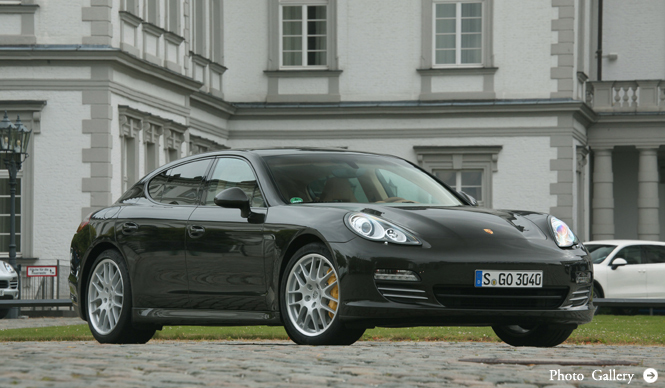
A year after its debut, the Porsche Panamera is becoming a more common sight on the streets. Two new models equipped with the long-awaited V6 engine have been added. The 2WD model is simply called "Panamera," while the full-time 4WD version is named "Panamera 4."
The most noteworthy aspect is, of course, the engine itself. While the naturally aspirated and turbocharged 4.8-liter V8 unit is largely shared with the Porsche Cayenne, the 3.6-liter V6 engine is actually different from the one used in the Cayenne. The reason is simple: the Cayenne's V6 wouldn't fit within the Panamera's low hood line.
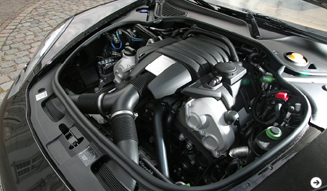
This engine, which is 41mm shorter in height and 14kg lighter, can essentially be considered a V8 unit with two cylinders removed. It produces a maximum output of 300ps at 6,200rpm and a peak torque of 400Nm at 3,750rpm.
The differences from the existing grades are almost exclusively this engine. Externally, the distinguishing features are the matte black side window frames, the oval single-tube tailpipes at the rear, and the emblems.
To coincide with the addition of these V6 models, minor revisions have been made across the entire Panamera range. The PDK-equipped models now feature a decorative plate engraved with "PDK" on the steering wheel. Additionally, options such as PTV Plus, a brake-based torque vectoring function first introduced on the 911 Turbo, and paddle shifters for PDK-equipped cars, also from the 911 Turbo, are now available.
Given the Panamera's imposing size, stretching nearly 5 meters in length, everyone is undoubtedly curious whether the V6 engine delivers the performance befitting the Porsche name. To put it simply, it more than meets expectations. In fact, I would go as far as to say it exceeded them.
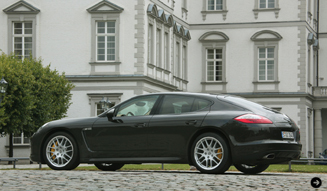
The Full-Time 4WD "Panamera 4" is Equipped with a 7-Speed PDK
My first drive was in the Panamera 4. It features an electronically controlled full-time 4WD system called PTM, and is exclusively offered with a 7-speed PDK gearbox.
The primary reason for the impressive driving experience is the strong performance in the commonly used rev range below 4,000rpm. While the engine's torque curve indicates a peak torque at 3,750rpm, higher than the Cayenne's V6, the reduced weight of the car plays a significant role. The Panamera responds instantly to throttle inputs, offering a sporty agility from the moment you start moving. The deep, resonant engine sound likely enhances this impression.
Conversely, the power in the higher rev range doesn't feel overwhelmingly strong, which might be partly due to the satisfying low-end performance. While it doesn't possess excessive power, the engine revs smoothly to the top end, with its sound becoming clearer and more refined as it does. It's undoubtedly a sporty heart that is worth revving out.
Furthermore, when the vehicle comes to a stop at traffic lights, the engine automatically shuts off to conserve fuel. Upon acceleration, the engine restarts automatically as soon as you release the brake. While this "start-stop" function is also available on the existing V8 and Turbo models, it has been refined for quicker startup and reduced vibration. In practice, the operation is seamless, and I experienced no disruption to the driving rhythm during the test. Overall, the driving experience can be described as exceptionally refined.
PORSCHE PANAMERA
The Lightweight Panamera, Blessed with a V6 Engine (2)
Agile Handling That Belies Its 5-Meter Length
The pleasant surprise wasn't limited to the powertrain; it extended to the handling as well. It is remarkably agile. The way the nose instantly tucks into the turn the moment you turn the steering wheel is astonishing, making it hard to believe you're piloting a four-door car nearly 5 meters long.
Opening the hood and looking inside reveals the reason for this agility. The engine is essentially the V8 unit with the front two cylinders removed. This means the engine is mounted further back, and the front of the car is significantly lighter by the equivalent weight of two cylinders. It's no wonder this contributes to such dynamic responsiveness.
Not only is the turn-in sharp, but the subsequent behavior is also stable. As you accelerate, the PTM system directs more power to the front wheels, pulling the car through the corner exit. Yet, it doesn't feel difficult to turn; instead, it allows for a precise exit from the corner. The test car was equipped with the newly available "PTV (Porsche Torque Vectoring) Plus" option, which lightly brakes the inner wheel during cornering to enhance the drive to the outer wheel, undoubtedly contributing to this performance.
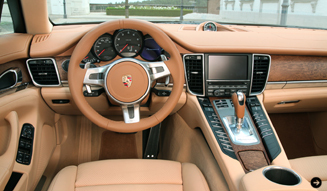
The 2WD "Panamera" with a 6-Speed Manual Transmission
Next, I test-drove the rear-wheel-drive "base" Panamera. This one, remarkably, came with a 6-speed manual transmission.
The feel of the gear shift itself is neither particularly good nor bad. The throw is long, and while the shift effort is light, there's a lack of distinct gate feel, so shifting gears isn't exactly a joy. However, the pleasure of controlling everything yourself, including clutch operation, remains. This is, of course, because the Panamera possesses the driving dynamics of a pure sports car.
The lightness of the front end, already noticeable in the Panamera 4, feels even more refined in this rear-wheel-drive Panamera. The weight difference is 60kg even between PDK models, and most of this is concentrated at the front. Furthermore, with no power being sent to the front wheels, the immediate grip generated by the front tires in response to steering inputs is transmitted with visceral clarity to your palms. The sheer lightness and directness made me feel as if I were driving a Boxster.
There are no issues with stability either. The chassis performance is already at such a high level that it cannot be overwhelmed by approximately 300ps of power.
A Magical Ride That Keeps the Body Flat
The ride comfort is also excellent. All test cars were equipped with the adaptive air suspension, which will be standard on the Japanese models. While maintaining Porsche's signature sporty feel, the body remains perfectly level even under significant impacts. I even drove spiritedly on mountain roads with passengers in the back, and not a single complaint was heard from them. This ride quality is truly like magic.
The Panamera series is selling well globally. However, many potential buyers were waiting for the V6 models to be introduced before making a decision. For them, the conclusion is likely to be: "It was worth the wait" and "You will surely be satisfied."
Yet, it's also true that the value and presence of the existing models have not been diminished. As is often the case with Porsche, I am truly impressed by their skill in creating distinct characters within the same Panamera model line.
According to Porsche, these V6 models are expected to account for half of the series' sales. It's certain that we will see even more Panameras on the road from now on.