Test Drive: The Daihatsu Copen Kei Specialty Car | Daihatsu
Daihatsu Copen Robe
Test Drive: The Daihatsu Copen, a Kei Specialty Car
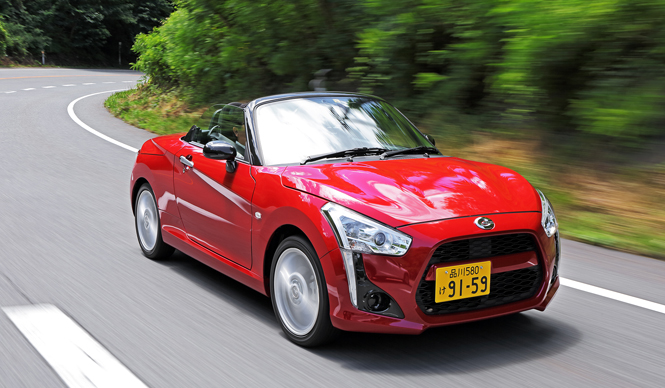
Among the open-top sports cars born from Japan's unique kei car segment, the "Copen," popular for its electric retractable roof and classic looks, has been reborn into its second generation. Yasuhiko Kawamura test drives the new Copen, which has a dramatically different styling image from its predecessor.
Text by KAWAMURA YasuhikoPhotographs by HANAMURA Hidenori
The Appeal of Kei Car Regulations
The CAR section you see here today—is, fitting for a media outlet like OPENERS, a space that carefully selects and features premium models. You've likely noticed this.
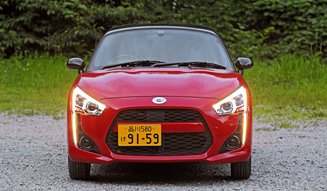
That said, this space is not based on a narrow-minded approach, such as "we feature foreign cars but not Japanese cars." One piece of evidence for this is the appearance of this model, which has carved out a niche among numerous high-end, premium vehicles. It is, remarkably, a "kei car" with a brilliantly shining "yellow license plate."
Kei cars, which now account for about 40% of Japan's new car sales, are certainly gaining strong support due to their low running costs, starting with lower automobile taxes. This is a fact.
Furthermore, with the advancements in technology and product development by manufacturers, many people are likely attracted to the fact that these cars are no longer "compromise cars" as they were perceived a generation ago, whether you're looking at them or driving them. These models, belonging to a uniquely Japanese category, target only the Japanese market, which is said to be "the world's strictest regarding quality and visual refinement."
As a result, the reality that the interior quality, for instance, has surpassed that of many compact cars today, which are designed with global markets, particularly emerging ones, in mind, must also be contributing to their popularity.
While reports of declining populations and "young people's disinterest in cars" are common, leading Japanese automakers to shift their focus to overseas markets for growth, kei cars are a different story. It's true that kei cars are sometimes derided as "Galapagos cars" only viable in Japan. However, the advantages of being Galapagos should not be ignored.
On the other hand, it is a regrettable trait of Japan's mass-production manufacturing industry that as soon as a market is identified, "everyone starts making the same thing." This is most evident in the world of cars, and kei cars are a prime example.
It is, unfortunately, a familiar sight in Japan to see "tall, box-shaped cars overflowing everywhere you look."
Daihatsu Copen Robe
Test Drive: The Daihatsu Copen, a Kei Specialty Car (Part 2)
The World's Only Compact Two-Seater with an Electric Retractable Hardtop
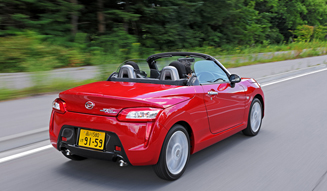
Therefore, the new "Copen" we are featuring here deserves praise simply for its existence. It is a two-seater sports car, remarkably compact, and equipped with a retractable electric hardtop.—Such a model exists nowhere else in the world.
3,395×1,475mm—The length and width, at the maximum dimensions allowed for kei cars, are no different from many other popular models. However, the height of this model, at just 1,280mm, is remarkably low, almost "abnormal" even among kei cars. The Copen has, in this respect, already become a "solitary existence," having broken away from the "battle for space" that all other kei cars participate in.
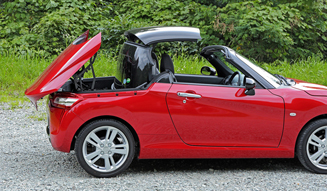
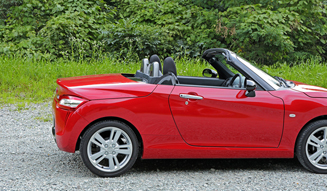
The new model's appearance is a complete departure from the previous generation's extremely rounded styling, which resembled an inverted bowl. Naturally, those who favored the previous model might comment, "Why didn't you maintain the image?"
Indeed, research indicates that many former Copen owners have expressed dissatisfaction. Interestingly, however, younger individuals, unburdened by any prior attachment to the previous model, tend to have very positive opinions about the new styling.
Coinciding with the launch, Daihatsu has already revealed images of an alternative design model that will be added in the near future.
That version, with its round headlights, clearly evokes the atmosphere of the previous model, which disappeared with much regret.
The new model's resin outer panel structure, which strongly appeals with its "customizable" capability based on mood, also offers the significant advantage of making it easier to propose new designs, even for low-volume production vehicles.
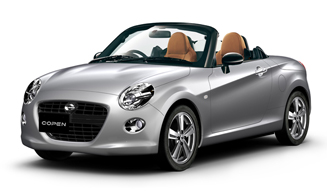
Daihatsu Copen's Third Design
Incidentally, only the door panels among the exterior panels are made of conventional steel, not resin. The development engineers' response is that this was "a decision made considering safety, including security."
Daihatsu Copen Robe
Test Drive: The Daihatsu Copen, a Kei Specialty Car (Part 3)
An Interior Designed to Be Seen
While the new Copen's exterior design is likely to elicit mixed reactions, its interior boasts a considerable presence, with a design that undoubtedly considers the fact that it will be "seen" due to its open-top nature.
Admittedly, the finish is not "luxurious." The steering wheel appears rather large for a sports car, which slightly detracts from the mood. Also, when the genuine navigation system is installed, the way its cluster protrudes haphazardly in the center of the dashboard is something that, frankly, makes you think, "Couldn't they have done better?"
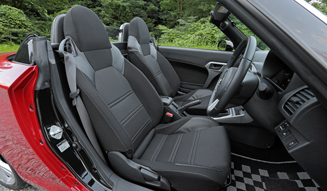
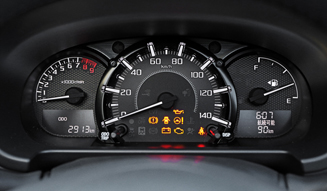
However, the vertically oriented center panel, with its face-level air vents at the top and simple, easy-to-use climate control switches below, is both functional and visually distinctive. The carbon-look instrument panel garnish also has a surprisingly high-quality feel in person.
The lightly bolstered seats, which come standard with built-in heaters, also give the impression that the designers really understood what drivers want. In reality, opening the roof under the direct sun in midsummer, despite its cool appearance, is almost suicidal for a convertible. Conversely, driving in slightly cool weather, enveloped in warmth, is the most comfortable and enjoyable experience.
In that regard, seat heaters are a crucial item that extends this comfortable driving period into early winter. Of course, in spring, when the cherry blossoms bloom, it's certainly pleasant enough to "consider opening the roof."
Daihatsu Copen Robe
Test Drive: The Daihatsu Copen, a Kei Specialty Car (Part 4)
Driving Performance Befitting a Sports Car
Once inside the Copen with the roof closed, the cabin space is indeed quite tight. Whether it's a couple who want to spend every moment together, or a husband and wife who know each other well,—in either case, spending a long time in this space would be difficult unless you are a pair who are comfortable being close enough to hear each other's breath. Viewed another way, the new Copen's cabin space is merely a "1+1 layout."
On the other hand, like all retractable-roof models, the trunk space with the roof closed is surprisingly large. This is understandable, as this is where the rear window and roof sections are folded and stored. While the luggage space is drastically reduced when the roof is open, the new Copen, with the roof closed, is equipped with "GT car"-like practicality, capable of easily accommodating enough luggage for a few days' trip for two.
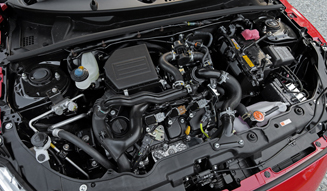
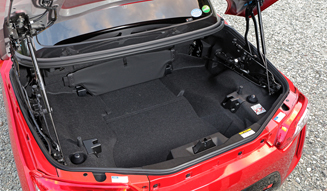
Furthermore, this model, which proudly calls itself a "sports car," delivers driving performance that convincingly lives up to that claim.
Although it is equipped with a turbocharged engine, the acceleration is within the normal range for a kei car. Because it has an elaborate roof system that transforms from coupe to open-top in about 20 seconds with the push of a button, it's not exceptionally lightweight, so its absolute acceleration is not particularly remarkable.
What is extraordinary is the refinement of its suspension and handling. The meticulously designed chassis and the low center of gravity, which is unheard of in other kei cars, seem to be effectively contributing. Unnecessary body movements are suppressed, and the sense of flatness is surprisingly high. In other words, the ride comfort is also quite good.
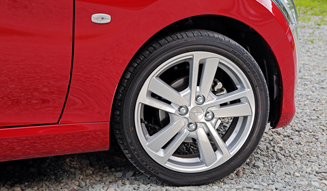
The fact that its suspension possesses such high capabilities is also demonstrated by how the traction control and stability control systems do not easily intervene, even when pushing the car moderately on winding roads.
In fact, even when pushed to its limits on a mini-circuit-style course, it was confirmed that there were no signs of spinning or drifting out. On the other hand, when the roof is open, the body's rigidity noticeably decreases.
If you want to tackle winding roads like a true sports car,—then the "closed mode," which enhances handling precision, is recommended.
Daihatsu Copen Robe
Test Drive: The Daihatsu Copen, a Kei Specialty Car (Part 5)
A Premium Model in a Small Car
Meanwhile, after coming to a stop and pressing the switch on the center console, wait about 20 seconds. First, the rear lid lifts significantly, and then, with an elaborate process of folding and storing the rear window and roof sections, the model achieves "open-air" status. The sense of freedom it provides is incomparable.
The "improved aerodynamics" in the new model are evident not only in enhanced stability at high speeds but also in the airflow when the top is down. While you do feel the wind starting around 60 km/h, if you raise the side windows, it's limited to the top of your head. The fact that it maintains the exhilaration unique to open-top cars without causing excessive hair disarray must be the result of careful "aerodynamic tuning."
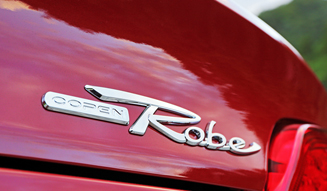
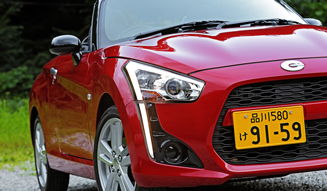
Despite being a kei car, its price is around 1.8 million yen. It's somewhat predictable that some will say the new Copen is "too expensive."
However, this depends on one's values. When a model that offers the choice between a closed mode with weather resistance comparable to a coupe and a solid sports car driving feel, and an open mode for exhilarating open-air driving, all selectable with the touch of a button, can be obtained for under 2 million yen, it's natural that many will feel it's "dreamily affordable."
In any case, such an existence is unique in the world.—It is, quite simply, a joy to see such a "premium model" emerge from Japan, and specifically from the kei car segment.

Daihatsu Copen Robe
Body Dimensions | Length 3,395 × Width 1,475 × Height 1,280 mm
Wheelbase | 2,230 mm
Tread Front/Rear | 1,310 / 1,295 mm
Weight | (5MT) 850 kg (CVT) 870 kg
Engine | 658 cc Inline 3-cylinder DOHC Intercooler Turbo
Bore x Stroke | 63.0 × 70.4 mm
Compression Ratio | 9.5 : 1
Max. Output | 47 kW (64 ps) / 6,400 rpm
Max. Torque | 92 Nm (9.4 kgm) / 3,200 rpm
Transmission | 5-speed MT / CVT
Drivetrain | FF
Front Suspension | MacPherson Strut
Rear Suspension | Torsion Beam
Front Brakes | Ventilated Disc
Rear Brakes | Drum
Tires Front/Rear | 165/50R16 75V
Fuel Economy (JC08 mode) | (5MT) 22.2 km/ℓ (CVT) 25.2 km/ℓ
Price | (5MT) ¥1.8198 million (Hokkaido region) ¥1.8306 million
(CVT) ¥1.7982 million (Hokkaido region) ¥1.809 million
Customer Relations Center
0800-500-0182
(Weekdays) 9:00-19:00