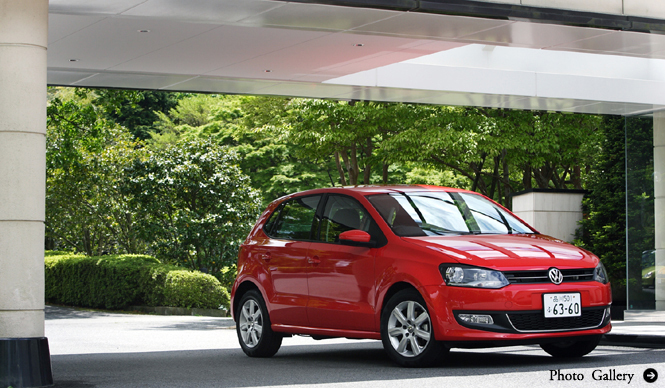
Volkswagen Polo TSI Highline | A New Generation Model with Agile Handling
Volkswagen Polo TSI Highline
A New Generation Model Characterized by Agile Handling (1)
The Volkswagen Polo, equipped with a 1.2-liter turbo engine, was released on June 10, 2010, by Volkswagen Group Japan. Its lightness was a key feature, enhancing its nimble feel.
Text by Fumio OgawaPhotos by Masayuki Arakawa
Downsizing Pays Off: 20 km/L Fuel Economy
The new Polo is available in two trims: the "TSI Comfortline" (¥2.13 million) and the well-equipped "TSI Highline" (¥2.43 million). The previous 1.4-liter engine models will eventually be phased out.
The Polo is a compact hatchback positioned below the Golf. The new model debuted in October 2009 with a 1.4-liter naturally aspirated engine. This iteration, however, features forced induction, boosting maximum output by 20 ps to 105 ps and increasing maximum torque by 43 Nm to 175 Nm (17.8 kgm). Volkswagen Group Japan states, "This performance rivals that of a 1.8-liter engine."
The strategy of reducing displacement while achieving high output through forced induction is known as the "downsizing concept," currently adopted by many global automakers, particularly German ones. Volkswagen is also enthusiastic about downsizing, and in the Polo's case, this pursuit of efficiency with reduced displacement has led to improved fuel economy. The 1.2-liter engine model achieves 20 km per liter in the 10-15 mode, a significant improvement from the previous 1.4-liter model's 17 km/L.
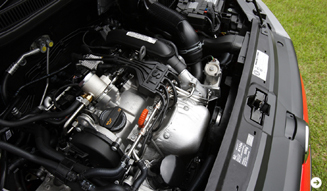
As Volkswagen claims, the 1.2-liter engine employs a "lightweight, compact, and low-friction simple head with 2 valves and SOHC." This same 1.2-liter engine, also found in the Golf TSI Trendline announced earlier, is reportedly about 40 kg lighter than the previous 1.4-liter unit. At this announcement, Volkswagen Group Japan's re-emphasis on "Think Small"—the keyword from an advertising campaign that contributed to the Beetle's success in the US—to highlight the Polo's reduced environmental impact was particularly memorable.
Enhanced Acceleration and Turbocharger Boost for Power
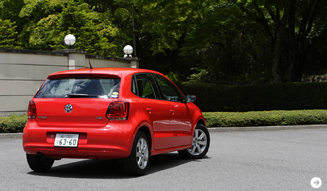
Driving it, the first impression is one of lightness! The way the car changes direction with steering input is remarkably smooth and natural, providing a pleasant sensation. Benefiting from its relatively light curb weight of 1.1 tons, it offers an impressively fresh feeling, especially when cornering downhill.
Acceleration is also brisk from a standstill. As the turbocharger engages and boost builds, you feel an even greater surge of power. By manually shifting the 7-speed DSG (Volkswagen's dual-clutch transmission) and utilizing the 4,000 rpm range, you can drive it with spirited enthusiasm. While this might seem at odds with the Polo's marketing emphasis on fuel efficiency, it's a car that offers genuine driving enjoyment.
Volkswagen Polo TSI Highline
A New Generation Model Characterized by Agile Handling (2)
Effective Noise Isolation from the Outside World
Lightness is arguably the most crucial element for a car. It allows for a smaller engine, as seen in the Polo, and reduces rotational inertia, enabling smaller brake diameters. This is a more efficient approach than trying to enhance the efficiency of large-displacement engines. Volkswagen's meticulous approach, not just to reducing engine displacement but also to optimizing head design and engine oil volume for weight reduction, is noteworthy. The Polo's agility can be seen as a representation of a new generation of automobiles.
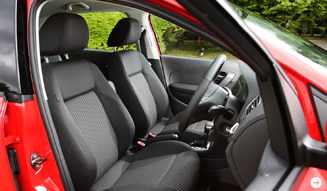
The Polo's strengths also lie in its pursuit of comfort. One key aspect is its high level of quietness. It effectively blocks external noise, as well as mechanical noise from the engine and transmission, intake and exhaust sounds, and noise from the tires and road. While Japanese cars have long prioritized noise reduction, models this size that achieve such thorough isolation are rare. The Polo's premium feel is evident in its sound insulation and the quality of its construction. Even the grip shape of the steering wheel, with its three-dimensional design, feels intuitively comfortable. Few manufacturers seem to focus on this, yet the tactile pleasure of the grip connects to a fundamental human sense of comfort. In automotive terms, design that engages the senses is called 'sensory quality,' and VW's high quality is apparent here as well.
Polo or Golf: A Difficult Choice
The Comfortline (¥2.13 million) is the base grade, while the Highline (¥2.43 million) offers more extensive equipment. Exclusive features for the Highline include fully automatic air conditioning, Park Distance Control, sports seats, a leather-wrapped steering wheel, and alloy wheels.
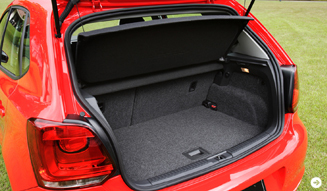
When comparing equipment, there's a subtle overlap with the Golf TSI Trendline (¥2.57 million), which also uses the 1.2-liter engine. In terms of spaciousness, the Golf, with its 2,575mm wheelbase and 4,210mm hatchback body, contrasts with the Polo's 2,470mm wheelbase and 3,995mm length. The body width also differs, with the Polo at 1,685mm compared to the Golf's 1,790mm. These dimensional differences are reflected in the perceived interior space.
Currently, Golf models with the 1.4-liter engine, having low mileage and being in good condition, are available on the market for under ¥2 million. Considering this, the choice between the Polo and the Golf is a tough one. The Polo, being more compact, possesses a certain straightforwardness that is undeniably appealing.
Volkswagen Polo TSI Highline
フォルクスワーゲン・ポロ TSI ハイライン
Body | Length 3,995 x Width 1,685 x Height 1,475mm
Wheelbase | 2,470mm
Curb Weight | 1,100kg
Engine | 1,197cc Inline 4-cylinder SOHC + Intercooler Turbocharger (2 valves)
Max. Output | 77kW [105ps] / 5,000rpm
Max. Torque | 175Nm [17.8kgm] / 1,550-4,100rpm
Drive System | Front-wheel drive
Transmission | 7-speed DSG
Price | ¥2.42 million
Volkswagen Customer Centre
0120-993-199