Test Drive: Caterham Seven 160 | Caterham
Caterham Seven 160
A Seven That Fits Kei Car Regulations
Test Drive: Caterham Seven 160
The "Seven," a naked car born in Britain, has a new entry model called the "Seven 160" which is powered by a 660cc engine from Suzuki and is notable for being registrable as a kei car in Japan. It's a primitive car designed purely for driving enjoyment, with no electronic stability control, air conditioning, or even a radio. Tatsuya Otani reports on the Seven 160.
Nothing is Ordinary
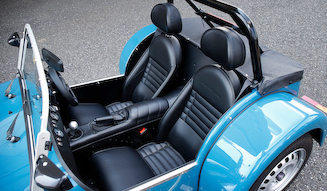
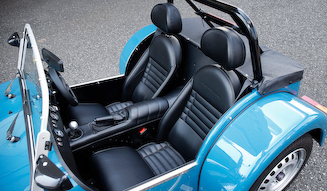
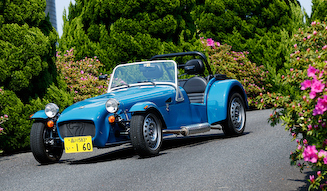
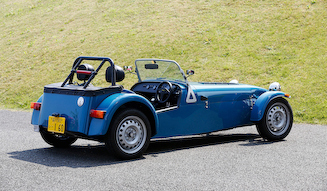
It's immediately obvious that this is a vehicle entirely different from an ordinary car, lacking not only a roof but also doors and side windows. Furthermore, the seating position is so low it's practically on the ground, and the legroom is extremely narrow, requiring the driver to support their upper body with their arms while quickly sliding their legs into the footwell. It's akin to getting into a Formula car.
However, once you experience the joy of maneuvering this tiny Caterham "Seven 160," all such considerations will likely vanish from your mind. You might even come to believe that this form, stripped of everything but the essential functions for driving, is the only way to achieve such an agile, go-kart-like feel.
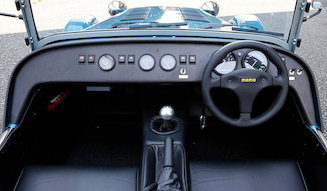
You'll soon find yourself growing fond of the "super" small steering wheel, about 25cm in diameter, the manual gearshift lever protruding only about a fist's length from the center tunnel, and the simple body made of just bent thin aluminum sheets.
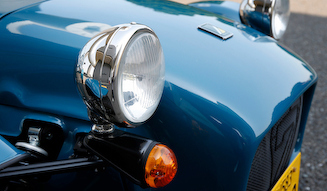
The "Seven," born as the Lotus "Seven" in the 1950s, saw its production discontinued by Lotus in the 1970s. Caterham, originally a Lotus distributor, took over the rights and has continued production to this day, making it a sports car with a long lineage. Its classical appearance and extremely simple mechanics are understandable when you consider its prototype originated over 50 years ago.
Caterham Seven 160
A Seven That Fits Kei Car Regulations
Test Drive: Caterham Seven 160 (Part 2)
The "Seven" Evolves with the Times Towards Higher Power
However, throughout its long history, the Seven has been forced to evolve, whether it liked it or not. Larger and more powerful engines were installed, and the suspension was gradually strengthened in step with this. Combined with its inherently lightweight body, it began to take on the characteristics of a road-going racer.
Caterham's current lineup still includes monsters with power-to-weight ratios as low as 2.1kg/ps, which would undoubtedly be exhilarating to drive. However, this deviates significantly from Lotus's original concept of creating a unique sports car by compensating for a lightweight body with a relatively low-powered engine. Frankly, while fine for intense driving, it had become a model that was a bit too much for casual sporty driving.
The Seven 160 Returns to its Roots
This is where the "Seven 160" comes in. As widely discussed, the engine nestled in the front of the Seven 160 is a 660cc three-cylinder turbo engine made by Japan's Suzuki for kei cars. Its maximum output is only 80ps, but with a vehicle weight of just 490kg (!), the power-to-weight ratio is a respectable 6.1kg/ps. For comparison, the BMW "Z4 sDrive20i" a similarly open two-seater, has a ratio of 8.2kg/ps, illustrating how high-performance the Seven 160 is in relative terms.
Even so, the Seven 160's suspension feels surprisingly soft. To put it bluntly, it feels comfortable enough for daily driving.
Yet, it's easy to imagine that on winding roads, you'd experience a directness of driving feel rarely encountered elsewhere (this test drive was conducted in an urban area, so unfortunately, we couldn't thoroughly test the handling). Despite its remarkably simple mechanics, the incredibly lightweight body undoubtedly plays a significant role in achieving both comfortable city driving and direct handling.
Caterham Seven 160
A Seven That Fits Kei Car Regulations
Test Drive: Caterham Seven 160 (Part 3)
A Car That's Purely Fun to Drive
As you operate the Seven 160, you realize how remarkably well-thought-out the cockpit's simplicity is in terms of usability.
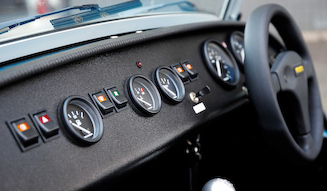
For instance, the turn signals are operated by toggle switches that simply click left and right, without even an auto-return mechanism. Yet, they are positioned perfectly to be reached naturally when you lift your left hand after shifting gears, allowing everything to be done with minimal movement. They are so easy to use that you might find yourself thinking the turn signal lever doesn't need to return automatically.
Furthermore, despite lacking any automatic systems like ESP (Electronic Stability Program), ABS, or traction control, there's nothing about controlling it all yourself that feels burdensome. Everything is made possible by the Seven's lightweight, simple, and easy-to-handle nature.
Therefore, I believe you could easily go on a trip with the Seven 160. You don't have to push it hard on mountain roads. Taking this agile sports car, which feels like an extension of your own limbs, on a short one- or two-night trip would be a truly enjoyable experience.
However, there's one thing you shouldn't forget: the protective features for the driver are truly minimal in this car.
Therefore, in the event of an accident, the risk of driver injury is as high as with a motorcycle, and even without an accident, you should be aware of the potential for injury from flying stones, especially on highways. For example, wearing motorcycle apparel with protectors would offer greater peace of mind, and you might consider wearing a helmet for facial and head protection.
—While I may have ended with a bit of a warning, I can guarantee that the Seven 160 is an immensely fun car to drive. Incidentally, its affordable price of 3,942,000 yen and the advantage of being registrable as a kei car have led to a flood of orders, with delivery times now reportedly around 10 months.
Conversely, this indicates that there are many people who purely seek the joy of driving. Hearing this, I couldn't help but smile.

Caterham Seven 160
Body Dimensions | Length 3,100 x Width 1,470 x Height 1,090 mm
Wheelbase | 2,225 mm
Tread Front/Rear | 1,220 / 1,301 mm
Minimum Ground Clearance | 100 mm
Weight | 490 kg
Engine | 658 cc Inline 3-cylinder DOHC Turbo
Bore x Stroke | 68 x 60.4 mm
Max Output | 58.8 kW (80 ps) / 5,500 rpm
Max Torque | 107 Nm (10.9 kgm) / 3,400 rpm
Transmission | 5-speed MT
Drivetrain | FR
Front Suspension | Double Wishbone
Rear Suspension | Rigid Axle
Tires | 155/65R14
Front Brakes | Solid Disc
Rear Brakes | Drum Brakes
Max Speed | 160 km
0-100km/h Acceleration | 6.9 seconds
Price (incl. 8% consumption tax) | 3,942,000 yen
Caterham Cars Japan
Tel | 03-5754-2227