Test Drive the New Porsche 911 Targa | Porsche
Porsche 911 Targa | Porsche 911 Targa
An Icon for Discussing Porsche Design
Test Drive of the New 911 Targa
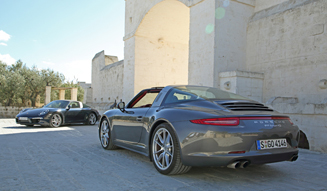
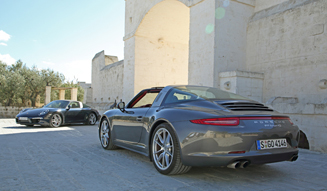
Among the Porsche "911" models, the most elegant and luxurious is the "Targa." Following the debut of the current Type 991 Carrera in 2011, this latest model arrives after careful preparation, featuring a completely new roof opening and closing system. Its visual impression has also been significantly transformed. Set against the backdrop of a southern Italian town on the Adriatic coast, Tatsuya Kuijima enjoys open-air motoring.
Text by KUSHIMA Tatsuya
A Vehicle Perfect for Japanese Sensibilities
Porsche enthusiasts, or indeed any car lovers, will likely know that the Porsche "911" has a model called the "Targa." It's an open-top model that retains the coupe-like silhouette, yet offers a distinct experience from a cabriolet.
Originally, it was created for the American market in the 1960s. This was in response to a surge in fatalities and injuries from convertible rollovers at the time. Simply cutting off the roof wouldn't protect occupants. Thus, the Targa top method, which retained the center pillar, was conceived. This pillar would serve as a roll bar, protecting the occupants.
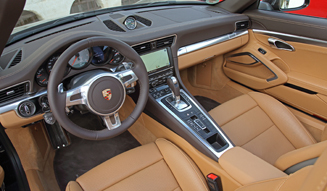
Porsche unveiled the prototype at the 1965 Frankfurt Motor Show and put it into production in '67, shortly after the 911's debut. This was long before the cabriolet was introduced. In the 1970s, it was a mainstream model, accounting for about 40 percent of the 911 series.
I personally owned a Targa for several years until just a few years ago. It was the last air-cooled model, the 993. As you know, from the 997 generation onwards, the Targa top signified a panoramic glass roof. The entire roof surface was glass, sliding open to provide the open-air experience.
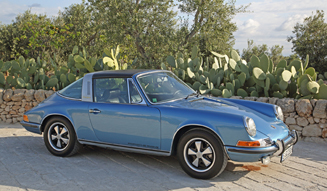
Porsche 911S Targa (Type 901)
This system was incredibly convenient. Why? Because from the side, you couldn't tell the roof was open. In other words, you could enjoy open-air motoring without the conspicuousness of a cabriolet.
It could truly be called a vehicle perfectly suited for the understated Japanese sensibility. As a result, it remained in my garage for the longest period of any car in my history of ownership: seven years.
Porsche 911 Targa | Porsche 911 Targa
An Icon for Discussing Porsche Design
Test Drive of the New 911 Targa (2)
A New Opening Mechanism
Now, about the new Targa. As you can see, this car differs from previous Targas. The motif is the first-generation Targa mentioned earlier, with the roof opening while retaining the center pillar. This is a new opening and closing system, a departure from the panoramic glass sheet.
I call it "new" because the entire operation is electric. With a single switch, the rear glass section lifts diagonally backward, and the two-part top retracts underneath. This takes just 19 seconds. Once the rear glass returns to its original position, the finish is so seamless it's as if the top was never there.
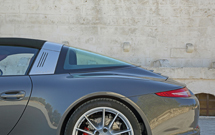
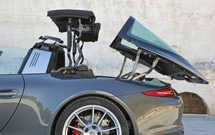
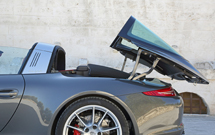
This sequence of operations cannot be performed while driving. While some open-top models now operate at speeds below 50 km/h, this one does not. When pressed for the reason, the answer was quite logical.
It's because the rear glass momentarily obscures the brake lights during operation. Indeed, it's dangerous if you can't tell whether the brake lights are on. It's a rather convincing explanation.
Now, let's move on to the driving impressions.
Porsche 911 Targa | Porsche 911 Targa
An Icon for Discussing Porsche Design
Test Drive of the New 911 Targa (3)
You Should Enjoy Open-Air Motoring
The available grades are "Targa 4" and "Targa 4S." The base is the cabriolet body, to which the center pillar and the movable roof system are integrated. The engines are the same as in the coupe and coupe S relationship.
The Targa 4 is equipped with a 3.4-liter engine producing 350 hp, while the Targa 4S features a 3.8-liter unit with 400 hp. The "4" indicates it's all-wheel drive. Since the previous generation Targa, the drive system has been exclusively all-wheel drive.
Regarding wind buffeting, it's barely noticeable up to 80 km/h. Conversations with the passenger are smooth, and you don't need to raise your voice even when driving on the highway. However, as you accelerate beyond that, the wind noise increases, and wind rushes in intensely from above the windshield and the sides.
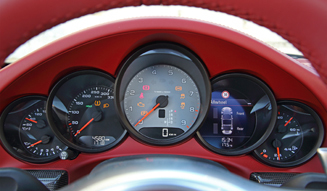
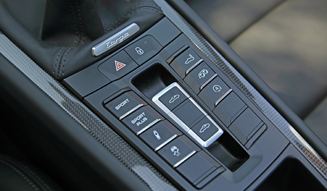
While the rear glass prevents your hair from being blown about as dramatically as in a cabriolet, comfort is still compromised. Considering the passenger's comfort, I recommend closing the roof when accelerating hard.
Of course, when driving alone, you should fully embrace the open-air motoring experience. Enjoying the 911's performance while feeling the wind is a true luxury. The body rigidity, which is 10% higher than the cabriolet's, proves its worth at such times.
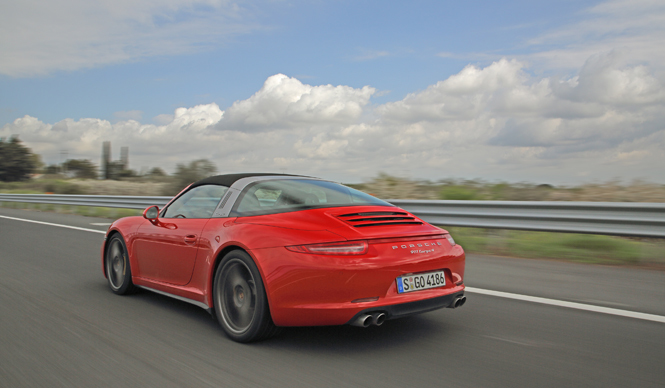
Porsche 911 Targa | Porsche 911 Targa
An Icon for Discussing Porsche Design
Test Drive of the New 911 Targa (4)
Body Color is Key
The difference between the Targa 4 and Targa 4S is the same as with the coupe. Consequently, the former is for those seeking agility, while the latter is for those pursuing power. In either case, they are undeniably fast. Personally, I found the Targa 4 to be perfectly adequate.
More importantly, when choosing a Targa, the body color is what you should focus on. Since the silver center pillar remains the same regardless of the color, you need a discerning eye to find the right combination. Seeing the actual cars, the Dark Blue Metallic and Anthracite Brown Metallic looked particularly stylish. While the popular Sapphire Blue Metallic is also not bad, it lacks a certain mature sophistication.
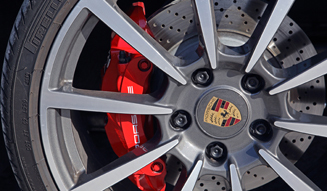
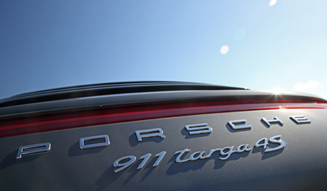
With a design this striking, it's easy to imagine the new Targa attracting the keen attention of creatives. Fashion designers, creative directors, and spatial producers would likely be drawn to it. It wouldn't be surprising to see such a phenomenon unfold in cities like New York, Milan, Paris, or London.
In that sense, this model might showcase a different facet of Porsche. An icon for discussing Porsche through its design – that is this new Targa...
Porsche 911 Targa 4 | Porsche 911 Targa 4
Body Dimensions | Length 4,491 x Width 1,852 x Height 1,298 mm
Wheelbase | 2,450 mm
Tread Front/Rear | 1,532 / 1,560 mm
Weight (DIN) | 1,560 kg
Engine | 3,436 cc Horizontally opposed 6-cylinder Direct Injection DOHC
Compression Ratio | 12.5 : 1
Bore x Stroke | 97.0 x 77.5 mm
Max. Output | 257 kW (350 ps) / 7,400 rpm
Max. Torque | 390 Nm / 5,600 rpm
Transmission | 7-speed Automatic (7 PDK)
Gear Ratio | 1st 3.91
2nd 2.29
3rd 1.65
4th 1.30
5th 1.08
6th 0.88
7th 0.62
Final Drive Ratio (Front/Rear) | 3.44 / 3.33
Drivetrain | 4WD
Suspension Front | MacPherson Strut
Suspension Rear | 5-Link
Tires Front/Rear | 235/40R19 / 295/35R19
Brakes Front | Drilled Ventilated Discs (φ330 x 28 mm)
Brakes Rear | Drilled Ventilated Discs (φ330 x 28 mm)
Max. Speed | 280 km/h
0-100 km/h Acceleration | 5.0 seconds (4.8 seconds with Sport Chrono Package)
0-200 km/h Acceleration | 17.5 seconds (17.2 seconds with Sport Chrono Package)
Fuel Consumption (NEDC) | 8.7 L/100km (11.5 km/L)
CO2 Emissions | 204 g/km
Fuel Tank Capacity | 68 Liters
Trunk Capacity (VDA) | Front 125 Liters, Rear 160 Liters
Price | 15,000,000 Yen
Porsche 911 Targa 4S | Porsche 911 Targa 4S
Body Dimensions | Length 4,491 x Width 1,852 x Height 1,289 mm
Wheelbase | 2,450 mm
Tread Front/Rear | 1,538 / 1,552 mm
Weight (DIN) | 1,575 kg
Engine | 3,800 cc Horizontally opposed 6-cylinder Direct Injection DOHC
Compression Ratio | 12.5 : 1
Bore x Stroke | 102.0 x 77.5 mm
Max. Output | 294 kW (400 ps) / 7,400 rpm
Max. Torque | 440 Nm / 5,600 rpm
Transmission | 7-speed Automatic (7 PDK)
Gear Ratio | 1st 3.91
2nd 2.29
3rd 1.65
4th 1.30
5th 1.08
6th 0.88
7th 0.62
Final Drive Ratio (Front/Rear) | 3.44 / 3.33
Drivetrain | 4WD
Suspension Front | MacPherson Strut
Suspension Rear | 5-Link
Tires Front/Rear | 245/35R20 / 305/30R20
Brakes Front | Drilled Ventilated Discs (φ340 x 34 mm)
Brakes Rear | Drilled Ventilated Discs (φ330 x 28 mm)
Max. Speed | 294 km/h
0-100 km/h Acceleration | 4.6 seconds (4.4 seconds with Sport Chrono Package)
0-200 km/h Acceleration | 15.5 seconds (15.2 seconds with Sport Chrono Package)
Fuel Consumption (NEDC) | 9.2 L/100km (10.9 km/L)
CO2 Emissions | 214 g/km
Fuel Tank Capacity | 68 Liters
Trunk Capacity (VDA) | Front 125 Liters, Rear 160 Liters
Price | 18,000,000 Yen
*Figures other than price are for the home market.