Test drive the Golf Variant in Japan | Volkswagen
Volkswagen Golf Variant
Test Drive: Golf Variant in Japan
On December 26, 2013, as the year drew to a close, the "Golf Variant," a station wagon based on the seventh-generation "Golf," was announced in Japan. This model, which extends the body of the Golf 7—the first imported car to win the "2013-2014 Japan Car of the Year" award—to improve usability, how does it perform? Satoshi Shiomi investigated.
Text by SHIOMI SatoshiPhotographs by MOCHIZUKI Hirohiko
Intelligent Downsizing
The Volkswagen Golf hatchback was released in Japan in mid-2013.7th Generation New ModelIt features a design that, as always, avoids the unconventional, and a packaging that, as always, is excellent.
Since the previous generation, Volkswagen's pursuit of efficiency (fuel economy) has been relentless. In the new model, they have further improved efficiency. By brushing up the familiar powertrain—a combination of a supercharged engine with a downsizing concept and a dual-clutch transmission—and mounting it on a lighter body, they have achieved good fuel economy.
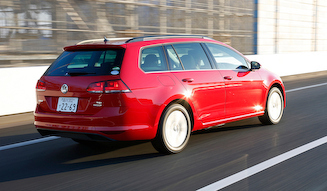
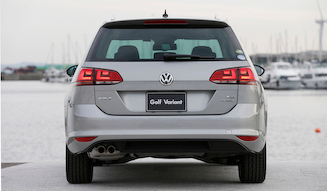
Announced at the end of 2013,Golf Variantis the wagon version of the Golf. The design from the rear doors forward is the same as the hatchback, with a dedicated design for the rear overhang. The wheelbase of 2,635mm is identical to the hatchback. Like the hatchback, it showcases Volkswagen's advanced pressing technology; the sharpness of the character lines on the hood and body sides is impressive.
Two trims are available: the "Comfortline" with a 1.2-liter inline-4 turbo and the "Highline" with a 1.4-liter inline-4 turbo. The entry-level "Trendline" trim, available for the hatchback, is not offered for the Variant at this time.
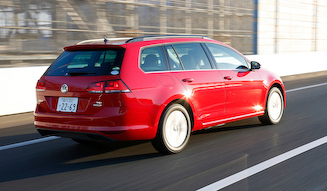
The test car was the Comfortline. While the peak power and torque are modest at 105ps/4,500-5,500rpm and 17.8kgm/1,400-4,000rpm respectively, the engine delivers most of its capability from low revs across a wide range, making it more than sufficient to propel the lightweight 1,300kg body. Driving a light body (for its size) efficiently with a small engine feels like a very intelligent act, and I felt no envy even when lined up next to a high-performance car with a V8 engine. On the contrary, I felt like saying, "You must have a tough time."
Volkswagen Golf Variant
Test Drive: Golf Variant in Japan (2)
More Than Enough Fuel Efficiency
The car's handling is remarkably close to that of the hatchback. It achieves a high level of balance between agility in the city and straight-line stability on the highway. The Golf boasts fuel economy that qualifies it as an eco-car, but in terms of driving enjoyment, it sets itself apart from many other eco-cars. That's not to say it's sporty; rather, it offers precise control. Turn the steering wheel, and it turns exactly that amount, with body roll occurring at a predictable rate and magnitude that is not uncomfortable. The pedals, both accelerator and brake, are light and require minimal force but are highly controllable. It's the kind of car that foreign magazines often describe as "precise."
The Comfortline cannot be equipped with DCC (Adaptive Chassis Control), which allows adjustment of the damper's damping force and power steering characteristics. While the DCC, an option for the Highline priced at 147,000 yen, is exceptionally comfortable, especially in "Comfort" mode, making it a feature that might justify choosing the Highline solely for its presence, it's not essential. It would be perfect if it were also available for the Comfortline.
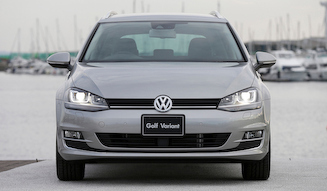
While the displacement of the 1.2-liter inline-4 turbo is the same as the previous generation, the cylinder head has been upgraded from a 2-valve SOHC to a 4-valve DOHC. All of this evolution has been directed towards improving fuel economy, not increasing power, resulting in a JC08 mode fuel consumption of 21.0 km/ℓ, the same as the 60kg lighter hatchback. For comparison, the more powerful Highline achieves 19.5 km/ℓ. This is more than sufficient.
Even with the same grade names, "Comfortline" and "Highline," there are subtle differences in equipment between the hatchback and the Variant. To put it simply, the Variant's Comfortline has reduced equipment compared to the hatchback, keeping its price at 2,695,000 yen, only 5,000 yen higher. In contrast, the Highline boasts enhanced equipment and is priced at 3,225,000 yen, 235,000 yen more than the hatchback.
The 530,000 yen price difference between the Comfortline and Highline is primarily due to the engine (1.2-liter vs. 1.4-liter) and whether safety features like "Adaptive Cruise Control" and "Lane Keep Assist" are standard equipment. Additionally, the Highline comes standard with a steering wheel featuring paddle shifters and audio controls, and its headlights are bi-xenon. The tire and wheel sizes also differ.
Volkswagen Golf Variant
Test Drive: Golf Variant in Japan (3)
Exceptional Practicality
A notable feature of this Variant is its large luggage capacity. It has increased by 100 liters from the previous generation's 505 liters to 605 liters. Considering that the wagon version of the larger Mazda "Atenza"offers 506 liters, the Subaru "Legacy" wagon offers 520 liters, and the 5-seater Toyota "Prius α"offers 535 liters, it's clear that the previous generation's 505 liters was by no means insufficient. However, the new model not only significantly surpasses the previous generation and its rivals but also, in its eagerness, exceeds even the larger Passat Variant (603L). This highlights the exceptional practicality of the Golf Variant.
The Adaptive Cruise Control, an option on the Comfortline and standard on the Highline, and the Lane Keep Assist are convenient features that are one step away from autonomous driving. Based on personal experience, the Golf Variant's ability to recognize the vehicle ahead with its Adaptive Cruise Control is satisfactory.
The Lane Keep Assist's ability to recognize lane markings is extremely high. While cruise control systems often require quick activation, the Golf Variant allows immediate access via the steering wheel switches.
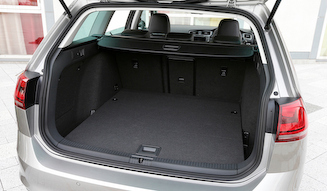
The Golf Variant is an exemplary car, achieved through a relentless pursuit of serious engineering. Compared to the hatchback, there are no special differences other than the vast luggage space, so if you need a large cargo area, choose the Variant; if not, the hatchback is the straightforward choice. It is currently the car I can most confidently recommend to others without hesitation.

Volkswagen Golf Variant TSI Comfortline
Body Dimensions: Length 4,575 x Width 1,800 x Height 1,485mm
Wheelbase: 2,635mm
Tread: 1,545/1,515mm
Minimum Ground Clearance: 140mm
Minimum Turning Radius: 5.2m
Engine: 1,197cc Inline-4 DOHC Turbo
Maximum Output: 77kW (105ps) / 4,500-5,500rpm
Maximum Torque: 175Nm (17.8kgm) / 1,400-4,000rpm
Transmission: 7-speed DSG
Drivetrain: FF
Tires: 205/55 R16
Brakes (Front/Rear): Ventilated Discs / Discs
Suspension (Front/Rear): MacPherson Strut / Trailing Arm
Fuel Economy (JC08 Mode): 21.0km/ℓ
Price: 2,695,000 yen
Volkswagen Golf Variant TSI Highline
Body Dimensions: Length 4,575 x Width 1,800 x Height 1,485mm
Wheelbase: 2,635mm
Tread: 1,535/1,510mm
Minimum Ground Clearance: 140mm
Minimum Turning Radius: 5.2m
Engine: 1,394cc Inline-4 DOHC Supercharged with Intercooler
Maximum Output: 103kW (140ps) / 4,500-6,000rpm
Maximum Torque: 250Nm (25.5kgm) / 1,500-3,500rpm
Transmission: 7-speed DSG
Drivetrain: FF
Tires: 225/45 R17
Brakes (Front/Rear): Ventilated Discs / Discs
Suspension (Front/Rear): MacPherson Strut / 4-Link
Fuel Economy (JC08 Mode): 19.5km/ℓ
Price: 3,225,000 yen
Volkswagen Customer Centre
0120-993-199