Test Drive the 911 Turbo (Type 991) | Porsche
Porsche 911 Turbo | Porsche 911 Turbo
Porsche 911 Turbo S | Porsche 911 Turbo S
A World-Class Pure Sports Car
Test Drive: 911 Turbo (Type 991)
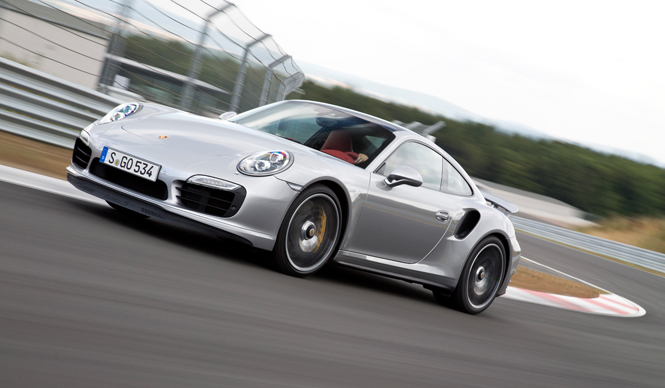
It has been two years since the "Type 991"Porsche 911Porsche 911 was released. The long-awaited Turbo model has finally debuted. Featuring rear-wheel steering, a variable wing, and packed with unprecedented high technology, this new model was test-driven by Tatsuya Otani in Germany. Its performance, boasting a Nürburgring lap time 13 seconds faster than its predecessor, was no mere boast.
Text by OTANI Tatsuya
Why Was Lap Time Reduced by 13 Seconds?
One car manufacturer touts its environmental technology with fuel economy data, while another appeals for its existence with top speed. But for understanding Porsche's models,Porschethe most useful metric is the lap time around the Nürburgring Nordschleife. This is because there is no other course as suitable for comprehensively evaluating the performance of both the engine and chassis.
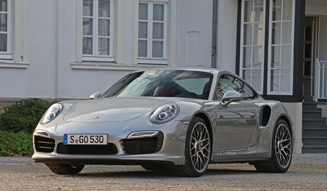
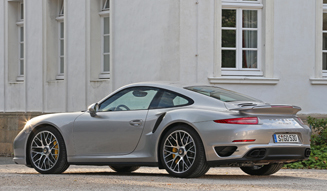
The predecessor, the "997" 911 Turbo,911 Turbooffered two models: the standard "911 Turbo" and its high-performance variant, the "911 Turbo S." When the 911 Turbo S was equipped with high-performance tires offering superior cornering ability, its Nürburgring lap time was 7 minutes and 37 seconds.
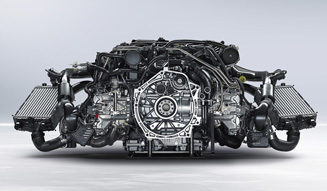
When the new "991" 911 Turbo S, for which an international test drive was held in Germany, was driven on the same Nürburgring course, it recorded a time of 7 minutes and 24 seconds, a full 13 seconds faster. (Hereafter, "911 Turbo" will be used to refer to both the 911 Turbo and 911 Turbo S.) One might naturally assume that this improvement is due to a significant increase in engine power. However, the "911 Turbo" of the 991 generation is powered by an improved version of the same 3.8-liter direct-injection twin-turbo engine found in the late 997 "911 Turbo."
While the 991 generation "911 Turbo" features an improved version of the same 3.8-liter direct-injection twin-turbo engine as the late 997 "911 Turbo."
Consequently, although the peak output and maximum torque have increased by 20 ps and 10 Nm respectively for the 911 Turbo (reaching 520 ps and 660 Nm), and by 30 ps and 10 Nm for the 911 Turbo S (reaching 560 ps and 700 Nm), the difference is not substantial. Therefore, it can be inferred that the majority of the 13-second improvement in Nürburgring lap time is attributable to chassis-related enhancements.
According to the Porsche engineers responsible for the new "911 Turbo," the most significant contributor to the improved lap time is the latest 991 chassis, which features a 100mm longer wheelbase and wider front and rear tracks by 51mm/42mm (49mm/42mm for the Turbo S) compared to the previous model.
This accounts for about half of the 13-second gain, with the remaining half attributed to the various high-tech devices adopted in the 991 generation——such as Porsche Dynamic Chassis Control (PDCC), Active Rear Axle Steering, Porsche Torque Vectoring (PTV) Plus, and Adaptive Aerodynamics.——according to the engineers.
Porsche 911 Turbo | Porsche 911 Turbo
Porsche 911 Turbo S | Porsche 911 Turbo S
A World-Class Pure Sports Car
Test Drive: 911 Turbo (Type 991) (2)
All for Performance Enhancement
This "PorschePorscheDynamic Chassis Control (PDCC)" limits the operation of the anti-roll bars to cornering, disengaging them from the suspension during straight-line driving to achieve both high cornering performance and excellent comfort.
The "Active Rear Axle Steering," first seen on the recently announced newGT3" is a form of four-wheel steering. During high-speed cornering, it steers the rear wheels in the same direction as the front wheels (in-phase) to enhance stability, while at low speeds, it steers the rear wheels in the opposite direction (out-of-phase) to reduce the turning radius. The system operates in-phase at speeds above 80 km/h with a maximum steering angle of 1.5 degrees, and out-of-phase at speeds below 50 km/h with a maximum steering angle of 2.8 degrees.
"Porsche Torque Vectoring (PTV) Plus" is a type of torque vectoring that lightly brakes one of the rear wheels to aid cornering. In the new "911 Turbo," this is combined with an electronically controlled rear differential to create PTV Plus, which improves traction performance by locking the rear differential as needed.
Movement of the Active Rear Axle Steering
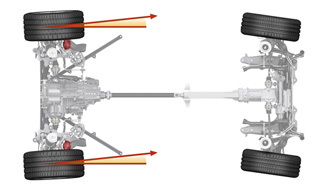
Until the speed reaches 50 km/h, the rear wheels steer in the opposite phase to the front wheels (counter-steer).
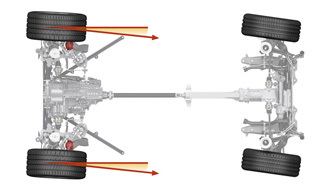
Conversely, when the speed exceeds 80 km/h, the system steers the rear wheels in the same phase as the front wheels.
Porsche 911 Turbo | Porsche 911 Turbo
Porsche 911 Turbo S | Porsche 911 Turbo S
A World-Class Pure Sports Car
Test Drive: 911 Turbo (Type 991) (3)
Immense Downforce
The "Adaptive Aerodynamics" system features electronically controlled aerodynamic components. While systems that alter the height and angle of the rear wing based on vehicle speed or mode changes have existed before, the "911 Turbo" uniquely incorporates a variable front chin spoiler. This spoiler extends significantly at higher speeds to increase downforce, while retracting at lower speeds to facilitate clearing obstacles like speed bumps (automatically deploys above 120 km/h, retracts below 80 km/h).
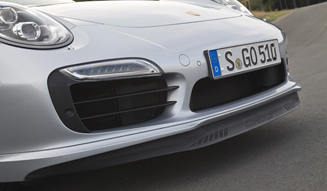
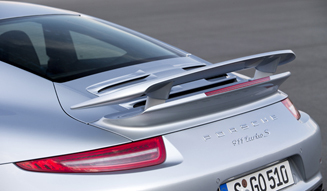
Furthermore, pressing the Aerodynamics switch or the Sport Plus switch forces the system into a performance mode that generates even greater downforce than the variable control based on speed. In this mode, a downforce of 44 kg at the front and 88 kg at the rear is generated, enhancing stability at high speeds (figures at 300 km/h).
Although not explicitly mentioned by the engineers on-site, the adoption of a water-cooled drive system for the front wheels in the new model should also contribute to performance improvements. This allows for greater torque transfer to the front by cooling the electronically controlled multi-plate clutch located above the front axle. Concurrently, clutch control has also been refined, enabling efficient and precise torque distribution.
In terms of technology, the overboost function is also added (increases maximum boost pressure by approximately 0.15 bar for up to 20 seconds in the mid-range during full throttle. Equipped on models with the Sport Chrono Package).
In terms of comfort and environmental features, it is also equipped with dynamic engine mounts, a virtual intermediate gear that allows for the use of a higher gear by utilizing the clutch, idling stop (auto start/stop), and coasting functions.
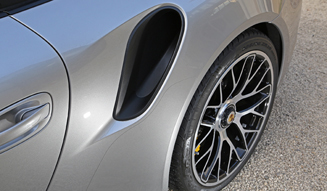
In the new model, both the Turbo and Turbo S come standard with 20-inch wheels. For the Turbo S, the width of both front and rear wheels has been increased by 1.5 inches, to 9J at the front and 11.5J at the rear, which should also contribute to performance enhancement.
Porsche 911 Turbo | Porsche 911 Turbo
Porsche 911 Turbo S | Porsche 911 Turbo S
A World-Class Pure Sports Car
Test Drive: 911 Turbo (Type 991) (4)
Coexistence of Stillness and Motion
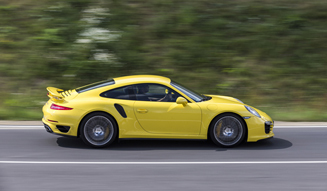
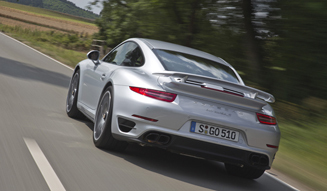
Listing all these new features and equipment might make the new model seem like an intimidating supercar, but the first impression upon driving it on public roads was quite the opposite: it was an exceptionally comfortable and easy-to-handle car. The ride quality, in particular, with its soft damping, was superb.
This was the same kind of surprise felt when the 991 generation911 Carrera" was released. The suspension's ability to stroke as smoothly as a sports sedan, rather than a sports car, was truly astonishing. Furthermore, road noise is noticeably quieter than in the previous generation. The exhaust note is also clearly more subdued than in the "997," where the engine's presence was constantly felt; when cruising calmly, one could almost forget it was running.
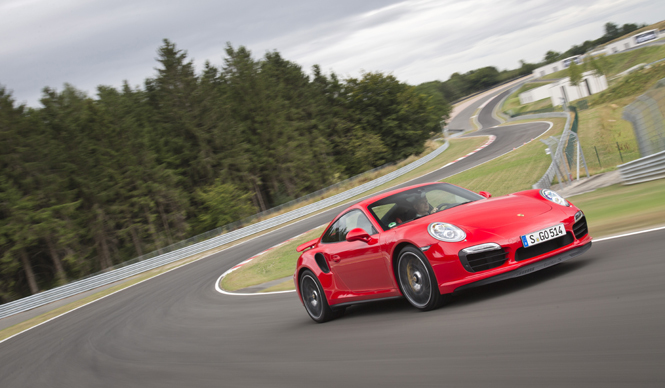
However,——you might be expecting the word "but." That "but" came when we moved from public roads to the circuit. The course we drove on was called Bilster Berg, a members-only circuit in northern Germany that had only recently opened. It was apparently built not for hosting races, but for sports car owners to enjoy driving at the limit in a safe environment.
The circuit's design is said to have involved Hermann Tilke, renowned for designing F1 circuits, as well asPorsche's test driver Walter Röhrl. It features a challenging layout that skillfully utilizes the natural terrain with numerous rhythmic S-bends.
On this occasion, we were driving behind instructors provided by Porsche, and their pace was incredibly fast. Even during the warm-up lap, the tires were squealing from the start.
They navigated the 4.2 km course at speeds so high that the tail would easily begin to slide if driven carelessly. This allowed us to ascertain the car's limits far more safely than by conducting reckless tests on public roads.
Porsche 911 Turbo | Porsche 911 Turbo
Porsche 911 Turbo S | Porsche 911 Turbo S
A World-Class Pure Sports Car
Test Drive: 911 Turbo (Type 991) (5)
Never Tiresome, No Matter How Much You Drive
Frankly, the impression was that few people could handle a car any faster than this. In fact, even with this "911 Turbo," it is not easy to extract 100 percent of its performance. This is not due to an overwhelming turbo power that leaves one helpless, but rather because the performance of the chassis, in perfect combination with the drivetrain, is astonishingly high, resulting in outstanding speed as a sports car.
Of course, it's not just about having a high limit. As mentioned earlier, Bilster Berg has several S-bends that require quick changes of direction, but its agile handling is so nimble that it's hard to believe the car weighs 1,600 kg.
If you ease off the throttle slightly as per the theory before turning the steering wheel, the nose tucks in smoothly, allowing for a quick transition to acceleration. In the next moment, it's already prepared for the turn in the opposite direction, and you can repeat the sequence of easing off the throttle, turning the steering wheel, and applying throttle with astonishingly rapid rhythm.
We were instructed to drive with the stability control on, and we complied. Even within its limits, if the rear grip is lost, a slight tail slide will occur.
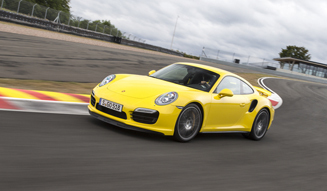
Of course, the system will eventually intervene, but as long as you don't intentionally try to drift, you can enjoy cornering without being consciously aware of its presence.
Meanwhile, the wealth of information transmitted through the steering and seats is worthy of Porsche's reputation. You can intuitively feel "how much grip the rear has right now," and just before it starts to slide, you get a sense of "here it comes, here it comes, there it goes!" making it easy to anticipate the next action. This allows you to easily time your counter-steer, so the driver remains completely unfazed.
In any case, there was no experience of sluggish response or waiting for the car's attitude to settle. If this were the "GT3," all movements would likely be even sharper and more refined, but based on my experience, I can confidently say that I have never enjoyed sports driving as much as I did with this "911 Turbo."
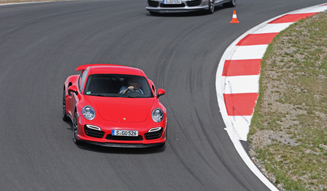
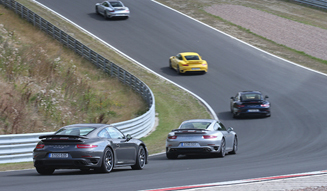
When accelerating from a constant speed for an overtake by flooring the throttle, with the "997," you needed a countdown like "3, 2, 1, GO!" before full boost was achieved.
With the "991," although you still have to wait a moment for that sensation of being pressed back into the seat, you can feel the torque gradually building right after you press the throttle, so the impression of waiting is diminished. This improvement in engine response likely contributes to the enjoyment of driving on the circuit.
We were allowed to drive to our heart's content on both the circuit and public roads from morning till evening on the test day. Yet, I continued to drive the "911 Turbo" until just before the return time of 6 PM. One reason for this was the car's high level of perfection, making it impossible to get tired of driving it, no matter how much you drove. Another reason was that despite its astonishingly high performance, it did not impose unnatural tension on the driver, placing little physical or mental burden. Perhaps this second reason is the unique appeal of the "911 Turbo," something the GT3 does not possess.

Porsche 911 Turbo | Porsche 911 Turbo
Body Dimensions | Length 4,506 x Width 1,880 x Height 1,296 mm
Wheelbase | 2,450 mm
Tread Front/Rear | 1,542 / 1,590 mm
Trunk Capacity | 115 Liters
Weight | 1,595 kg
Engine | 3,800cc Horizontally Opposed 6-Cylinder Turbo
Maximum Output | 383 kW (520 ps) / 6,000-6,500 rpm
Maximum Torque | 660 Nm / 1,950-5,000 rpm (710 Nm with overboost)
Transmission | 7-Speed PDK
Drivetrain | 4WD
Tires Front/Rear | 245/35ZR20 / 305/30ZR20
0-100 km/h Acceleration | 3.4 seconds [3.2 seconds]
Price | 20.3 million yen
*Figures in brackets are with the Sport Chrono Package
Porsche 911 Turbo S | Porsche 911 Turbo S
Body Dimensions | Length 4,506 x Width 1,880 x Height 1,296 mm
Wheelbase | 2,450 mm
Tread Front/Rear | 1,542 / 1,590 mm
Trunk Capacity | 115 Liters
Weight | 1,605 kg
Engine | 3,800cc Horizontally Opposed 6-Cylinder Turbo
Maximum Output | 412 kW (560 ps) / 6,500-6,750 rpm
Maximum Torque | 700 Nm / 2,100-4,250 rpm (750 Nm with overboost)
Transmission | 7-Speed PDK
Drivetrain | 4WD
Tires Front/Rear | 245/35ZR20 / 305/30ZR20
0-100 km/h Acceleration | 3.1 seconds
Price | 24.46 million yen