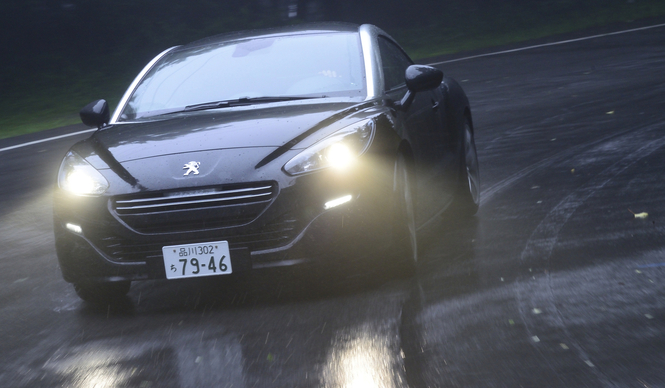
Test Drive: The Peugeot RCZ
Peugeot RCZ | The Peugeot RCZ
Test Drive: The Peugeot RCZ Coupe
We test drive the Peugeot "RCZ," a coupe with a distinctive style. In September 2012,Paris Motor Show at thefaceliftedIs this car a sports car, a specialty car, or a GT car? Tatsuya Otani explains what the RCZ represents for Peugeot.
Text by OTANI TatsuyaPhotographs by ABE Masaya
What Exactly is the RCZ?
On the day of the assignment, S from the OPENERS editorial department came to pick me up in the new Peugeot "RCZ." He got out of the car with a puzzled look. When I asked why, he said, "I can't quite understand this car."
"The styling is like a futuristic sports car and it's incredibly cool, but the ride is comfortable and the handling isn't that sharp. So, it doesn't feel much like a sports car," he continued.
Ah, so that's what it was. In that case, I thought S was misunderstanding something. Let me explain why.
Tracing the origins of the RCZ leads us back to the concept car "308 RCZ" announced at the Frankfurt Motor Show in 2007.
In other words, the basic structure of the RCZ is a stylish body draped over the FWD C-segment compact car,308"308".
In other words, the RCZ is a car that wins on design, and Peugeot's commitment to styling was strong.
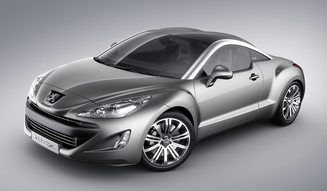
Peugeot 308 RCZ Concept
First, the overall proportions are superb. Utilizing the transverse engine layout, the cabin is boldly pushed forward, creating a long deck (trunk) behind it, despite being a coupe. This form, for some reason, reminds me of the pre-war Grand Prix cars, the "Auto Union Type C."
Grand Prix cars were racing cars positioned as the pinnacle of motorsport before the advent of F1 regulations in 1950. Dr. Ferdinand Porsche, who was in charge of their design, was the first to bring the mid-ship layout, as we know it today, into the world of motorsport. In essence, they were cars at the absolute cutting edge of their time.
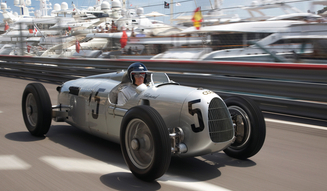
Auto Union Type C
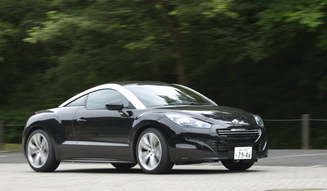
Of course, this was 80 years ago, and no longer cutting-edge, but it's likely not just me who finds the cutting-edge of half a century ago to feel more futuristic and advanced than today's cutting-edge.
As proof, the designs of robots and fighter jets in sci-fi anime are often based on the high-tech of about half a century ago. Human perception is a strange thing.
Peugeot RCZ | Peugeot RCZ
Test Drive: The Peugeot RCZ Coupe (2)
Six "Biceps"
Getting back to the topic, the first appeal of the RCZ is its cabin-forward proportion. By adding a total of six "biceps" to this, the muscular design is emphasized.
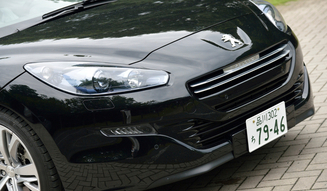
The first four of these six are the front and rear fenders. When you bulge these parts, which cover the tires, so significantly, you can imagine the tires gripping the road firmly and racing forward with power.
Frankly, it's a technique any car designer would want to use. Moreover, because they literally look like "biceps," they give the impression of having robust suspension and explosive power. In short, it's powerful and cool.
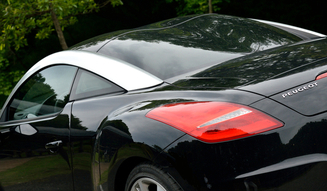
The remaining two are the two bulges on the roof. For enthusiasts, this "double-bubble roof," reminiscent of the radical compact sports cars of the 1950s like the "Fiat Abarth 750 Zagato," was born to secure just enough headroom for occupants while reducing the frontal projected area to improve aerodynamic performance.
In the RCZ, adopting the same technique creates an effect that makes the car look more compact. Furthermore, by extending the two bulges on the roof to the rear window, this design becomes even more striking. Still, I've never seen a car with such a complexly curved rear window before.
And what ties these six bulges together, and also helps emphasize the cabin-forward proportions, is the "aluminum arch" that traces from the A-pillar to the side of the roof and connects to the C-pillar. This silver-shining plate tightens the RCZ's design and successfully creates a strong impression of its distinctive coupe form.
Peugeot RCZ | Peugeot RCZ
Test Drive: The Peugeot RCZ Coupe (3)
Inside the Beautiful Design
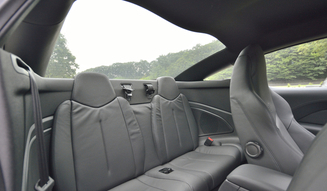
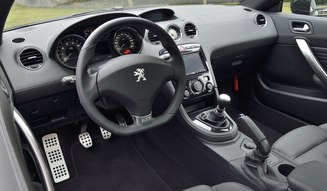
As such, the RCZ's design is full of highlights, but it goes without saying that this styling assumes a limited 2+2 interior space.
A sedan type that could comfortably seat four adults would not have such a tight design. In other words, only those who can accept the certain inconvenience of a 2+2 can obtain the RCZ's beautiful styling.
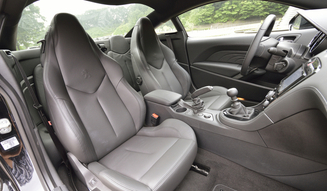
Meanwhile, while its basic structure is the same as the 308, the 1.6-liter direct-injection twin-scroll turbo engine, jointly developed by PSA and BMW, produces either 156 hp or 200 hp. The former is paired with a 6-speed automatic transmission, while the latter is exclusively available with a 6-speed manual.
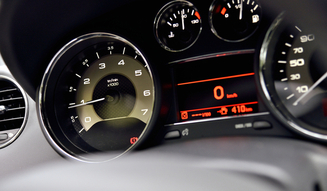
Also, the steering wheel position is right-hand drive for the 156 hp version and left-hand drive only for the 200 hp version. In any case, the 200 hp version we test drove is clearly the more performance-oriented specification. In fact, it boasts a respectable 0-100 km/h acceleration of 7.6 seconds and offers enjoyable driving on winding roads, leveraging its low center of gravity.
But, as S from the editorial department said, it doesn't have the exceptionally sharp handling that one would expect from a sports car.
Why is that?
Peugeot RCZ | Peugeot RCZ
Test Drive: The Peugeot RCZ Coupe (4)
That's Why I Want to Drive It Every Day
This is because the RCZ was born to be enjoyed for its styling rather than its handling.
This might sound rather cheap, but as mentioned earlier, the RCZ's styling is exceptionally well-crafted and highly refined. Moreover, this is a design that assumes a 2+2 configuration from the outset.
The RCZ would not have come into existence without sacrificing cabin space. But, thanks to that, an exceptionally beautiful styling has been achieved. Many people who actually buy the RCZ do so because they fell in love with its design, and not necessarily because they were expecting sporty performance, wouldn't you agree?
Let's consider it from a slightly different perspective.
If Peugeot had felt that the RCZ needed genuine sports car performance, would it have been impossible to achieve? No, I don't believe it would have been impossible for Peugeot, known as a magician of suspension tuning.
So, why has the current RCZ been given a comfort that allows for long-distance drives without any trouble?
Simply put, it's because Peugeot judged that this is what customers want. Just because it has a sporty design doesn't mean the suspension has to be rock-hard; otherwise, people might avoid driving it daily due to the uncomfortable ride. But that's misguided. Precisely because it's beautiful, you want to drive it every day. I believe the RCZ is a sporty coupe built on that concept.
For those of you who still can't shake the suspicion that "Peugeot just couldn't create a true sports car with the RCZ," here's some useful information.
Peugeot announced that in 2014, they would release the "RCZ R", which increases the maximum output of the 1.6-liter direct-injection twin-scroll turbo engine to 270 hp (!) and lowers the minimum ground clearance by 10 mm to improve performance.
As expected, Peugeot didn't "fail" to do it; they "deliberately chose not to."
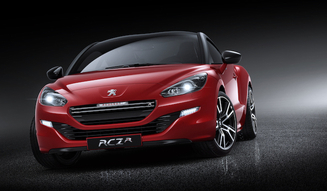
Peugeot RCZ R
Perhaps if S from the editorial department had driven the RCZ R first, he wouldn't have had any doubts.

Peugeot RCZ | Peugeot RCZ
Body Dimensions | Length 4,290 x Width 1,845 x Height 1,360 mm
Wheelbase | 2,610 mm
Tread Front/Rear | 1,575 / 1,595 mm
Minimum Ground Clearance | 120 mm
Minimum Turning Radius | 5.4 meters
Weight | 1,350 kg
Engine | 1,598cc Inline 4-cylinder Direct Injection DOHC Turbo
Compression Ratio | 10.5 : 1
Maximum Output | 147kW (200ps) / 5,800 rpm
Maximum Torque | 275Nm / 1,700 rpm
Transmission | 6-speed Manual
Gear Ratio | 1st 3.538
2nd 2.041
3rd 1.433
4th 1.102
5th 0.880
6th 0.744
Reduction Ratio | 4.101
Drivetrain | FF
Suspension Front | MacPherson Strut
Suspension Rear | Torsion Beam
Tires | 235/40R19
Brakes Front/Rear | Ventilated Disc / Disc
Fuel Economy (JC08 mode) | 13.2 km/ℓ
Fuel Tank Capacity | 55 ℓ
Price | 4,260,000 yen